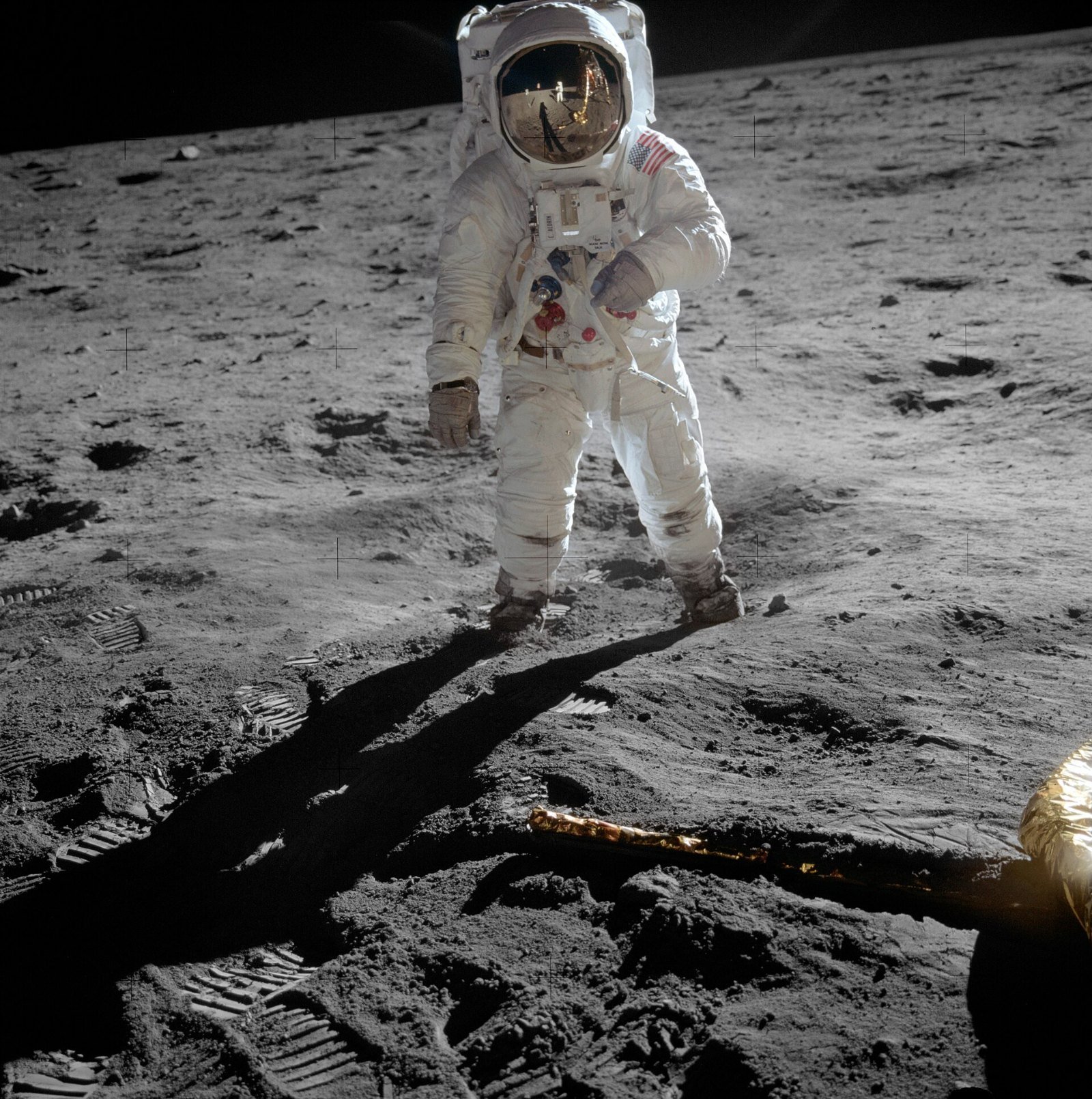
What it is
Between July 1969 and December 1972, NASA's Apollo program landed six crews on the Moon. Twelve astronauts walked on its surface. Then the flights stopped, and no human went back for more than half a century.
That long silence gave room to a question. What if it never happened at all? The moon-landing hoax theory says NASA faked the landings, most often on a film set, to beat the Soviet Union in the Space Race.
The idea is far from mainstream, but it has never gone away. A 2019 C-SPAN/Ipsos poll found about 6% of Americans think the landings were faked, with the figure higher among younger adults.
The case the doubters make
Here are the main claims, laid out the way believers present them.
The book that started it. In 1976 Bill Kaysing self-published We Never Went to the Moon: America's Thirty Billion Dollar Swindle. Kaysing had worked as a technical writer at Rocketdyne, the company that built Saturn V engines, until 1963. Believers saw him as an insider who knew the hardware was not ready.
The TV special. In February 2001 Fox aired Conspiracy Theory: Did We Land on the Moon?, hosted by X-Files actor Mitch Pileggi. It reached millions of viewers and gave the hoax claims a national stage.
The waving flag. There is no air on the Moon, so why does the flag ripple in the footage? Doubters say it looks like wind on a set.
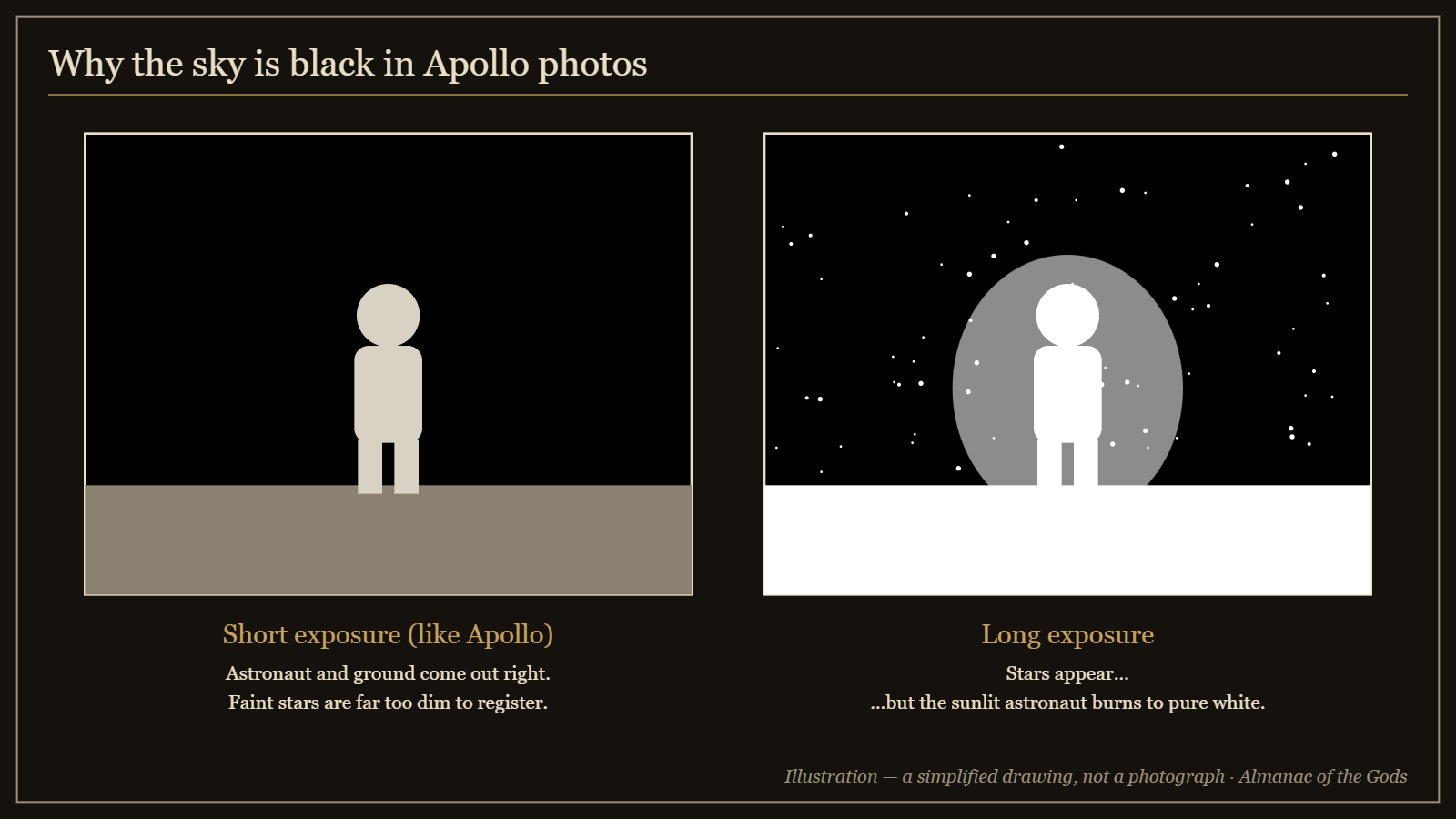
No stars. The black sky in Apollo photos is empty. Believers ask how the sky above an airless world could hide every star.
Shadows that don't line up. In some photos, shadows run in different directions. With only one sun, doubters say, that points to several studio lights.
The Van Allen belts. Earth is wrapped in belts of trapped radiation. Hoax believers argue that no crew could have crossed them and lived.
Crosshairs behind objects. Apollo cameras etched small crosses onto every frame. In some prints a cross seems to vanish behind an object, which believers read as proof of photos pasted together.
The "C rock". One Apollo 16 photo seems to show a rock marked with a neat letter C, like a labeled prop.
No blast crater. The lunar module landed on a rocket engine. So why is there no crater under it?
The confrontation. On September 9, 2002, filmmaker Bart Sibrel, who made a 2001 hoax film, confronted Buzz Aldrin outside a Beverly Hills hotel. He called Aldrin a liar and pushed a Bible at him to swear on. Aldrin, then 72, punched him. Prosecutors declined to bring charges. Believers sometimes point to the moment as a nerve being struck.
The ancient-alien case
Most ancient-astronaut theorists do not doubt the landings at all. Their question is different: what did the astronauts find up there?
Theorists point to Apollo 11's trip out, when the crew reported a strange object pacing their ship. Stories have circulated for decades claiming the astronauts saw other craft on the lunar surface and were "warned off." Some ask whether that is the real reason the program ended after Apollo 17.
The "we never went back" question is a big part of this. If the trip was possible in 1969, theorists ask, why did it take more than fifty years for anyone to return? Ancient Aliens has returned to NASA again and again, suggesting that the space agency knows more than it shares.
What scientists say
The flag hung from a horizontal rod that did not fully extend, which left it rumpled. It moves only when astronauts twist the pole. With no air to slow it, it swings longer than it would on Earth.
No stars is a camera setting. The sunlit ground and white suits were bright, so exposures were short. Faint stars simply do not register. Try photographing stars over a floodlit stadium and you will get the same black sky.
Odd shadows come from uneven ground, slopes, and wide-angle lenses. Shadows cast across bumps and dips bend. You can see the same effect in any parking lot at sunset.
The Van Allen belts were crossed quickly on a path that skirted the worst of them. Apollo crews averaged under 1 rem of radiation. That is about three years of natural background at sea level, and a fifth of the 5-rem yearly limit for U.S. nuclear workers.
Crosshairs "behind" objects show up only in copied prints. Bright white areas bleed over the thin black lines. They are not missing on the original film.
The C rock does not appear on the original film. It is most likely a stray fiber or hair on a later print.
No crater because the engine was throttled down for landing and spread its push over a wide area. Below the loose dust, lunar soil is tightly packed. The blast scoured only a few inches.
The Apollo 11 "object" was most likely one of the four panels that had covered the lunar module on the way up. They were cast off near the crew's ship and drifted along with it. Aldrin himself has said so.
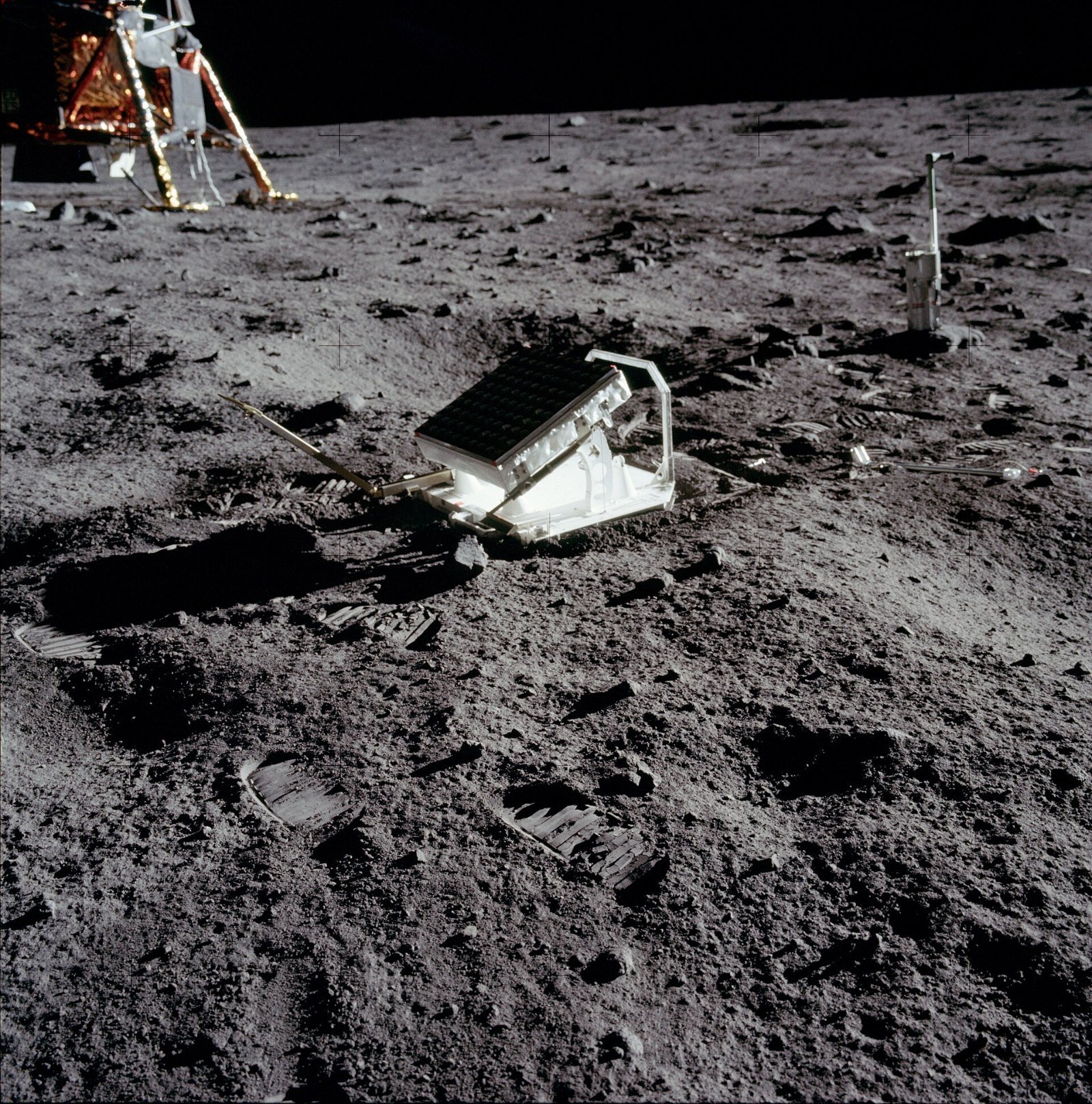
Then there is the hard evidence. Astronauts brought home 382 kg of rock and soil, studied by labs around the world. The Soviet Union tracked the missions and never cried fraud. The laser mirrors left on the Moon still bounce back light from Earth's observatories.
The view from orbit
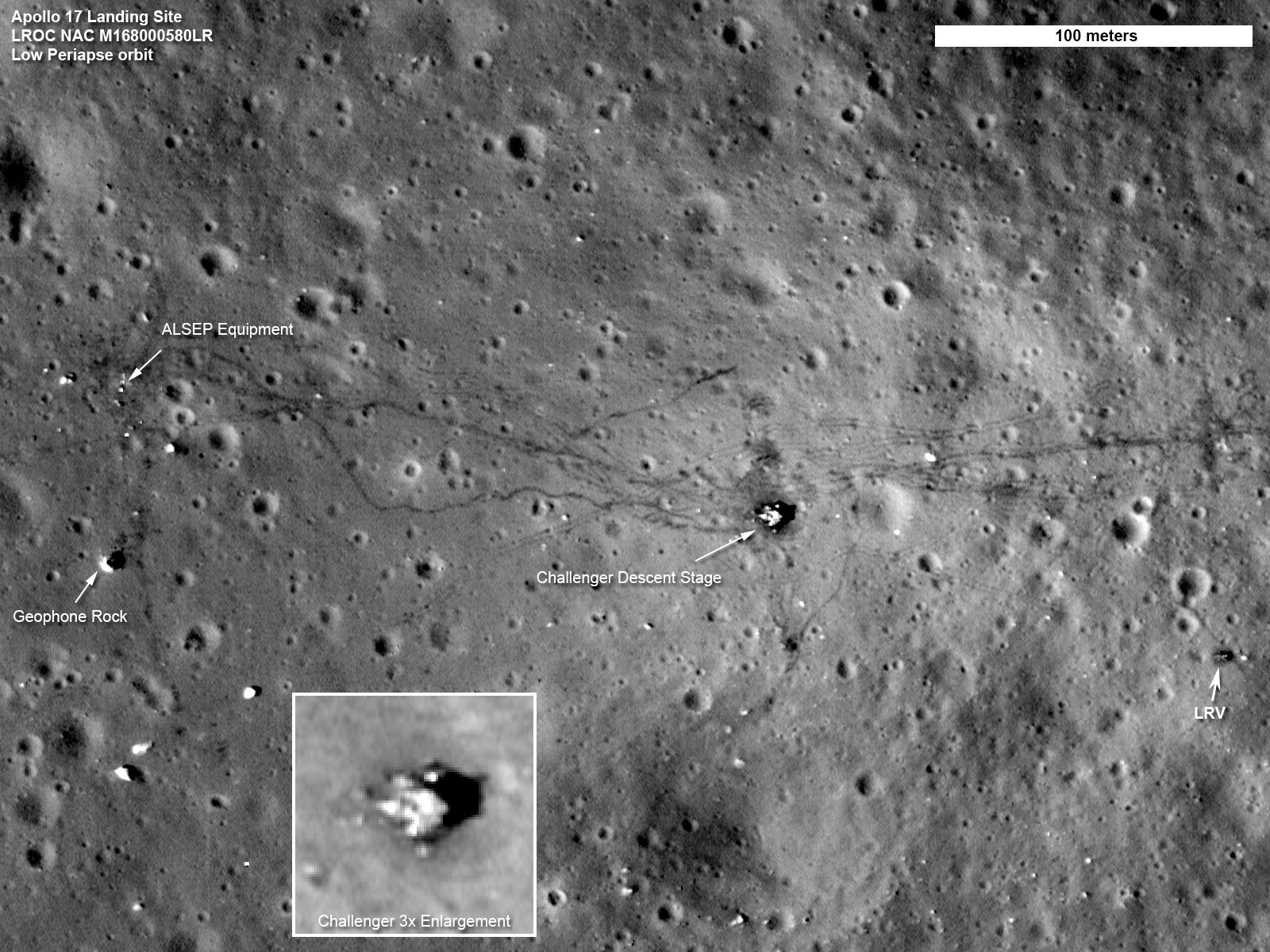
Starting in 2009, NASA's Lunar Reconnaissance Orbiter photographed every Apollo landing site. In 2011 it dropped to a lower orbit and caught sharper shots: descent stages, rover tracks, and the faint trails of astronauts' footsteps.
In July 2012 the LRO team reported that flags at five sites still cast shadows. The exception was Apollo 11. Aldrin had reported seeing that flag knocked over by the engine blast at liftoff.
Other nations have looked too. Japan's SELENE (Kaguya) probe spotted the pale "halo" of blasted soil at the Apollo 15 site in 2008. India's Chandrayaan-2 orbiter photographed the Apollo 11 lander in 2021. South Korea's Danuri orbiter imaged the Apollo 11 and 17 sites in 2023. China has said its Chang'e 2 probe saw Apollo traces, though those images have not been widely published.
Why we stopped, and why we're going back
The reason Apollo ended is well documented and less mysterious than the rumors. NASA canceled Apollo 20 in January 1970 so its Saturn V could launch Skylab. Budget cuts killed Apollo 18 and 19 that September. Public interest had faded and money moved to the Space Shuttle.
The return is now underway. NASA's Artemis II launched on April 1, 2026, carrying Reid Wiseman, Victor Glover, Christina Koch and Canada's Jeremy Hansen around the Moon. They splashed down off San Diego on April 10 after setting a new distance record for humans.
A landing is still a few years off. In February 2026 NASA reshaped the plan: Artemis III is now a crewed test in Earth orbit, aimed for late 2027. Artemis IV, planned for 2028, is expected to be the first landing.
Timeline
- 1969Apollo 11 lands on July 20. Armstrong and Aldrin walk on the Moon and leave a laser mirror.
- 1970Apollo 20 canceled in January; Apollo 18 and 19 canceled in September.
- 1972Apollo 17 ends the program. Gene Cernan and Harrison Schmitt are the last moonwalkers.
- 1976Bill Kaysing self-publishes We Never Went to the Moon.
- 2001Fox airs Conspiracy Theory: Did We Land on the Moon?
- 2002Aldrin punches Bart Sibrel in Beverly Hills; no charges are filed.
- 2008Japan's SELENE images the Apollo 15 blast halo.
- 2009NASA's LRO photographs the Apollo landing sites.
- 2012LRO team reports flag shadows at five of six sites.
- 2021India's Chandrayaan-2 images the Apollo 11 lander.
- 2026Artemis II flies four astronauts around the Moon and back.
Still unanswered
- What exactly was the light Apollo 11 saw on the way out? Aldrin believed it was a panel shed by their own rocket, but no one photographed it up close.
- Will China's Chang'e 2 images of the Apollo sites ever be released in full?
- When Artemis crews finally land, will any doubter change their mind?
Did you know?
- Laser shots off the Apollo mirrors show the Moon drifting away from Earth by about 3.8 cm a year.
- The Apollo 11 mirror needs no power. It is just a panel of 100 glass prisms.
- Soviet Luna probes brought back about 326 grams of Moon soil, under a thousandth of Apollo's haul.
- Artemis II's crew traveled 406,771 km from Earth, beating Apollo 13's record.
- A viral 2015 clip of Aldrin saying "we didn't go there" was cut from a talk about why crews stopped going after 1972.
On Ancient Aliens
- S04E05The NASA ConnectionAsks whether the space program drew on ancient-astronaut ideas.
- S10E02NASA's Secret AgendaTheorists argue NASA hides what it finds in space.
- S11E11Space Station MoonWas the Moon itself built or used by visitors?
Episode numbers follow Wikipedia's episode list.
See it yourself
You can browse every Apollo photo, uncropped and full size, in NASA's Apollo Lunar Surface Journal and the Project Apollo Archive. Compare a print with a "missing" crosshair against the original scan and see for yourself.
The Lunar Reconnaissance Orbiter Camera team at Arizona State University posts its landing-site images online, and you can zoom right in on the descent stages and tracks.
A moon rock is closer than you think. The Smithsonian's National Air and Space Museum in Washington, D.C., has one you can touch. On a clear night, a small backyard telescope will show you the Sea of Tranquility, where Apollo 11 came down, even if the hardware itself is far too small to see.
Sources
- Moon landing conspiracy theoriesen.wikipedia.org
- Third-party evidence for Apollo Moon landingsen.wikipedia.org
- Fox special coverage, 2001globalsecurity.org
- Bart Sibrelen.wikipedia.org
- Did Buzz Aldrin punch a conspiracist?snopes.com
- Apollo 11 flag photo AS11-40-5875nssdc.gsfc.nasa.gov
- Where are NASA's Apollo lunar rocks now?space.com
- The Apollo experiment that keeps on givingjpl.nasa.gov
- New LRO images offer sharper views of Apollo 12, 14 and 17 sitessvs.gsfc.nasa.gov
- APOD: Apollo 17 Site, a Sharper Viewscience.nasa.gov
- Apollo Flags Still Standing (LROC, 2012)lroc.asu.edu
- The Apollo 11 "UFO" (Dwayne Day, 2014)thespacereview.com
- Fact check: Aldrin "we didn't go there" clipnewcastleherald.com.au
- Canceled Apollo missionsen.wikipedia.org
- Artemis IIen.wikipedia.org
- Artemis IIIen.wikipedia.org
- List of Ancient Aliens episodesen.wikipedia.org
Research notes: what we checked
- The flag-shadow finding was announced in July 2012; the sharper low-orbit LRO shots of descent stages, tracks and footpaths came in 2011.
- China has said Chang'e 2 saw Apollo traces, but we could not find published images. The page says so plainly instead of counting it as proof.
- Japan's SELENE/Kaguya "halo" was at the Apollo 15 site (2008), not Apollo 11 or 17.
- The Fox special first aired February 15, 2001 (rebroadcast March 19, 2001); the page says February 2001.
- Sibrel incident: Wikipedia says assault charges were "dropped"; Snopes and press reports say prosecutors declined to file. The page says prosecutors declined to bring charges.
- The "astronauts were warned off by aliens" story is not tied to any NASA transcript we could find. We could not confirm who first published it, so no author is named.
- Radiation dose: Wikipedia gives an average under 1 rem (10 mSv), equal to about three years of sea-level background. The U.S. NRC occupational limit is 5 rem (50 mSv) a year, so the Apollo average is about a fifth of it.
- Artemis status checked October 2026: Artemis II flew April 1–10, 2026. Artemis III was redesignated an Earth-orbit test in February 2026; Artemis IV (2028) is the planned landing.
- Episode notes are short paraphrases of each title's theme; Wikipedia's list gives no plot summaries.