What it is
Abydos lies on the desert edge west of the Nile in Upper Egypt, north of Luxor. It was one of the holiest places in ancient Egypt. Early kings were buried here around 3000 BCE, and later Egyptians believed the god Osiris was buried here too. For centuries pilgrims came to take part in his festivals, and many left monuments behind.
The best-preserved building is the temple of Seti I, a pharaoh of the 19th Dynasty who reigned about 1290-1279 BCE. He died before it was finished, and his son Ramesses II completed and altered it. The temple is L-shaped and built mostly of fine limestone. It holds seven chapels, for six gods and for Seti himself. Its painted reliefs are among the most delicate in Egypt.
In a corridor called the Gallery of Ancestors, Seti and the young Ramesses honor a long list of earlier kings. This Abydos King List is a key source for the order of Egyptian rulers. Behind the temple lies the Osireion, a sunken hall of huge granite pillars that stands in groundwater. Most scholars see it as a symbolic tomb for Osiris built in Seti's time.
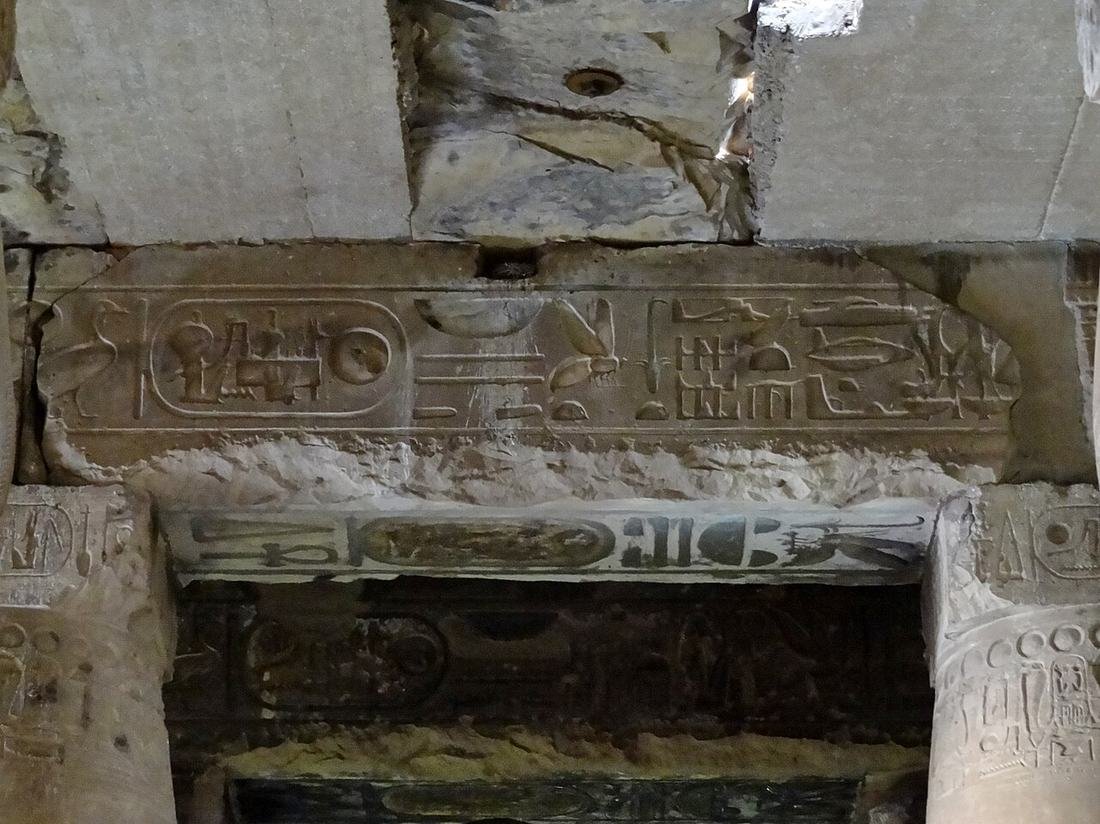
In the temple's first hypostyle hall, one carved ceiling beam carries the famous 'helicopter hieroglyphs'. Photos of it spread online from the 1990s. They seem to show a helicopter, a submarine or tank, and a jet. For ancient-astronaut fans the beam became one of the best-known pieces of evidence in the world. Few visitors realize how small the carving is, or how high up it sits.
The ancient-alien case
Theorists see the Abydos beam as a snapshot of machines the Egyptians saw with their own eyes. The shapes look, to many viewers, like a helicopter with rotor and tail, a craft like a submarine or tank, and a jet or glider. Supporters ask why an ancient artist would carve these shapes side by side unless he was recording real flying machines.
The claim fits the heart of the ancient-astronaut idea: that visitors from other worlds brought sophisticated aircraft to early civilizations. Believers also point to Egyptian texts about gods who travel through the sky in boats as further hints of flight.
Ancient Aliens has turned to Abydos for broader reasons. In 'Return of the Egyptian Gods', the show tells the story of Omm Sety and suggests she was drawn to the temple by a mental link to beings from beyond Earth. Ryan Sprague describes her belief that the temple worked as a kind of time portal. William Henry compares the djed pillar, a symbol of Osiris shown in the temple, to a Tesla coil.
Other writers focus on the Osireion. Graham Hancock, Robert Bauval, John Anthony West and Robert Schoch have argued that its plain, massive granite architecture looks far older than Seti's temple. They suggest it could date to a lost age before a great flood.
What archaeologists say
Egyptologists say the 'helicopter' is a palimpsest, a text written over an older one. Seti I's titles were carved first. Ramesses II had the signs filled with plaster and cut his own titles in the same place. Over three thousand years the plaster fell out, and the two texts now show at once. A bow sign from Seti's text and two arm signs from Ramesses' text combine into the helicopter outline. Scholars can read both versions.
Critics add that the best-known photo was retouched to sharpen the effect, and other photos of the beam look far less modern. No Egyptian text, tomb painting, model or excavated object points to engines or aircraft. The human mind's habit of seeing familiar shapes in random patterns, called pareidolia, explains the rest.
On the Osireion, archaeologists point to Seti I's cartouches and an inscription naming him as the builder, plus its link to his temple's layout. Historian Jason Colavito traces the 'older than Egypt' idea to a nineteenth-century misreading of an unrelated inscription, later repeated in fringe books. Egyptologist Jaroslav Černý looked at Omm Sety's writing in ancient Egyptian script and judged it the work of a beginner.
Timeline
- c. 3000 BCEEarly kings are buried in the Umm el-Qa'ab cemetery at Abydos.
- c. 1290-1279 BCESeti I builds his temple and the Osireion; the ceiling-beam inscription is first carved with his titles.
- After 1279 BCERamesses II finishes the temple, fills parts of his father's inscriptions with plaster and re-carves them with his own titles.
- 1st century BCEThe Greek geographer Strabo describes the Osireion and its pool.
- 1863Auguste Mariette clears and restores the temple.
- 1902-1903Flinders Petrie and Margaret Murray find the Osireion behind the temple.
- 1956-1981Dorothy Eady, known as Omm Sety, lives at Abydos and works at the temple, believing she was a priestess there in a past life.
- 2014A Penn Museum team led by Josef Wegner finds the tomb of King Senebkay of the forgotten Abydos Dynasty.
- March 2025Wegner's team announces a larger, 3,600-year-old royal tomb, probably of another Abydos Dynasty king whose name is lost.
Still unanswered
- Exactly how did Ramesses II's craftsmen decide which of Seti's inscriptions to overwrite, and why here?
- How did the Osireion's builders manage the groundwater that now floods its floor?
- Who were the kings of the short-lived Abydos Dynasty, and whose tomb did Penn Museum find in 2025?
- How much did Omm Sety actually contribute to excavations at Abydos, given that her guidance stories are hard to check?
Did you know?
- The Abydos King List skips rulers the later pharaohs wanted forgotten, such as Hatshepsut and Akhenaten.
- Omm Sety was born in London and spent her last 25 years living beside the temple she believed she had served in a past life.
- Abydos was also home to a whole forgotten dynasty of kings, confirmed only in 2014 when Senebkay's tomb was found.
On Ancient Aliens
- S18E20 Return of the Egyptian Gods Tells Omm Sety's story at Abydos and suggests an alien link, with Ryan Sprague and William Henry.
Episode numbers follow Wikipedia's episode list; History and some reviewers number a few seasons differently.
Visiting
Getting there. Near the town of El Balyana in Sohag Governorate. Most visitors come by road on a long day trip from Luxor, often paired with the Dendera temple.
What you can see. The temple of Seti I is open to visitors, and the helicopter beam can be seen from the floor of the first hypostyle hall. The Osireion can be viewed from above; its floor is flooded. Excavation areas elsewhere at Abydos are generally closed.
Tip. Bring binoculars or a zoom lens: the helicopter beam sits high up, and a guard can usually point you to it.
Sources
- Helicopter hieroglyphs - Wikipedia en.wikipedia.org
- Temple of Seti I (Abydos) - Wikipedia en.wikipedia.org
- Osireion - Wikipedia en.wikipedia.org
- Helicopter Hieroglyphs? Debunking the Mystery of the Abydos Carvings - Ancient Origins ancient-origins.net
- Penn Museum and Egyptian Archaeologists Unearth a 3,600-Year-Old Tomb - Penn Museum penn.museum
- Review of Ancient Aliens S18E20 'Return of the Egyptian Gods' - Jason Colavito jasoncolavito.com
- The 'Antediluvian' Osirion at Abydos - Jason Colavito jasoncolavito.com
Research notes: what we could not confirm
- No Ancient Aliens episode could be confirmed that shows the helicopter beam itself or names who discusses it. S1E1 'The Evidence' is often suggested but was not confirmed; checks of S18E07, S19E12, S21E01 and S22E04 found no Abydos segment. Only S18E20 is confirmed for Abydos in general.
- Ryan Sprague's 'time portal' and William Henry's 'Tesla coil' remarks come from the old entry (citing Colavito's S18E20 review); the fetched summary of that review did not repeat these specific lines.
- The claim that the best-known helicopter photo was retouched comes from the old entry and skeptic sources; it was not confirmed in a page opened this session.
- The count of 76 kings, the omission of Hatshepsut and Akhenaten, the placement of the beam in the first hypostyle hall, and Omm Sety's London birth come from general knowledge, not a page opened this session.
- Whether Abydos is on Egypt's UNESCO tentative list was not confirmed.