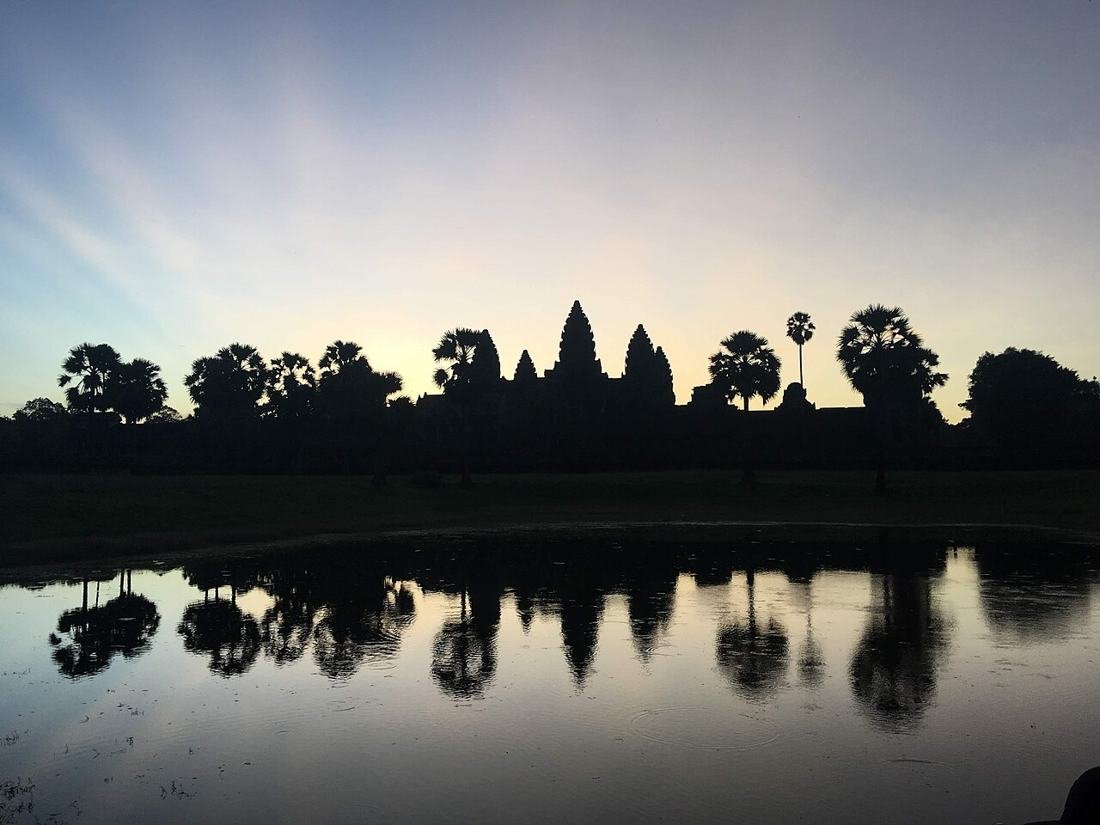
What it is
Angkor Wat is a vast stone temple near the city of Siem Reap in northwest Cambodia. It stands at the heart of Angkor, the old capital region of the Khmer Empire. Protected ruins there spread across about 400 square kilometers and date from the 9th to the 15th centuries. Angkor Wat itself covers about 162 hectares, making it the largest religious monument in the world.
King Suryavarman II built it between about 1113 and 1150 CE as a temple to the Hindu god Vishnu and, most likely, as his own funeral monument. It faces west, which is unusual for Khmer temples. From the late 1200s it slowly became a Buddhist shrine, and monks and pilgrims have used it ever since. It has never been fully abandoned.
The design is a model of the Hindu universe in stone. A moat about 190 meters wide stands for the cosmic ocean. Walls and three rising galleries lead to five towers shaped like lotus buds, which stand for the peaks of Mount Meru, home of the gods. The central tower rises about 65 meters. Galleries carry long bas-reliefs, including the famous Churning of the Ocean of Milk.
The temple used millions of sandstone blocks brought from the Phnom Kulen hills about 40 kilometers away, with rough laterite hidden inside. More than 1,700 carved celestial dancers, called devatas or apsaras, decorate the walls. Angkor Wat has appeared on the Cambodian flag since 1863. It is the country's proudest national symbol and its biggest tourist draw, pulling hundreds of thousands of foreign visitors a year.
The ancient-alien case
For ancient-astronaut writers, the question at Angkor is how a medieval kingdom planned something so huge, so precise and so tied to the sky. They see the temple's layout and its cosmic symbols as clues that its builders inherited older knowledge.
The most detailed claim comes from Graham Hancock, building on work by researcher John Grigsby. In Heaven's Mirror, Hancock argues that key temples across Angkor match the stars of Draco, the dragon constellation, as it looked in the far past. Ancient Aliens took up the idea in 'Decoding the Dragon Gods', using it to suggest dragon myths worldwide recall sky visitors. Andrew Collins told the show in an earlier episode that Angkor ranks among the oldest sky observatories.
Giorgio Tsoukalos has pointed to a small carving at Ta Prohm, a temple a short drive from Angkor Wat. He says it shows a stegosaurus and argues the carver could only have learned of such an animal from aliens who had seen the fossil record. The show has also set a Cambodian step pyramid beside the Maya temples of Tikal, suggesting one shared blueprint behind step pyramids on opposite sides of the world.
What archaeologists say
Archaeologists say Angkor Wat is fully explained by Khmer skill and royal power. Inscriptions name Suryavarman II and describe the temple's gods. Geologists have matched its sandstone to quarries on Phnom Kulen and traced likely canal routes used to float blocks toward the site. The blocks are fairly small, and many still show the holes used to lift and fit them. Laser mapping from aircraft has revealed the dense city and waterworks around the temple, showing a large, organized workforce.
Scholars reject the Draco match. Jason Colavito and others note that Angkor has hundreds of temples, so picking a few to fit a star pattern is easy, and the fit is loose. The temples were also built over several centuries by different kings. The layout follows Hindu cosmology, with Mount Meru and the cosmic ocean, which is recorded in Khmer texts.
The Ta Prohm 'stegosaurus' sits in a row of round frames showing ordinary animals. Seen head-on, most researchers see a rhinoceros or a boar with a leafy background, not bony plates. Ta Prohm was also built decades after Angkor Wat. The 'Cambodian pyramid' shown next to Tikal is a separate site, and step pyramids appear in many cultures because stacking layers is a simple way to build high.
Timeline
- c. 1113-1150 CESuryavarman II builds Angkor Wat as a Vishnu temple.
- 1177Cham forces sack Angkor; King Jayavarman VII later rebuilds the capital nearby at Angkor Thom and builds temples such as Ta Prohm.
- Late 13th century onwardAngkor Wat gradually becomes a Theravada Buddhist temple.
- 1586Portuguese friar António da Madalena visits and writes one of the first European descriptions.
- 1860–1864French naturalist Henri Mouhot visits in 1860; his travel notes, published after his death in 1863–64, make Angkor famous in the West.
- 1908French scholars begin a formal conservation program at Angkor.
- 1992Angkor is listed as a World Heritage Site and placed on the danger list; it is removed from that list in 2004.
- Late 1990sGraham Hancock's book Heaven's Mirror popularizes the claim that Angkor's temples map the constellation Draco.
- January 2025Cambodia's APSARA National Authority begins restoring the causeway and naga balustrade on Angkor Wat's second terrace.
Still unanswered
- Were the temple's solar alignments, such as the equinox sunrise over the central tower, as deliberate and exact as some researchers argue?
- How exactly did the Khmer move millions of blocks from Phnom Kulen, and how long did it take?
- Was Angkor Wat mainly a temple, a royal tomb, or both?
- Why did the Khmer capital decline after the 14th century: war, climate swings, a failing water system, or all three?
Did you know?
- Angkor Wat faces west, the direction linked with death in Hindu tradition, which is one reason scholars think it served as a royal funeral temple.
- The Churning of the Ocean of Milk relief shows 92 demons and 88 gods pulling on a giant serpent.
- Angkor Wat has appeared on every version of Cambodia's flag since 1863.
On Ancient Aliens
- S04E10 Aliens and Dinosaurs Giorgio Tsoukalos presents the Ta Prohm carving near Angkor Wat as a stegosaurus.
- S06E11 Aliens and Mysterious Mountains Andrew Collins calls Angkor one of the oldest sky observatories.
- S12E04 The Alien Architects Opens by comparing a Cambodian step pyramid with a Tikal temple as a shared design.
- S18E09 Decoding the Dragon Gods Presents the claim that Angkor's temple layout mirrors the constellation Draco.
Episode numbers follow Wikipedia's episode list; History and some reviewers number a few seasons differently.
Visiting
Getting there. Siem Reap, a short drive or tuk-tuk ride from the temples. The Siem Reap-Angkor International Airport has regular flights from Phnom Penh, Bangkok and other Asian hubs.
What you can see. An Angkor Pass, sold for one or more days, is required to enter the archaeological park. Visitors can walk the galleries and bas-reliefs; the steep upper level is open with limits on numbers and a modest dress code (covered shoulders and knees). Some areas close for restoration or ceremonies.
Tip. Watch sunrise from the pools in front of the west entrance, then tour the bas-reliefs while the tour groups are still at breakfast.
Sources
- Angkor Wat - Wikipedia en.wikipedia.org
- Angkor - UNESCO World Heritage Centre whc.unesco.org
- Restoration Work Underway at Angkor Wat - Archaeology Magazine archaeology.org
- Stegosaurus, Rhinoceros, or Hoax? - Smithsonian smithsonianmag.com
- Heaven's Mirror - Graham Hancock grahamhancock.com
- Ancient Aliens S04E10 'Aliens and Dinosaurs' review - Jason Colavito jasoncolavito.com
- Review of Ancient Aliens S06E11 - Jason Colavito jasoncolavito.com
- Review of Ancient Aliens S12E04 'The Alien Architects' - Jason Colavito jasoncolavito.com
- Review of Ancient Aliens S18E09 'Decoding the Dragon Gods' - Jason Colavito jasoncolavito.com
Research notes: what we could not confirm
- The 'Cambodian pyramid' in S12E04 is probably Prasat Thom at Koh Ker rather than Angkor Wat itself; the review does not name it, and the old entry's framing of it as Angkor was not confirmed.
- Which speaker presents the Draco correlation on screen in S18E09 was not confirmed; the review credits the theory to Hancock and Grigsby.
- Heaven's Mirror's publication year is given as late 1990s: Hancock's site says 1999, while other listings give 1998.
- Details on canal routes from Phnom Kulen, aerial laser mapping, the 1177 Cham sack, the 1908 start of French conservation, the west-facing funerary interpretation, the Angkor Pass rules and dress code come from general knowledge, not pages opened this session.
- The claim that Tsoukalos says the carver learned of the animal from aliens follows Colavito's summary, which reports the claim that the artist drew from alien descriptions; the exact on-screen wording was not checked.