What it is
Baalbek lies in Lebanon's Beqaa Valley, at roughly 1,150 meters above sea level, between the Lebanon and Anti-Lebanon mountain ranges. The Greeks called the town Heliopolis, the City of the Sun. Under Rome it became a colony settled by army veterans, and over about two and a half centuries it grew into one of the largest religious sanctuaries in the Roman world. Pilgrims came to worship a local trio of gods recast in Roman dress, led by Jupiter Heliopolitanus.
The complex is huge. Visitors walk through a monumental gateway, a six-sided forecourt and a great courtyard before reaching the Temple of Jupiter, where six giant columns still stand on the edge of the podium. Next door, the Temple of Bacchus is one of the best-preserved Roman temples anywhere, with its walls and carved ceiling largely intact. A small round temple, usually linked to Venus, stands a short walk away.
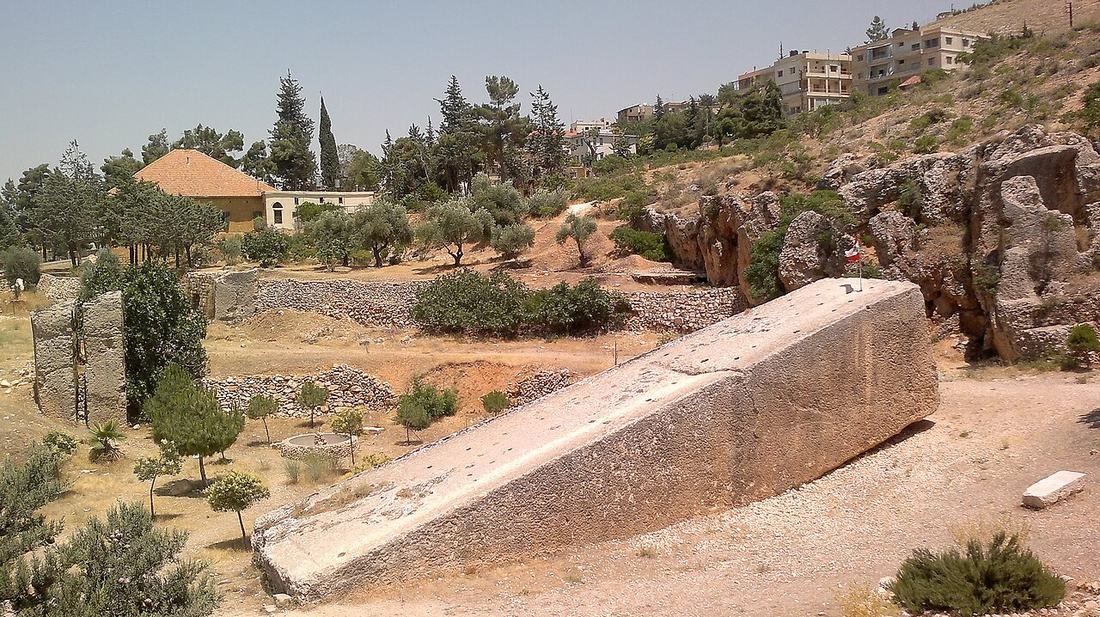
What draws ancient-astronaut fans is under the Temple of Jupiter. Its podium wall contains the Trilithon, a row of three limestone blocks, each around 19 meters long and estimated at 750 to 800 tonnes. A layer of blocks near 350 tonnes sits beneath them. About 900 meters away, in the ancient quarry, lie even larger stones that were never moved, including one found by German archaeologists in 2014 and estimated at about 1,650 tonnes.
The hill under the temples has been lived on for thousands of years. Excavators have found Bronze Age pottery and signs of much earlier settlement, and German research shows a pre-Roman terrace sits beneath part of the sanctuary. That long, layered history is why Baalbek matters. It shows how far Roman engineers could push stone, and it keeps alive a debate about what, if anything, stood on the spot before them.
The ancient-alien case
Theorists start with weight. Nothing else in the ancient world, they say, compares to the Trilithon, and the quarry blocks are heavier still. On Ancient Aliens, the foundation stones have been described as weighing about 4.8 million pounds, or 2,400 tons each, and the program argues that no known ancient crane, ramp or team of oxen could lift them into place with such tight joints.
The idea that Baalbek was built for flying craft goes back to 1959, when Soviet scientist Matest Agrest proposed that the stone terrace served as a launch pad for spaceships. David Childress has carried the idea forward on the show, calling Baalbek a kind of spaceport, and the series has framed the platform as a landing pad for the craft of sky gods. Giorgio Tsoukalos regularly holds up the site as prime megalithic evidence.
A second strand argues that the megalithic platform is far older than Rome. In this view, the Romans found a ready-made foundation and simply built their temple on top of it. Writer Zecharia Sitchin tied Baalbek to the Anunnaki of Mesopotamian myth, linking it with the cedar-forest 'Landing Place' in the Gilgamesh story. Theorists point to the difference in style between the giant lower blocks and the smaller Roman masonry above as a sign of two very different builders.
Finally, theorists ask why anyone would cut a 1,000-tonne or 1,650-tonne block and then leave it in the quarry. To them, the abandoned stones hint that the original builders had a technology that later people could not match, and that the knowledge was lost.
What archaeologists say
Archaeologists say the Trilithon is Roman. The German Archaeological Institute's architectural studies place it in the early imperial building phase of the Temple of Jupiter, part of a podium that was never fully completed. An inscription shows the temple was nearly done around 60 CE. The excavators say the quarry blocks were cut for the podium of the same temple, and their tool marks let researchers study how the work was done. Researchers also note the show's weight figure is roughly triple the real estimate of 750 to 800 tonnes.
As for the unfinished blocks, researchers who studied the Stone of the Pregnant Woman found flaws in the stone near its edges. They think the quarry workers gave up on some blocks because they risked cracking in transport. The 2014 block had one side smoothly finished, which suggests it was meant to move in one piece, but it too was left behind.
Engineers have shown how Roman crews could have shifted such weights with levers, sledges, earth ramps and banks of capstans or treadwheel winches. The quarry is under a kilometer from the temple, so the haul was short. German research does confirm a pre-Roman terrace on the site, but it is a Hellenistic structure, not an ice-age one, and it lies beneath the later Roman work rather than forming the Trilithon.
Timeline
- Neolithic to Bronze AgePeople settle the mound now under the temples; excavators have found early Bronze Age pottery and traces of even older occupation.
- Late Hellenistic periodA large T-shaped terrace is laid out on the site; German studies suggest its temple was never finished or was torn down before the Romans began.
- Late 1st century BCEAugustus settles veterans of the 5th and 8th Legions here as a Roman colony.
- 1st century CE (by c. 60 CE)The Temple of Jupiter and its podium, including the Trilithon, are built; an inscription shows the temple was nearly finished by about 60 CE.
- 2nd–3rd century CEBuilders add the Temple of Bacchus, the courtyards and the monumental gateway, finished in the era of Emperor Caracalla.
- Late 4th century CEUnder Emperor Theodosius the pagan sanctuary is shut down and the Temple of Jupiter is wrecked.
- 1898–1904A German expedition sent by Kaiser Wilhelm II and led by Otto Puchstein carries out the first systematic excavation.
- 1984Baalbek is inscribed as a UNESCO World Heritage Site.
- 2014The German Archaeological Institute, working with Lebanese University's Jeanine Abdul Massih, uncovers a roughly 1,650-tonne block in the quarry.
- 2024–2026Israeli airstrikes hit Baalbek and the wider Beqaa in late 2024, and the conflict flares again from March 2026, raising alarm over the site's safety.
Still unanswered
- Exactly how Roman engineers lifted the Trilithon blocks onto the lower course has not been demonstrated at full scale.
- What the pre-Roman T-shaped terrace originally supported, and why its temple was never finished, remains unclear.
- Why the Romans stopped using blocks this large after the Trilithon is still debated.
- The full height and final weight of the 2014 quarry block are unknown because it is still partly buried.
- How much damage the 2024 and 2026 bombing in the city has done to the wider archaeological setting has not been fully assessed.
Did you know?
- The biggest block in the Baalbek quarry was only found in 2014, directly beside the far more famous Stone of the Pregnant Woman.
- German archaeologists first dug Baalbek on the orders of Kaiser Wilhelm II in 1898, and German teams are still researching the site.
- The Temple of Jupiter survived Rome's fall only to be pulled down on imperial orders in the late fourth century, when paganism was being suppressed.
On Ancient Aliens
- S03E03 Aliens and Sacred Places Presents the temple as standing on a massive stone base that resembles a landing pad for the gods.
- S08E02 Mysterious Structures Revives Agrest's launch-pad idea and quotes the foundation stones at 2,400 tons, far above the real figure.
Episode numbers follow Wikipedia's episode list; History and some reviewers number a few seasons differently.
Visiting
Getting there. Baalbek town in Lebanon's Beqaa Valley, roughly 85 km northeast of Beirut; visitors normally travel by road from Beirut over the mountains through the Beqaa.
What you can see. The temples sit inside a fenced archaeological site; the Roman quarry with the giant blocks lies a short distance to the south. Security: Lebanon has been an active conflict zone. Israeli airstrikes hit Baalbek and its surroundings in 2024, and fighting between Israel and Hezbollah escalated again from March 2026; a ceasefire announced later in 2026 has not stopped all fighting. As of August 2026 the US government tells its citizens not to travel to Lebanon at all, and the UK advises against all travel to the northern and eastern parts of the Baalbek-Hermel governorate and against all but essential travel to the rest of it. Check your own government's current advice and your insurance before planning a visit.
Tip. Walk down to the quarry as well as the temples; standing on the 1,000-tonne block is the best way to grasp the scale.
Sources
- UNESCO World Heritage Centre: Baalbek whc.unesco.org
- Wikipedia: Baalbek en.wikipedia.org
- Wikipedia: Baalbek Stones en.wikipedia.org
- Lohmann, The Architecture of the Jupiter Sanctuary in Baalbek (Bollettino di Archeologia Online) bollettinodiarcheologiaonline.beniculturali.it
- HeritageDaily: Research team discover the world's largest ancient stone block in Baalbek (2014) heritagedaily.com
- Guinness World Records: Largest megalith from antiquity guinnessworldrecords.com
- Jason Colavito: Review of Ancient Aliens 'Mysterious Structures' jasoncolavito.com
- Pogdesign episode guide: Ancient Aliens S03E03 'Aliens and Sacred Places' pogdesign.co.uk
- US State Department: Lebanon Travel Advisory travel.state.gov
- UK FCDO: Lebanon travel advice gov.uk
Research notes: what we could not confirm
- The Sitchin link (Baalbek as the Anunnaki 'Landing Place' in his 1980 book The Stairway to Heaven) is a widely repeated claim, but I did not open a source that confirms his exact wording, nor whether he says it on screen.
- The Tsoukalos attribution is general; I found no specific on-screen quote tied to an episode.
- 'Mysterious Structures' is S08E02 in Wikipedia's episode list, but Jason Colavito labels it a special edition numbered S06E21 (aired June 2014). Numbering differs between sources.
- Other episodes that may cover Baalbek (S1E1, S3E10, S3E13, S16E6, S19E10, S20E7, S20E19, S22E3, S22E15) were not confirmed and are not listed.
- Weight estimates for the 2014 block vary between about 1,500 and 1,650 tonnes depending on the source; the excavators' figure is 1,650.
- The claim about moving the blocks with capstans and treadwheels reflects standard engineering reconstructions; I did not open a specific experimental study for this dossier.
- The distance from Beirut (about 85 km) is approximate and was not checked against a specific source.