What it is
The Bermuda Triangle is not a place on any official map. It is a loosely drawn stretch of the western North Atlantic, usually marked by lines between Miami, Bermuda and San Juan, Puerto Rico. Writers never agreed on its edges, so its size ranges from about 1.3 to 3.9 million square kilometres depending on who is drawing it. The U.S. Board on Geographic Names does not recognize the name.
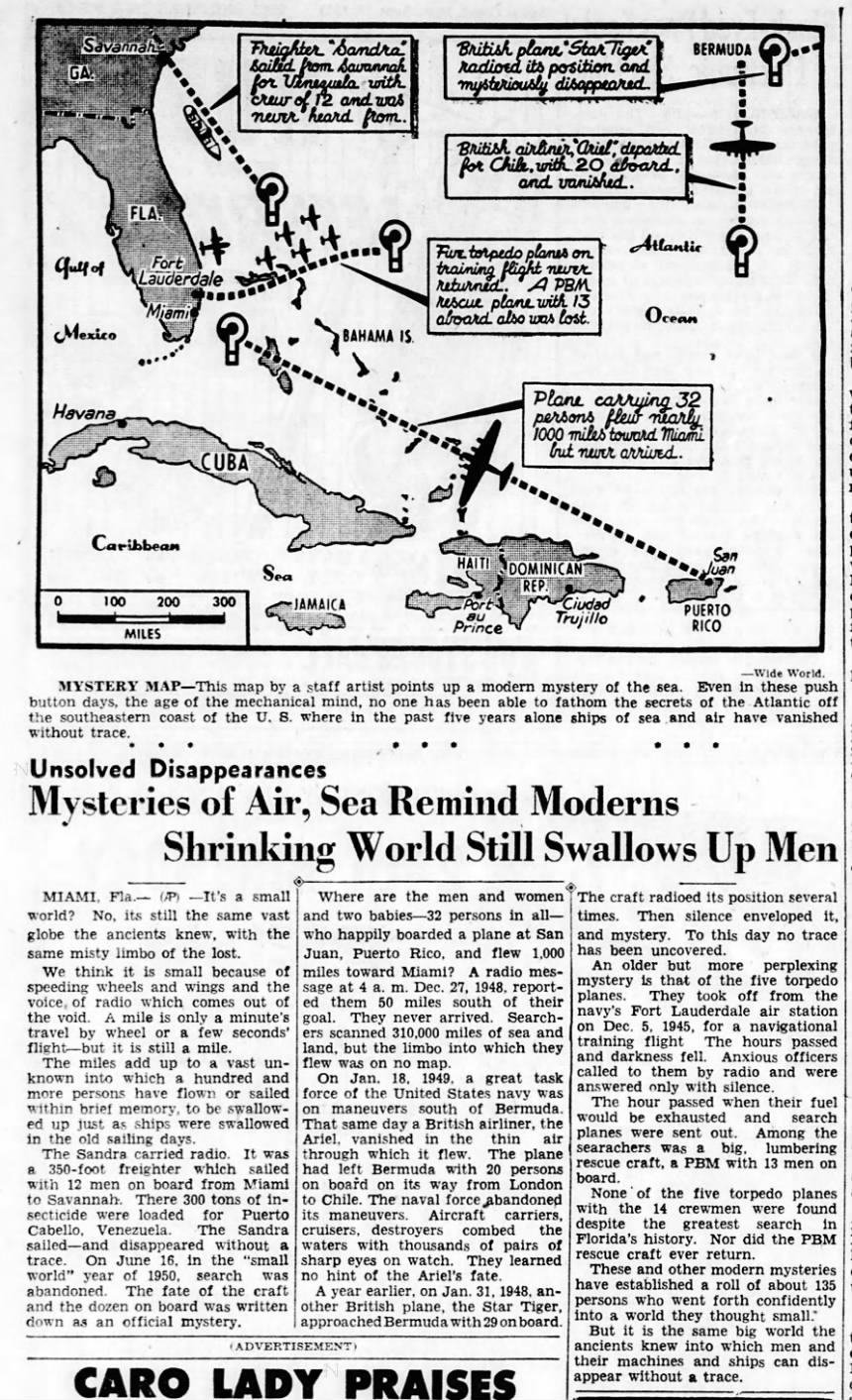
The legend is built on a string of ships and aircraft that went missing there. The best known are the collier USS Cyclops in 1918, the five Avenger bombers of Flight 19 in 1945 along with a flying boat sent to find them, and two British airliners, Star Tiger and Star Ariel, in 1948 and 1949. Many of these losses left no wreckage that searchers could find.
The idea of a cursed triangle grew in print. A 1950 Miami Herald piece by E. V. W. Jones gathered the losses together, a 1952 article in Fate magazine drew the triangle shape, and Vincent Gaddis gave it its catchy name in Argosy in 1964. Charles Berlitz's 1974 bestseller made it a household phrase.
The waters are genuinely busy and demanding. The Gulf Stream runs fast along Florida, hurricanes pass through in season, and the Bahamas are ringed with shallow shoals. Some of the heaviest ship and air traffic in the Atlantic crosses the area. That mix explains why it has seen many losses, and also why the legend found such a large audience.
The ancient-alien case
On Ancient Aliens, the Triangle is framed as one of a handful of spots on Earth where UFO sightings cluster and technology misbehaves. The series groups it with places like Mexico's Zone of Silence and asks whether these zones share a hidden cause linked to off-world visitors (Mysterious Places, S2E1).
The show's key witness is pilot Bruce Gernon. He says that in 1970 he flew through a strange tunnel of cloud and glowing mist over the Bahamas, his instruments failed, and he covered about 100 miles in a few minutes. On the show, this is offered as a sign of a natural vortex or small 'black hole' that bends time and space (Earth's Black Holes, S13E4).
Theorists on the series build on that idea. They suggest that if such distortions are real, they could explain aircraft and ships that vanish without a mayday, and might even act as doorways used by craft from elsewhere. The show has also placed old sea mysteries in this frame, including the Mary Celeste (S13E4).
The series has tied new events to the legend as well. In The Vanishings (S9E11), it discussed Malaysia Airlines Flight MH370 alongside the Triangle, relaying media speculation that the two might share an unexplained cause.
Beyond the show, writers in the genre have linked the Triangle to sunken Atlantis and to underwater energy sources. For believers, the lack of wreckage in some famous cases is the most telling clue.
What archaeologists say
Investigators say the Triangle has no more losses than any other busy stretch of ocean. Lloyd's of London and the U.S. Coast Guard have both found that the numbers are not unusual once heavy traffic is taken into account, and NOAA says the same. Larry Kusche's research showed that many famous cases were inflated: some ships sank in storms that the stories left out, some were lost far from the Triangle, and a few never existed.
Scientists point to ordinary but serious hazards. The Gulf Stream is fast and can scatter wreckage quickly. Storms can build suddenly. Shoals around the Bahamas are dangerous. In parts of the area a compass points to true north rather than magnetic north, which can confuse navigators who do not correct for it. The deep water nearby makes finding wreckage hard.
Flight 19 fits this pattern. Radio logs show the flight leader believed he was over the Florida Keys when he was actually over the Bahamas, so he led the planes the wrong way until they ran out of fuel at night in worsening weather. A tanker saw flames at sea soon after the PBM Mariner took off that is widely read as that aircraft exploding. The Navy's first report blamed navigation error; it was later changed to 'cause unknown' after the leader's family objected.
Timeline
- March 1918USS Cyclops, heavily loaded with ore, vanishes on a voyage from Barbados with 306 aboard.
- December 5, 1945Flight 19 goes missing on a training run from Fort Lauderdale; a PBM Mariner sent to search for it is also lost.
- 1948–1949British airliners Star Tiger and Star Ariel disappear on long overwater flights.
- 1950E. V. W. Jones writes about the losses in the Miami Herald.
- 1952George X. Sand's article in Fate magazine lays out the triangle shape.
- 1964Vincent Gaddis coins the name 'Bermuda Triangle' in Argosy.
- 1974Charles Berlitz's book The Bermuda Triangle becomes a bestseller.
- 1975Librarian Larry Kusche publishes a point-by-point check of the stories and finds many errors and exaggerations.
- 2010Ancient Aliens features the Triangle among Earth's UFO 'hot spots' in Mysterious Places.
- 2023Australian scientist Karl Kruszelnicki again points out that insurers and the Coast Guard see no unusual loss rate there.
Still unanswered
- Where exactly did the five Flight 19 Avengers go down, and will their wrecks ever be positively identified?
- What caused the loss of USS Cyclops, which left no confirmed wreck or distress call?
- What did Bruce Gernon actually experience in 1970—an unusual storm cell, instrument failure, or something else?
- Why do some famous losses leave no trace at all, while others in the same waters are found quickly?
Did you know?
- The U.S. Board on Geographic Names has no official file for the Bermuda Triangle and does not recognize the name.
- The search for Flight 19 was one of the largest air-sea searches ever mounted, sweeping more than 200,000 square miles.
- The Mary Celeste, often lumped into Triangle lore, was found abandoned near the Azores, far outside it.
On Ancient Aliens
- S02E01 Mysterious Places Presents the Triangle as one of several UFO 'hot spots' where planes and ships vanish.
- S13E04 Earth's Black Holes Pilot Bruce Gernon describes his 1970 'electronic fog' flight as evidence of a time-bending vortex.
- S09E11 The Vanishings Links the disappearance of Flight MH370 to the Triangle and to aliens, citing media speculation (Colavito numbers it S07E16).
Episode numbers follow Wikipedia's episode list; History and some reviewers number a few seasons differently.
Visiting
Getting there. Open ocean between South Florida, Bermuda and Puerto Rico; you cross it on many cruises and flights to the Bahamas, Bermuda and the Caribbean.
What you can see. There is nothing to 'visit' as such. The Naval Air Station Fort Lauderdale Museum, at the base Flight 19 flew from, tells the story of the lost squadron.
Tip. If you plan a cruise or small-boat trip through the area, check hurricane forecasts carefully; storms, not mysteries, are the real risk.
Sources
- NOAA National Ocean Service – Does the Bermuda Triangle really exist? oceanservice.noaa.gov
- Wikipedia – Bermuda Triangle en.wikipedia.org
- Wikipedia – Flight 19 en.wikipedia.org
- Naval Air Station Fort Lauderdale Museum – Flight 19 nasflmuseum.com
- Fox Weather – Karl Kruszelnicki on the Bermuda Triangle (2023) foxweather.com
- Jason Colavito – Review of Ancient Aliens S13E04 'Earth's Black Holes' jasoncolavito.com
- Jason Colavito – Review of Ancient Aliens 'The Vanishings' jasoncolavito.com
- TVmaze – Ancient Aliens episode guide tvmaze.com
- Wikipedia – List of Ancient Aliens episodes en.wikipedia.org
Research notes: what we could not confirm
- Which named theorists (e.g. Giorgio Tsoukalos or David Childress) speak about the Triangle in S2E1 and S13E4; reviews seen do not attribute the segments.
- Whether the show explicitly links the Triangle to Ivan Sanderson's 'vile vortices' grid or to Atlantis, as the old entry said; not confirmed in a source opened here.
- A Season 18 clip titled 'Time Warp in the Bermuda Triangle' was noted in the old entry; the episode it came from was not identified.
- The cause of the PBM Mariner loss; an in-flight explosion is the usual explanation, and the widely repeated claim that Mariners were prone to fuel-vapor fires was not confirmed here.
- USS Cyclops's route details and cause of loss remain unconfirmed; overloading and structural failure is a leading theory.