What it is
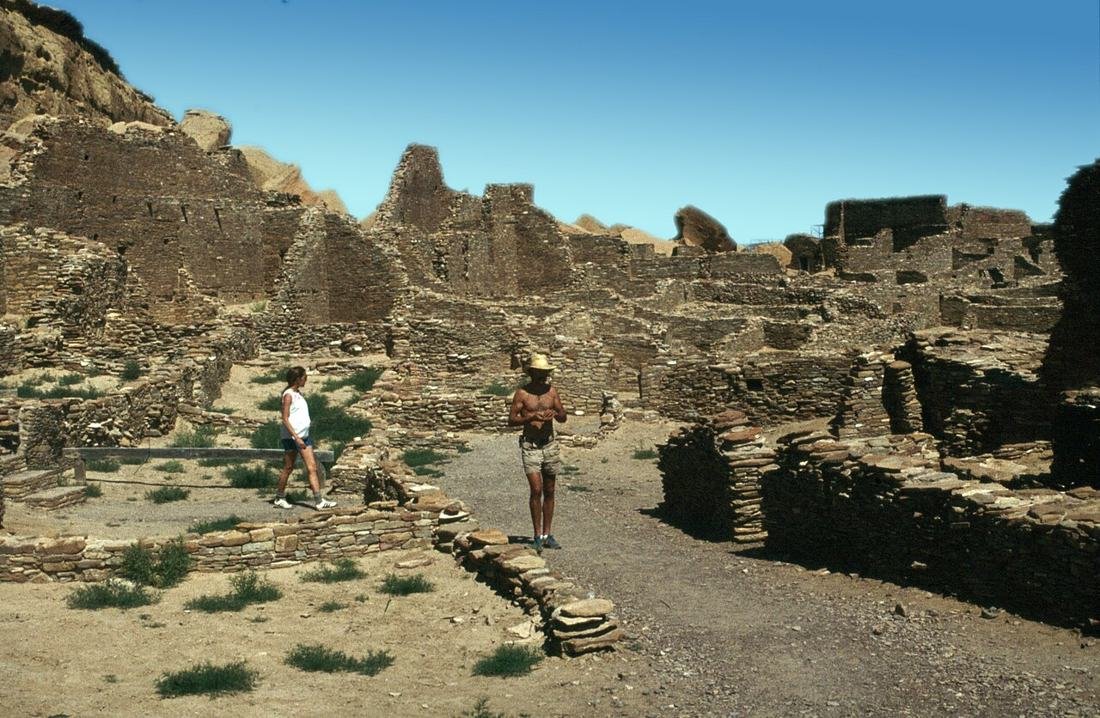
Chaco Canyon is a shallow desert canyon in the San Juan Basin of northwestern New Mexico, now protected as Chaco Culture National Historical Park. Between the mid-800s and the 1100s it was the heart of the Ancestral Puebloan world, the ancestors of today's Pueblo peoples such as the Hopi, Zuni and the Rio Grande pueblos. The land is harsh, with short growing seasons and little water, which makes what was built here all the more striking.
The Chacoans built 'great houses,' huge planned buildings of finely fitted sandstone with hundreds of rooms and many round ceremonial rooms called kivas. The largest, Pueblo Bonito, covers almost two acres, held at least 650 rooms and rose four or more stories. Other great houses such as Chetro Ketl, Pueblo del Arroyo and Una Vida line the canyon, and the great kiva Casa Rinconada sits across the wash.
Chaco was also the hub of a wider network. Wide, strikingly straight roads run out from the canyon, and dozens of great houses of Chacoan style stand across the region. The builders hauled some 200,000 roof beams from mountain forests many miles away. Many buildings line up with the sun and moon, and a spiral carving on Fajada Butte marks the solstices with slivers of light.
Why Chaco was built, and why its people moved on, are still open questions. Archaeologists debate whether it was a trade center, a pilgrimage site, or a seat of power. Pueblo descendants describe it as a gathering place where clans came together, not a lost civilization. On Ancient Aliens it features as an example of a people who supposedly 'vanished,' a framing that Pueblo people and archaeologists reject.
The ancient-alien case
Theorists focus first on the ending. In The Vanishings, David Childress argues that the Chacoans did not simply move away but may have left through a portal to another dimension. For the show, a people who built so much and then left their great houses empty fits a wider pattern of 'vanished' cultures around the world.
They also point to the sky knowledge. Chaco's buildings line up with the solstices, the equinoxes and even the long 18.6-year cycle of the moon. The Sun Dagger on Fajada Butte uses shafts of light to mark the seasons. Theorists ask how a farming people in a remote canyon gathered such exact data, and suggest it came from teachers from the stars.
The roads add to the puzzle. They run dead straight for miles, even going up cliffs with carved stairs instead of around them, and some seem to lead nowhere. Theorists argue that roads so straight and so wide were not built for walking traffic and may have been meant to be seen from above or to mark lines of energy.
Finally, theorists draw on Southwestern oral traditions. Hopi stories of emerging from earlier worlds, and of helpful 'Ant People' who sheltered humans underground, are read on the show and by writers in the ancient-astronaut field as memories of contact with beings from elsewhere.
What archaeologists say
Archaeologists say the Chacoans did not vanish. Tree-ring dates show a long drought beginning around 1130, and the canyon had been stripped of trees for building and fuel. Over several generations, people moved to better-watered places, and their descendants live today in the Pueblo communities of New Mexico and Arizona. Pueblo oral histories describe migrating from Chaco, and the park consults 27 associated tribes.
Chacoan astronomy is well studied and seen as the product of patient observation over generations. Farmers in a marginal climate had strong reasons to track the seasons, and Pueblo peoples still keep ceremonial calendars based on the sun. The road system is best explained as ceremonial and social, tying outlying communities to the canyon and marking sacred directions, with the Great North Road often linked to Pueblo stories of emergence from the north.
Critic Jason Colavito and many archaeologists object to the 'vanishing' framing itself. They point out that it erases living Native peoples and treats their ancestors' achievements as something only outsiders could have done.
Timeline
- mid-800s CEAncestral Puebloans begin building the first great houses, including early phases of Pueblo Bonito.
- c. 1020–1120 CEPeak of construction; Chaco becomes the ceremonial and economic center of the San Juan Basin and the road network expands.
- 1054 CEA painted panel at Peñasco Blanco may record the supernova that created the Crab Nebula.
- c. 1130–1180 CEA long drought sets in; building slows and people gradually move to other regions, including Mesa Verde, the Rio Grande and Hopi country.
- 1907President Theodore Roosevelt proclaims Chaco Canyon a national monument.
- 1977Artist Anna Sofaer notices the 'Sun Dagger' light marker on Fajada Butte, sparking modern study of Chacoan astronomy.
- 1980The monument is enlarged and renamed Chaco Culture National Historical Park.
- 1987UNESCO lists Chaco Culture as a World Heritage Site.
- 2013The park is certified as an International Dark Sky Park.
- 2023The Interior Department withdraws federal lands in a roughly 10-mile zone around the park from new oil and gas leasing, a move long sought by Pueblo nations.
Still unanswered
- Was Chaco mainly a place where people lived year-round, or a pilgrimage center that filled up for ceremonies?
- What were the long straight roads really for, and why do some seem to end in open desert?
- How was power organized at Chaco, and were there elite families or leaders?
- How were the builders able to plan and align great houses across miles of desert to the lunar standstill?
- Will the protected zone around the park hold as energy development pressure continues in the region?
Did you know?
- The Chacoans carried around 200,000 wooden beams on foot from mountains as far as 70 miles away, without wheels or pack animals.
- A rock painting at Chaco may show the 1054 supernova, which was also recorded by Chinese astronomers.
- Some Chacoan great houses as far as 15 miles from the canyon's core are placed to line up with the moon's extreme rising and setting points, which repeat only every 18.6 years.
On Ancient Aliens
- S09E11 The Vanishings David Childress suggests the Chacoans left through a portal to another dimension rather than migrating away.
Episode numbers follow Wikipedia's episode list; History and some reviewers number a few seasons differently.
Visiting
Getting there. Northwestern New Mexico, roughly between Farmington and Grants; the park is reached by unpaved roads, the last miles rough and slow after rain.
What you can see. Visitors can drive a loop road and walk into Pueblo Bonito, Chetro Ketl and other great houses on marked trails, and hike to back-country sites such as Pueblo Alto and Peñasco Blanco. Fajada Butte and the Sun Dagger are closed to the public to protect them. There are no services such as food or fuel in the park.
Tip. Stay after dark: Chaco is a certified Dark Sky Park and the park's night-sky programs let you see the sky the builders watched.
Sources
- Chaco Culture National Historical Park (Wikipedia) en.wikipedia.org
- Chaco Canyon (Wikipedia) en.wikipedia.org
- History and Culture, Chaco Culture National Historical Park (NPS) nps.gov
- Review of Ancient Aliens 'The Vanishings' (Jason Colavito) jasoncolavito.com
- List of Ancient Aliens episodes (Wikipedia) en.wikipedia.org
Research notes: what we could not confirm
- Only one Ancient Aliens episode (S09E11 'The Vanishings') could be confirmed for Chaco; the old entry's S03E01 'Aliens and the Old West' remains unconfirmed and was dropped.
- Colavito numbers 'The Vanishings' as S07E16; Wikipedia lists it as season 9, episode 11. The Wikipedia numbering is used.
- The alien-case paragraphs on the roads and on Hopi 'Ant People' describe common ancient-astronaut arguments about the Southwest; I did not confirm that these specific points were made about Chaco in an episode.
- The 2023 10-mile leasing withdrawal is from general knowledge; I could not open the Interior Department notice to confirm its date and 20-year term, or check for 2025–2026 changes to it.
- The Sun Dagger's 1977 discovery year and the 'rock-art survey' detail were not confirmed in a source opened for this entry.