What it is
The Temple of Hathor at Dendera stands on the west bank of the Nile in Upper Egypt, across the river from the city of Qena and roughly an hour's drive north of Luxor. It is one of the best preserved temples in the country. Hathor was a goddess of love, music, joy and the sky, and her temple still has its roof, its stairways, and much of its painted color.
The building you see today is late. Work began in 54 BCE under Ptolemy XII, father of Cleopatra VII, and the great columned hall was finished under the Roman emperor Tiberius. Egypt was then ruled by Greek kings and later by Rome, but the temple follows old Egyptian rules of design. Older shrines stood on the same spot, and the site's history reaches back to the Old Kingdom king Pepi I.
Inside the front hall, 24 columns are topped with Hathor's face. The ceiling carries a painted map of the sky, with star gods, the goddess Nut, and signs of the zodiac. A famous round zodiac once decorated a rooftop chapel; the original was cut out and taken to Paris in 1821, and a cast now fills its place. On the outer back wall, Cleopatra VII appears with her son Caesarion.
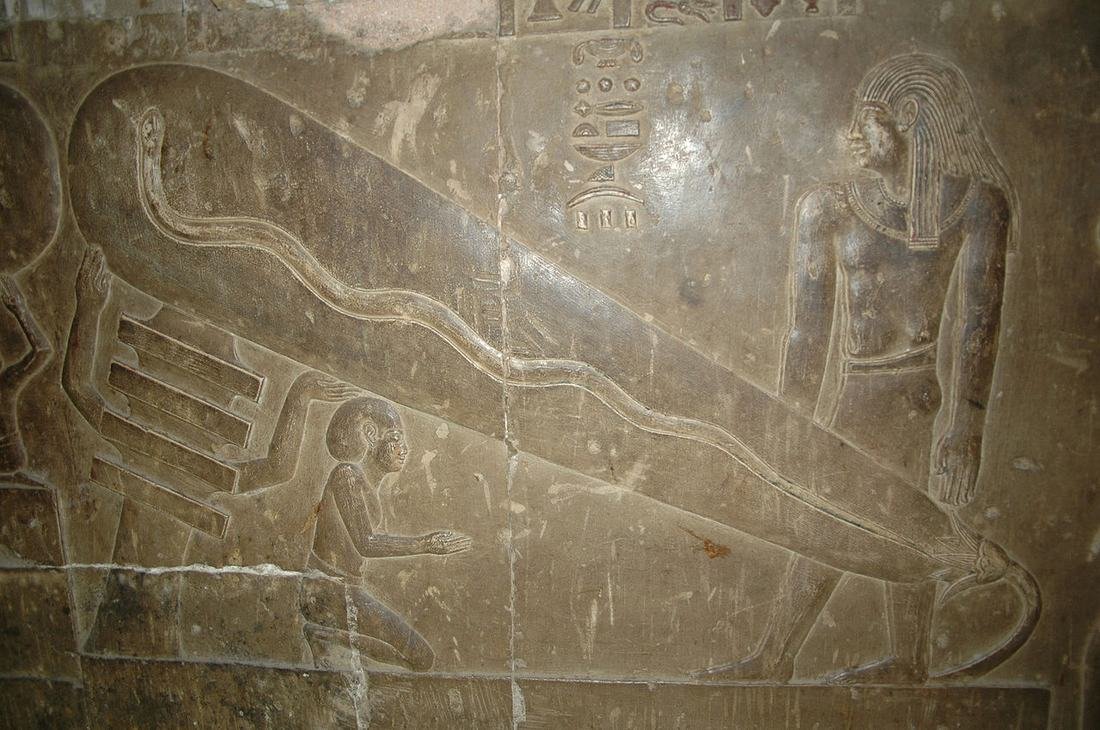
Below the floors lies a network of narrow crypts. On the walls of one of them are reliefs of a huge bulb-shaped lotus with a snake stretched inside, propped up by a pillar. Fringe writers call this the Dendera light. The reliefs have made a quiet religious chamber one of the most shared images in the ancient-astronaut world. Egyptologists read the same scene as a creation myth carved in stone.
The ancient-alien case
The Dendera light theory centers on a few reliefs in the temple crypts. Each shows a long, rounded bulb with a wavy snake inside. The bulb seems to grow from a lotus flower, and a stem trails off to a box where a small god kneels. A djed pillar, an Egyptian symbol of stability, props up the far end. To many viewers this looks like a glass tube with a glowing filament, a power cable, and an insulator.
The idea was built into a full theory by Peter Krassa and Reinhard Habeck in their 1982 book, and Erich von Däniken helped spread it. Ancient Aliens gave it a long segment in the 2013 episode Alien Power Plants. There, Jason Martell argued that the lotus stem is really an electrical cord and that the snake stands for the glowing element. He connected it with the so-called Baghdad battery to suggest the Egyptians could store and use current.
David Childress makes the soot argument. Tombs and inner rooms were painted in total darkness, he notes, yet many ceilings show little of the black residue that torches would leave. Mirrors, he says, could not carry sunlight that deep. For him, electric light is the simpler answer. Giorgio Tsoukalos goes further and links ancient stories of divine light to borrowed alien technology.
Theorists ask where such knowledge would have come from. Their answer is that it was handed down from visitors and later lost, with only the images left behind. They point out that the reliefs sit in hidden rooms that only priests could enter, which they read as a sign the scenes recorded secret technical knowledge rather than public myth.
What archaeologists say
Egyptologists say the reliefs are labeled. The hieroglyphs beside them name the snake as a form of Harsomtus, a child god who rises from a lotus at the moment of creation, just as the sun first rose from the waters. The lotus bud, the snake and the djed pillar are all common religious symbols. The texts even give the height and materials of the cult statues the scenes depict, showing the crypts were storerooms for sacred images kept in darkness.
On the soot question, archaeologists point to good evidence for smokeless lighting. Egyptians used oil lamps with wicks treated with salt and fat, which burn cleanly, and some tombs do carry soot. Critics such as Kenneth Feder add a simple test: a real electric system would leave glass, metal fittings, wiring or filaments behind. None have ever been found at Dendera or anywhere else in Egypt.
The idea's own history also counts against it. The first known mention of electric lamps in tombs came as a joke recorded by Norman Lockyer in 1894. The so-called Baghdad battery, often paired with Dendera, is a clay jar from Mesopotamia with no proven link to electricity. Most scholars read it as a storage vessel.
Timeline
- c. 2300 BCEEvidence of a shrine at Dendera goes back to the Old Kingdom reign of Pepi I.
- 54 BCEConstruction of the present Hathor temple begins under Ptolemy XII.
- c. 50 BCEThe round Dendera zodiac is carved in a rooftop chapel, according to studies of its planetary positions.
- 14–37 CEThe great columned front hall is completed under the Roman emperor Tiberius.
- 1821Claude Lelorrain cuts out the round zodiac with saws and gunpowder and ships it to Paris; it later goes to the Louvre.
- 1894Astronomer Norman Lockyer mentions a colleague's joking idea that electric lamps might explain soot-free tomb ceilings.
- 1982Austrian writers Peter Krassa and Reinhard Habeck publish Licht für den Pharao, arguing the crypt reliefs show electric lamps.
- 2003Egypt places Dendera on its UNESCO Tentative List along with Edfu, Kom Ombo and Esna.
- 2005–2021Conservators clean decades of grime from the front hall, revealing bright original colors on the ceiling.
- 2022–2026Zahi Hawass launches a 2022 petition to bring the zodiac home; in September 2026 Egyptian officials reportedly order wooden walkways to protect the temple floors.
Still unanswered
- Why did the priests hide these images in crypts that only a few people could ever enter?
- How exactly did painters light the deepest crypts and tombs while they worked, and in what mix of lamps and reflected light?
- Will the round zodiac ever return from the Louvre to Dendera?
- How much of the earlier temples that stood on the site still lies beneath the current building?
Did you know?
- The idea of electric lamps in Egyptian tombs first appeared in print as a joke told to astronomer Norman Lockyer in 1894.
- When the zodiac reached France in the 1820s, some scholars claimed it was thousands of years old; it later proved to date from about 50 BCE.
- Dendera's crypts were built into the thickness of the walls and under the floor, and some could only be reached by lifting a stone slab.
On Ancient Aliens
- S05E03 Alien Power Plants Jason Martell, David Childress and Giorgio Tsoukalos present the crypt reliefs as evidence of Egyptian electric lighting.
- S08E03 Mysterious Devices Repeats the Dendera light bulb segment as one of the show's mysterious artifacts.
Episode numbers follow Wikipedia's episode list; History and some reviewers number a few seasons differently.
Visiting
Getting there. Dendera lies on the west bank of the Nile opposite Qena, about 60 km north of Luxor; most visitors come on a day trip by road from Luxor, often paired with Abydos, or on a Nile cruise stop.
What you can see. The main temple, roof chapels, birth houses and sacred lake are open to visitors. At least one crypt, including the chamber with the 'light' reliefs, can usually be entered with a separate ticket. Wooden walkways were ordered in 2026 to protect the floors.
Tip. Climb the stairs to the roof to see the cast of the zodiac in its original chapel, then look for Cleopatra on the outside back wall.
Sources
- Dendera light – Wikipedia en.wikipedia.org
- Dendera Temple complex – Wikipedia en.wikipedia.org
- Dendera zodiac – Wikipedia en.wikipedia.org
- Temple of Dendera – Egypt Ministry of Tourism and Antiquities egymonuments.gov.eg
- Pharaonic temples in Upper Egypt from the Ptolemaic and Roman periods – UNESCO Tentative List whc.unesco.org
- Review of Ancient Aliens S05E03 'Alien Power Plants' – Jason Colavito jasoncolavito.com
- Review of Ancient Aliens 'Mysterious Devices' – Jason Colavito jasoncolavito.com
- Egypt orders new paths at Dendera Temple – ad-hoc-news (Sept 2026) ad-hoc-news.de
- List of Ancient Aliens episodes – Wikipedia en.wikipedia.org
Research notes: what we could not confirm
- The old entry listed S19E12 'The Top Ten Mysterious Devices'; Colavito's review of it lists no Dendera segment (it covers the djed pillar instead), so it was dropped. Other episodes in the old entry (Pilot, S1E1, S14E19, S20E7, S20E12, S20E19) were not confirmed.
- The September 2026 walkway order comes from a single news aggregator and was not confirmed by an Egyptian government source.
- The detail that some crypts were reached by lifting a floor slab, and that a crypt ticket is sold separately, rest on general knowledge and the ministry page's mention of an extra 'serdab' ticket; the exact crypt open to visitors was not confirmed.
- The distance from Luxor (about 60 km) is a common guidebook figure, not checked against an official source.
- Colavito's 'S06E22 Mysterious Devices' review is matched to History's S08E03 by air date (June 27, 2014).