What it is
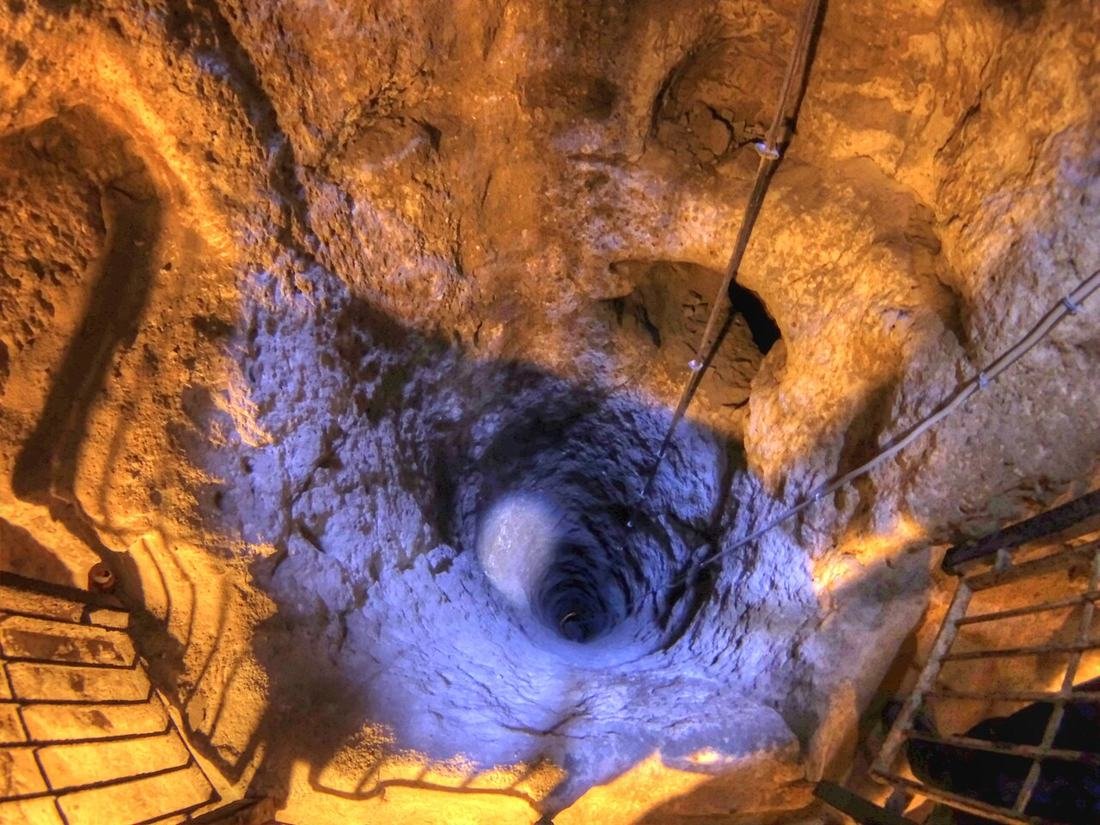
Derinkuyu is a many-level underground refuge carved into the soft volcanic rock of Cappadocia in central Turkey. It sits beneath the town of the same name in Nevşehir Province; the name means "deep well." Passages, rooms and shafts drop to a depth usually given as about 85 m, though some sources put it closer to 60 m. It is the deepest of the region's underground cities that visitors can enter.
The rock here is tuff, compacted volcanic ash that is easy to cut with hand tools but hardens once exposed to air. Over centuries, locals dug down level by level. The result includes stables, storerooms, kitchens, wine and oil presses, chapels and communal dining rooms. A deep central shaft, about 55 m long, brought in fresh air and also served as a well.
Defense was the point. Narrow, low tunnels force people to walk in single file and stooped over. Round stone doors, like giant millstones, could be rolled across passages from the inside to seal off each level separately. Estimates suggest the complex could shelter up to 20,000 people with their livestock and food, for as long as a threat lasted.
Derinkuyu is only one of roughly 250 such refuges known in Cappadocia. It is said to be linked to the underground city at Kaymaklı by a tunnel several kilometres long. In 2013 builders in Nevşehir, the provincial capital, broke into another huge complex that may prove even larger. Together they form part of a UNESCO World Heritage Site.
The ancient-alien case
On Ancient Aliens, Derinkuyu is presented as more than a hiding place from human raiders. In Underground Aliens (S2E4), the show asks whether Turkey's underground city was built with help from visitors from elsewhere, or dug as a shelter against an attack from the sky.
Author Andrew Collins leads a tour of Turkey's cave cities in Return to Göbekli Tepe (S12E16). He argues that survivors of a lost Ice Age culture sought shelter underground after a comet disaster, and theorists on the show connect these refuges to the builders of nearby Göbekli Tepe.
In the same episode, William Henry links the cave cities to the ancient Persian story of Yima, who was told by the god Ahura Mazda to build a 'vara' to protect people, animals and seeds from a coming catastrophe. Henry says the description closely matches Cappadocia's underground cities (S12E16). The show presents this as a possible memory of a warning from sky beings.
Theorists also stress scale. They ask why ordinary villagers would dig such an enormous, deep and carefully ventilated complex unless they feared something beyond normal warfare. The series later ranked Turkey's underground cities second in its countdown of the greatest ancient discoveries (The Top Ten Extraordinary Discoveries, S21E1).
What archaeologists say
Archaeologists say Derinkuyu is a human refuge built and enlarged over many centuries. Tuff is soft enough to dig with iron picks, and every chamber shows hand-tool marks. The features—stables, presses, chapels, rolling stone doors, cramped defensive passages—fit a population sheltering from raids, not an ancient high-tech culture.
The history of the region supports this. Cappadocia was a frontier during the Arab–Byzantine wars, and later saw repeated conflicts, so locals had long-running reasons to hide. The Greek writer Xenophon described Anatolian villagers living in underground houses around 400 BCE, showing the practice is old. Finds such as crosses, pottery and grindstones in the Nevşehir complex date from Byzantine to Ottoman times.
Scholars also dispute the Yima link. The old Persian text describes a walled enclosure, and its story concerns killing winters and floodwaters, not a meteor. There is no firm evidence that the underground cities date back to the time of Göbekli Tepe.
Timeline
- 8th–7th century BCEPhrygians may have dug the first chambers, according to a widely held but uncertain theory.
- 4th century CE onwardChristian communities spread in Cappadocia and carve churches and dwellings into the rock.
- c. 780–1180 CEThe refuges are expanded and heavily used during the Arab–Byzantine wars and later raids.
- Ottoman periodLocal Greek-speaking Christians keep using the tunnels as shelters in times of danger.
- 1923The town's Christian residents leave in the Greek–Turkish population exchange, and the tunnels are forgotten.
- 1963A resident renovating his house breaks through a wall and finds a passage into the city.
- 1969Derinkuyu opens to visitors.
- 1985Derinkuyu and Kaymaklı become part of the UNESCO site 'Göreme National Park and the Rock Sites of Cappadocia'.
- 2013–2014A vast new underground complex is uncovered under Nevşehir castle during a housing project.
Still unanswered
- When were the very first chambers dug, and by whom—Phrygians, Hittites, or later peoples?
- Is the long tunnel to Kaymaklı fully continuous, and how much of it has been explored?
- How long could 20,000 people actually survive underground, given air, water and waste?
- How large is the newly found Nevşehir complex, and is it connected to the other cities?
Did you know?
- The city was rediscovered in 1963 when a local man knocked through a wall during home repairs.
- The underground city's main air shaft also served as a well for the town above.
- Cappadocia has around 250 known underground refuges, and new ones are still being found.
On Ancient Aliens
- S02E04 Underground Aliens Asks whether Turkey's underground city was built with alien help or as a refuge from an alien attack (the synopsis does not name Derinkuyu).
- S12E16 Return to Göbekli Tepe Andrew Collins tours Turkey's underground cave cities, and William Henry ties them to Yima's 'vara'.
- S21E01 The Top Ten Extraordinary Discoveries Ranks Turkey's underground cities second, using footage from 2017.
Episode numbers follow Wikipedia's episode list; History and some reviewers number a few seasons differently.
Visiting
Getting there. In the town of Derinkuyu, Nevşehir Province, in central Cappadocia; reached by road, often on day tours from Göreme or Ürgüp that also stop at nearby Kaymaklı.
What you can see. About half the complex is open, along lit, signed routes that go down several levels. Passages are narrow and low, with steep steps; deeper sections remain closed.
Tip. Expect to stoop for long stretches; people who dislike tight spaces or have back or knee trouble may prefer the upper levels only.
Sources
- UNESCO World Heritage Centre – Göreme National Park and the Rock Sites of Cappadocia whc.unesco.org
- Wikipedia – Derinkuyu underground city en.wikipedia.org
- National Geographic – Massive underground city found in Cappadocia nationalgeographic.com
- Brewminate – Kaymaklı and Derinkuyu: two ancient underground cities brewminate.com
- Jason Colavito – Review of Ancient Aliens S12E16 'Return to Göbekli Tepe' jasoncolavito.com
- Jason Colavito – Review of Ancient Aliens S21E01 'The Top Ten Extraordinary Discoveries' jasoncolavito.com
- TVmaze – Ancient Aliens episode guide tvmaze.com
Research notes: what we could not confirm
- Depth: sources disagree (about 85 m versus about 60 m), as do counts of levels (often quoted as 8 to 18).
- The full 8–9 km tunnel to Kaymaklı has not been confirmed as walkable end to end.
- The Phrygian origin is a theory; no firm dating evidence for the earliest digging was found.
- Weights and sizes of the rolling stone doors (often quoted as several hundred kilograms) were not confirmed.
- S2E4's synopsis mentions 'an underground city in Turkey' without naming Derinkuyu; the old entry's S9E1 'Forbidden Caves' was not confirmed to cover it.
- Whether Erich von Däniken or other theorists wrote about Derinkuyu in their books was not checked.