What it is
Easter Island, called Rapa Nui by its people, is a small volcanic island in the southeastern Pacific that belongs to Chile. It covers about 164 square kilometers and lies roughly 3,700 kilometers off the Chilean coast. It is one of the most remote inhabited places on the planet. Its fame rests on the moai, the stone statues that stand on or lie near its shores.
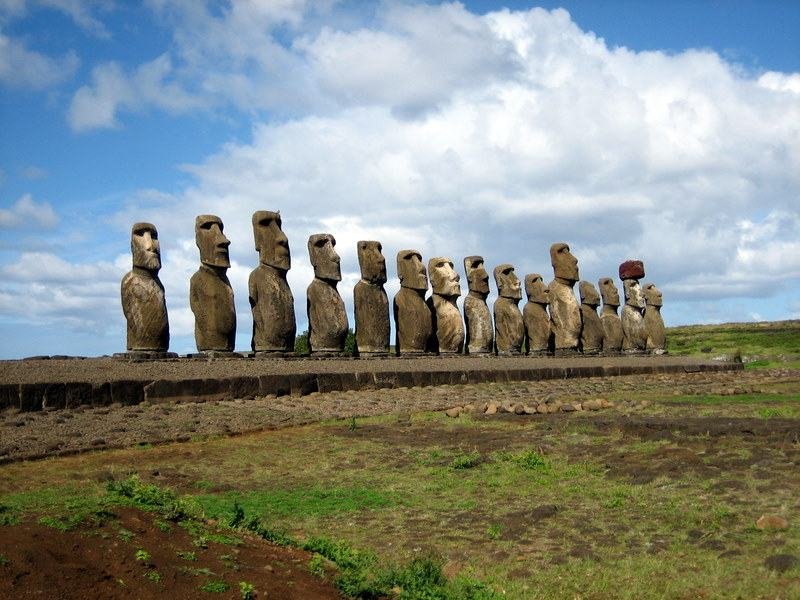
Polynesian voyagers settled the island around 1150-1200 CE, according to recent radiocarbon studies. Between about 1250 and 1500 CE their descendants carved close to a thousand moai. Most came from one quarry, the crater of the extinct volcano Rano Raraku, where they were cut from compressed volcanic ash called tuff. Many were set up on stone platforms called ahu, usually with their backs to the sea.
The statues show honored ancestors. They held mana, a sacred power tied to rank and lineage, and bigger statues signaled more powerful chiefs. Some later moai wore pukao, red stone topknots carved at a separate quarry called Puna Pau. Hundreds of unfinished figures still lie in the Rano Raraku quarry, including one that would have stood about 21 meters tall. Others lie along old roads, as if left mid-journey.
By the 1860s every standing moai had been pulled down. The causes included local conflict, earthquakes and the chaos that followed European contact and slave raids. About 50 have been set upright again. Rapa Nui National Park, now run by the island's Ma'u Henua community, protects the statues and the villages, rock art and ceremonial sites around them. The island's people still see the moai as living ancestors.
The ancient-alien case
Ancient-astronaut writers have pointed to Easter Island since Erich von Däniken's 1968 book Chariots of the Gods. The core argument is about scale. Theorists ask how a small island community could carve, move and raise stones weighing dozens of tonnes with no wheels, no metal tools and few large trees.
Island tradition says the moai walked to their platforms, moved by mana. Giorgio Tsoukalos reads that story literally. In the episode 'The Sentinels' he says either the islanders were confused or they were describing something like levitation. He treats the oral tradition as a memory of real technology.
The same episode focuses on Ahu Akivi, where seven moai look out toward the ocean instead of inland like most statues. The show suggests they were aimed at distant islands. David Childress proposes the statues once projected a protective force field around the island. William Henry remarks that the figures look alien.
In 'The Mystery of the Stone Giants', Childress suggests the moai could send out energy that influenced people. He ties them to the show's long-running idea of an ancient worldwide energy grid linking sacred sites. Theorists also compare the tight-fitting stone walls at Ahu Vinapu to Inca masonry in Peru, seeing a shared source of knowledge.
What archaeologists say
Archaeologists say the moai are Rapa Nui work from start to finish. The quarry at Rano Raraku still holds basalt picks, half-carved statues and the hollows left by finished ones, showing every stage of the process. The soft tuff can be worked with stone tools, and the carving sequence can be traced on the rock face.
On transport, Terry Hunt and Carl Lipo found that roadside moai have wide D-shaped bases and lean forward. In 2012 their team used three ropes to rock a 4.35-tonne replica upright and walk it forward. Their 2025 paper adds that the island's old roads are about 4.5 meters wide and dished in the middle, which would steady a rocking statue. This matches the walking tradition without magic.
The idea that the islanders wiped themselves out is also fading. A 2024 study of 15 ancient genomes found a population that grew steadily until European contact. It also found Native American ancestry from the 1200s to 1400s, which shows the islanders were skilled ocean voyagers, not a stranded people in need of outside help.
Timeline
- c. 1150-1200 CEPolynesian voyagers settle Rapa Nui, per recent radiocarbon dating (UNESCO's older listing gives a far earlier date).
- c. 1250-1500 CEThe main era of moai carving at Rano Raraku.
- 13th-15th centuries CEIslanders mix with Native Americans, according to a 2024 ancient DNA study, centuries before Europeans arrive.
- 1722Dutch explorer Jacob Roggeveen lands on Easter Sunday and gives the island its European name.
- 1860sBy this decade every moai has been toppled; Peruvian slave raids and disease devastate the population.
- 1888Chile annexes the island.
- 1995Rapa Nui National Park is added to the UNESCO World Heritage List.
- 2012Terry Hunt and Carl Lipo's team 'walks' a concrete replica moai upright with ropes.
- October 2022 - February 2023A wildfire chars moai at Rano Raraku; months later, a previously unknown 1.6 m moai turns up in the crater's dried-out lagoon.
- 2024-2025A Nature DNA study finds no sign of a population collapse; a 2025 paper by Lipo and Hunt adds physics and road evidence for the walking method.
Still unanswered
- When exactly did the first settlers arrive? Dates range from UNESCO's older estimate to about 1200 CE in newer studies.
- Why was the giant unfinished moai at Rano Raraku begun, and could it ever have been moved?
- How were the heavy pukao topknots lifted onto statues already standing?
- Did every moai walk, or were several transport methods used over time?
- What role did the 1200s-1400s contact with the Americas play in island life?
Did you know?
- In February 2023 a moai that no one had recorded before was found lying in the Rano Raraku crater lagoon after it began drying out.
- One of the best-known moai, Hoa Hakananai'a, was taken to Britain in 1868 and is now in the British Museum; islanders have asked for its return.
- Genes show Rapa Nui people had Native American ancestry centuries before any European ship arrived.
On Ancient Aliens
- S13E10 The Sentinels Tsoukalos, David Childress and William Henry discuss the seven ocean-facing moai of Ahu Akivi.
- S15E05 The Mystery of the Stone Giants Childress claims the moai could beam energy at people as part of a global grid.
- S17E02 Top Ten Mysterious Sites A countdown episode whose synopsis names the moai of Easter Island among its top sites.
Episode numbers follow Wikipedia's episode list; History and some reviewers number a few seasons differently.
Visiting
Getting there. Flights from Santiago, Chile (about five to six hours) land at Mataveri Airport by Hanga Roa, the island's only town. Some flights also connect from Tahiti.
What you can see. Visitors need a national park ticket and must be accompanied by an authorized local guide inside the park. Sites such as Rano Raraku, Orongo and Ahu Akivi require booking with a valid ticket. Chile also caps tourist stays at 30 days and requires an online entry form. Touching or climbing on moai and ahu is forbidden.
Tip. Plan Rano Raraku for a clear morning and book your slot early, since entry to the quarry is limited.
Sources
- Moai - Wikipedia en.wikipedia.org
- Rapa Nui National Park - UNESCO World Heritage Centre whc.unesco.org
- Easter Island's statues actually 'walked' - Binghamton University binghamton.edu
- Ancient DNA from Rapa Nui refutes population collapse theory - ScienceDaily sciencedaily.com
- Scientists find new Moai statue buried in a dry lake - ABC News abc.net.au
- Requirements for visiting Rapa Nui - Chile Travel chile.travel
- Review of Ancient Aliens S13E10 'The Sentinels' - Jason Colavito jasoncolavito.com
- Review of Ancient Aliens S15E05 'The Mystery of the Stone Giants' - Jason Colavito jasoncolavito.com
- Ancient Aliens 17x02 Top Ten Mysterious Sites - TVmaze tvmaze.com
Research notes: what we could not confirm
- The old entry's claim that the Pilot shows von Däniken comparing Ahu Vinapu to Inca masonry was not confirmed from a transcript; the Vinapu comparison is presented here as a general theorist argument.
- Pilot, S13E04, S15E01, S06E09, S19E13 and S22E03 may cover Easter Island but were not confirmed.
- The Hoa Hakananai'a removal year (1868), the 1722 Roggeveen landing, the 1888 annexation and the 1860s slave raids come from general knowledge, not a page opened this session.
- The Santiago flight time is approximate and was not checked against a current schedule.