What it is
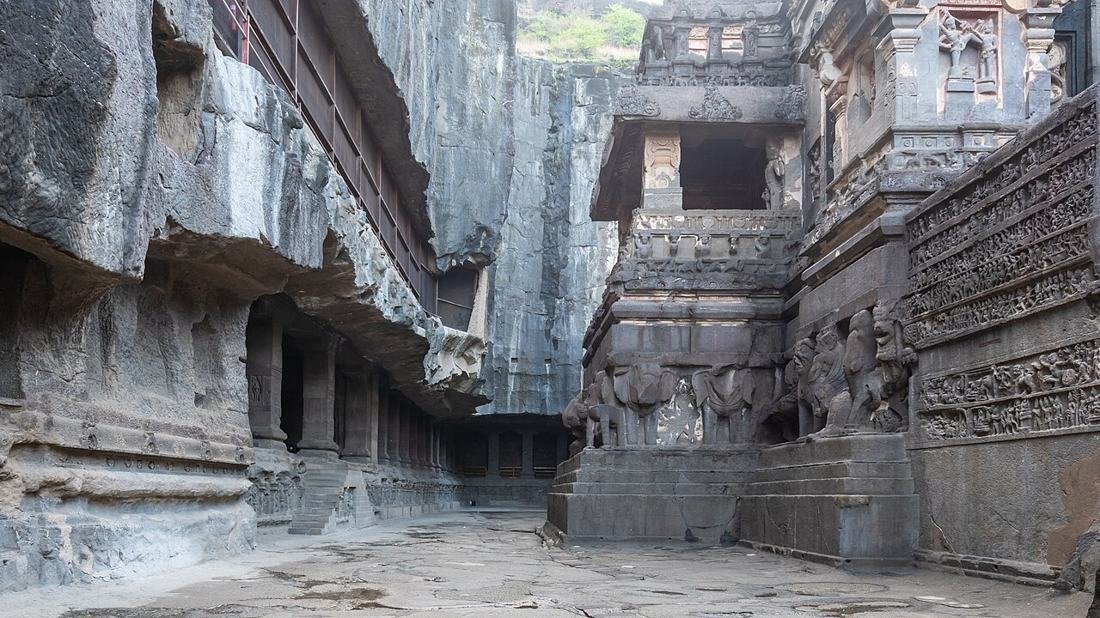
The Kailasa temple is Cave 16 at Ellora, a line of 34 rock-cut temples and monasteries along a basalt cliff in Maharashtra, western India. It lies about 30 kilometers from the city of Chhatrapati Sambhajinagar, long known as Aurangabad. Buddhist, Hindu and Jain communities carved caves here between roughly the 6th and 12th centuries. Kailasa is the largest and the most ambitious of them all.
It is not a cave in the usual sense. Carvers cut deep trenches into the hillside to free a huge block of rock, then shaped that block from the top down into a free-standing temple. The result is a full temple complex with a gateway, a pavilion for Shiva's bull Nandi, a main shrine, stairways, bridges, two tall pillars and two life-size stone elephants, all still attached to the bedrock beneath.
The temple is dedicated to Shiva and named for Mount Kailasa in the Himalayas, his mythical home. Its walls are crowded with sculpture. The best known panel shows the demon king Ravana shaking the mountain while Shiva calmly holds it steady with one toe. Traces of painted plaster show that parts of the temple were once brightly colored, possibly to look like a snowy peak.
Most historians credit the work to the Rashtrakuta dynasty and its king Krishna I, who ruled from about 756 to 773 CE. A copper-plate grant from about 812 CE praises a Shiva temple at Elapura, the old name of Ellora, built under Krishna. The courtyards and side shrines were probably finished by later rulers. UNESCO listed the Ellora Caves as a World Heritage Site in 1983.
The ancient-alien case
Ancient-astronaut theorists say the scale of Kailasa is hard to square with hand tools. On Ancient Aliens, Indian writer Praveen Mohan put the rock removed at 400,000 tons and said that, if the job took 18 years, workers would have had to haul away about five tons every hour without stopping. He suggested a weapon from Hindu texts, the Bhaumastra, might have turned stone to vapor.
Theorists also ask where all that rock went. Scholar Deepak Shimkhada noted on the show that no great piles of waste stone are seen near the site. To theorists, a missing spoil heap hints that the rock was not chipped out and carried off, but removed in some other way.
Then there are the tunnels. Narrow passages run beneath and around parts of Ellora, some going down many feet, and most are closed to visitors. David Childress has proposed that people sheltered in underground chambers during a great flood and then cut the temple as they dug their way out. The episode also drew on a nineteenth-century occult book that described secret underground meeting rooms beneath the temples.
Tying it together is the god himself. Giorgio Tsoukalos and others on the show have asked whether Shiva, the destroyer in Hindu belief, could be the memory of a real being who led a faction of visitors with powerful technology. For them, a temple to Shiva carved in an impossible way is a clue left on purpose.
What archaeologists say
Historians say Kailasa was carved by skilled Indian workers using iron chisels, picks and hammers, the same tools used at the older caves beside it. Unfinished caves at Ellora and elsewhere in the Deccan show the process step by step: trenches first, then rough blocks, then fine carving from the top down. Chisel marks are still visible on many surfaces. Carving from the top meant no scaffolding was needed.
The numbers on the show are inflated. Common estimates for the rock removed are about 150,000 to 200,000 tonnes, not 400,000. The 18-year figure comes from the length of Krishna I's reign, not from a record of how long the work took, and many parts were finished by later kings. Archaeologist M. K. Dhavalikar worked out that a few hundred workers could have cut the core temple in just a handful of years. Broken basalt is a useful building material, so waste rock was likely hauled off and reused over the centuries.
The tunnels are drains, passages and small chambers that belong to the temple's layout. They are closed mainly for safety. The underground meeting-room story comes from an 1876 spiritualist novel-like account called Ghost Land, which is not a historical source.
Timeline
- c. 66 million years agoLava flows of the Deccan Traps lay down the basalt from which the cliff is made.
- c. 550-700 CEBuddhist monasteries and halls are carved at the south end of the Ellora cliff.
- c. 756-773 CEUnder Rashtrakuta king Krishna I, work on the Kailasa temple begins.
- c. 812-813 CEThe Vadodara copper-plate grant praises a remarkable Shiva temple at Elapura built under Krishna.
- c. 800-1000 CELater rulers add side shrines, galleries and decoration around the temple.
- c. 800-1100 CEJain caves are carved at the north end of the cliff.
- 1600sMughal emperor Aurangzeb visits Ellora and describes the temples as a marvel.
- 1983UNESCO inscribes the Ellora Caves on the World Heritage List.
- 2016Ancient Aliens features Kailasa in the episode Shiva the Destroyer.
Still unanswered
- How long did the whole complex really take, and how many rulers' reigns did it span?
- Who were the master planners, and did they work from drawings or a scale model?
- Where did the great mass of waste rock end up?
- What were all of the small passages and hidden rooms around the temple used for?
- Was the whole temple once painted white to look like the snow-covered Mount Kailasa?
Did you know?
- The temple's two stone elephants and its victory pillars were cut from the same rock as the temple, not added later.
- The copper plate that credits Krishna I says even the gods were amazed by the temple, a rare boast about a specific building.
- Ellora has Buddhist, Hindu and Jain caves side by side, carved over several centuries.
On Ancient Aliens
- S11E15 Shiva the Destroyer Uses Kailasa as its main evidence that Shiva led a group of technologically advanced visitors.
Episode numbers follow Wikipedia's episode list; History and some reviewers number a few seasons differently.
Visiting
Getting there. Ellora (Verul), about 30 km northwest of Chhatrapati Sambhajinagar (Aurangabad), Maharashtra, India. The city has an airport and rail links, and visitors reach Ellora by taxi, bus or tour.
What you can see. The Archaeological Survey of India manages the site. Visitors can walk through the Kailasa courtyard and shrines and climb the path to the cliff top for a view down into the temple. Most tunnels and some upper areas are closed. The Buddhist and Jain caves are spread along the cliff, with shuttles covering longer gaps. The site is closed one day each week.
Tip. Walk the trail above Kailasa: only from the rim can you see that the whole temple sits in a pit cut out of the hill.
Sources
- UNESCO World Heritage Centre: Ellora Caves whc.unesco.org
- Wikipedia: Kailasa temple, Ellora en.wikipedia.org
- TVmaze: Ancient Aliens 11x15 Shiva the Destroyer tvmaze.com
- Jason Colavito: Review of Ancient Aliens S11E15 Shiva the Destroyer jasoncolavito.com
- History with the Szilagyis: review of Shiva the Destroyer historywiththeszilagyis.wordpress.com
- Ancientalienpedia: Shiva the Destroyer, the Ellora Caves ancientalienpedia.wordpress.com
- Wikipedia: List of Ancient Aliens episodes en.wikipedia.org
Research notes: what we could not confirm
- Only one full Ancient Aliens episode (S11E15) could be confirmed; History's web clip The Ellora Caves is labeled Season 12 but was not matched to a broadcast episode.
- The 150,000-200,000 tonne estimate for rock removed is widely repeated but no primary survey for it was found.
- The popular story that Aurangzeb sent workers to destroy the temple for three years is not supported by a source found here and is left out.
- The idea that the temple was painted white to look like snow is a common interpretation, not a confirmed fact.
- The attribution to Krishna I rests on inscriptions not physically found at the temple, so some scholars treat it as probable rather than certain.