What it is
Göbekli Tepe is a low, man-made mound on a limestone ridge in southeastern Turkey, roughly 15 km from the city of Şanlıurfa. Its name means "Potbelly Hill." Under the soil lie circles and ovals of standing stones, plus later rectangular buildings. The oldest parts date to about 9600 BCE, near the end of the last Ice Age. That makes the site several thousand years older than Stonehenge or the first Egyptian pyramids.
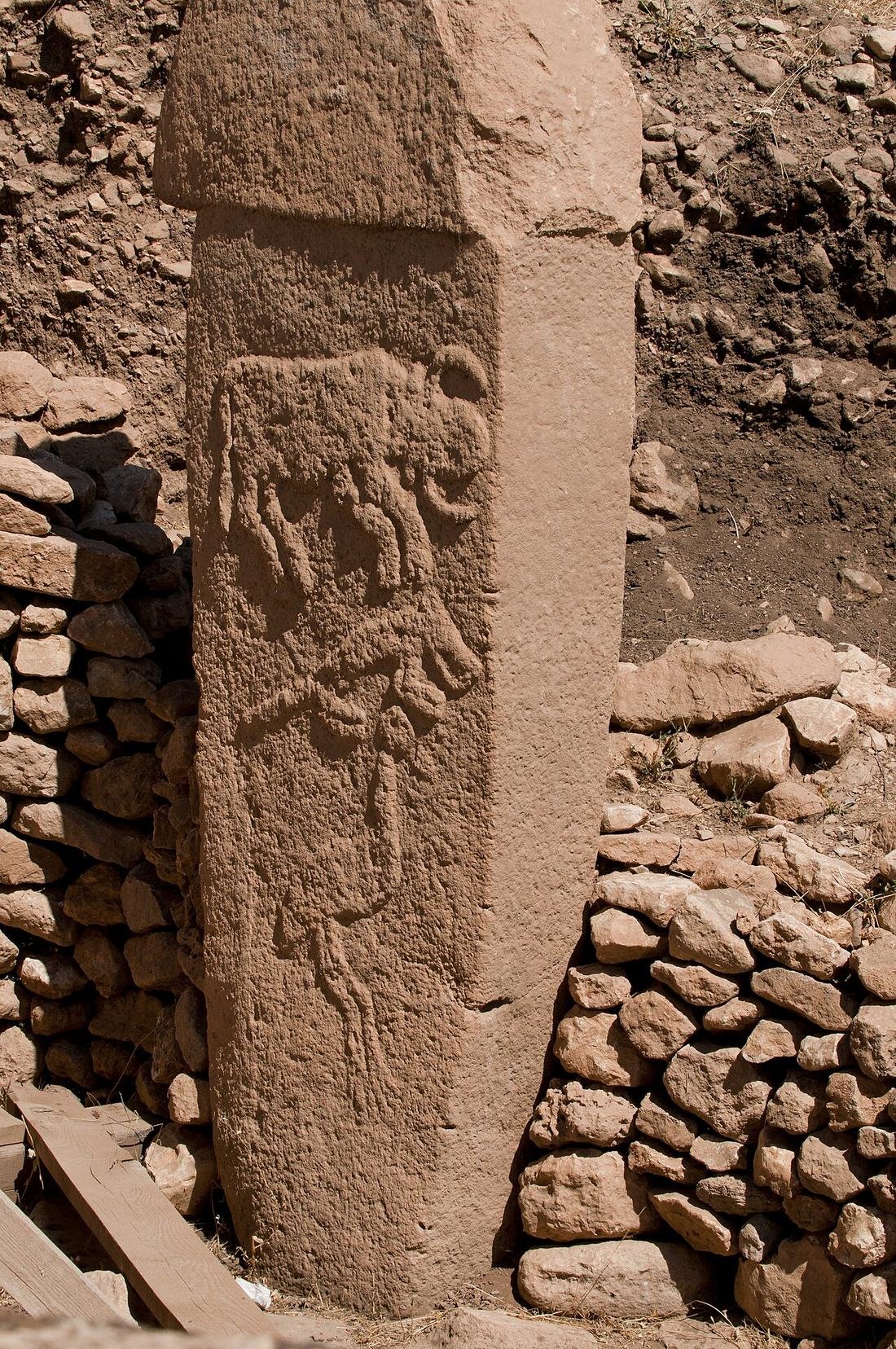
The defining feature is the T-shaped pillar. Each circle has a ring of these limestone slabs set into low stone walls, with two taller pillars standing in the middle. The biggest reach about 5.5 m. Many are carved with foxes, boars, snakes, vultures, scorpions and wild cattle. Some have arms, hands, belts and loincloths cut into their sides, which suggests the pillars stand for human or human-like figures.
The builders were not farmers in the usual sense. Archaeology points to Stone Age communities who hunted gazelle and gathered wild cereals, living in a region where plant and animal domestication was just beginning. For decades the German Archaeological Institute (DAI) led the work, first under Klaus Schmidt and now with Turkish partners. Only a small share of the mound has been dug; geophysical scans hint at many more buried enclosures.
Göbekli Tepe matters because it flipped an old assumption. Textbooks used to say that farming and towns came first and big monuments came later. Here the monuments appear at the same time as, or slightly ahead of, the shift to farming. In recent years a wider program called Taş Tepeler ("Stone Hills") has shown it was not alone: a dozen or so related sites, including Karahan Tepe, dot the surrounding hills.
The ancient-alien case
Ancient-astronaut theorists start with timing. They argue that bands of hunter-gatherers, with no metal, no writing and no pack animals, had no obvious way to plan, quarry and raise multi-tonne pillars. In their view, a leap this big hints that someone passed along knowledge from outside. Early in the series, the show called the site a kind of Noah's Ark in stone, a record left for the future (Unexplained Structures, S2E8).
Author Andrew Collins, a frequent guest, argues that Göbekli Tepe preserves the memory of a lost Ice Age culture. On the show he links it to a comet disaster and says survivors sheltered underground. He also claims the enclosures were aligned on the star Deneb in the constellation Cygnus (Return to Göbekli Tepe, S12E16).
Giorgio Tsoukalos takes that star link a step further. He proposes that the Cygnus region is home to the beings who first taught humans to build (S12E16). William Henry offers a different reading, tying the animal carvings to the Noah story and to the place where the Ark came to rest (S12E16).
Theorists also point to the carvings themselves. Vultures, snakes and scorpions appear again and again, sometimes beside odd symbols. To the ancient-astronaut camp, this imagery looks like a message about visitors from the sky or a warning of cosmic danger. They add that early excavators believed the site was buried on purpose, which they read as an effort to protect a secret.
Finally, the series places Göbekli Tepe in a worldwide family of megalithic sites and ranks it first on its list of the greatest ancient discoveries (The Top Ten Extraordinary Discoveries, S21E1). For the theory's supporters, the shared love of huge stones across continents is a clue to a common teacher.
What archaeologists say
Archaeologists say the evidence points squarely to local Stone Age people. The limestone was quarried on the same plateau, where natural bedding layers made it easier to pry out slabs. Flint picks and wooden wedges fit the tool marks, and an unfinished 7 m pillar still lies in the quarry. Moving the finished stones meant distances of well under a kilometre, a task a large, organized group could handle with sledges, ropes and levers.
The picture of who used the site has shifted. Schmidt saw it as a ritual center with no homes, where people gathered for feasts. Newer work finds everyday tools, thousands of grinding stones, water cisterns and, in 2026, buildings that may be houses plus intact graves. Many researchers now describe a settlement with ceremonial buildings. The old idea of deliberate burial has also faded: the team now favors slope slides and erosion as the main cause.
The dating comes from radiocarbon results tied to layers across the site, and the cluster of sister sites nearby shows a regional tradition rather than one-off genius. The excavators have also rejected claims that the Vulture Stone (Pillar 43) records a star map or a comet strike, saying the carvings fit the local animal symbolism seen on other pillars.
Timeline
- c. 9600 BCEThe earliest round-oval enclosures with T-shaped pillars go up on the ridge.
- c. 8700–8000 BCELater phase with smaller rectangular buildings; people are buried on site (intact burials announced in 2026).
- c. 8000 BCEThe site falls out of use; slope slides and debris gradually cover the buildings.
- 1963A joint Istanbul–Chicago survey led by Halet Çambel and Robert Braidwood records the mound but misreads it as a medieval cemetery.
- 1994–1995Klaus Schmidt of the DAI recognizes the Stone Age pillars and begins excavation.
- 2014Schmidt dies; work continues under the DAI with Turkish colleagues.
- 2018Göbekli Tepe is added to UNESCO's World Heritage List.
- 2019 onwardKarahan Tepe and other nearby mounds are excavated under the Taş Tepeler program.
- October 2025At Karahan Tepe, a T-shaped pillar with a carved human face is found, backing the idea that the pillars represent people.
- August–September 2026At Göbekli Tepe, excavators report rectangular buildings that may have been homes, then the first intact human burials at the site.
Still unanswered
- Were the big circles roofed buildings or open-air enclosures?
- What exactly did the T-shaped pillars represent: ancestors, spirits, or specific people?
- How many people lived at the site year-round, and how many came only for gatherings?
- How did Göbekli Tepe relate to Karahan Tepe and the other Taş Tepeler sites—rivals, partners, or stages of one tradition?
- Did the labor of building here help push the region toward farming, or was farming already underway?
Did you know?
- The 1963 survey that first noted the mound took the broken slabs for gravestones and moved on.
- Carved arms and hands wrap around the sides of some pillars, turning the stones into giant stylized bodies.
- In 2025 a pillar at nearby Karahan Tepe turned up with a carved human face, the first seen on this type of stone.
On Ancient Aliens
- S02E08 Unexplained Structures Introduces the site as a recently found 12,000-year-old temple and calls it a Noah's Ark in stone.
- S12E16 Return to Göbekli Tepe Andrew Collins, Giorgio Tsoukalos and William Henry link the site to a lost Ice Age culture, the star Deneb and the Flood story.
- S19E03 Mystery of the Lost Civilization Includes a Göbekli Tepe segment, later reused in the 2026 compilation episode.
- S21E01 The Top Ten Extraordinary Discoveries Göbekli Tepe takes the number one spot in this countdown.
- S22E06 Mysterious Monuments A 'special edition' that reruns the Göbekli Tepe segment from S19E03.
Episode numbers follow Wikipedia's episode list; History and some reviewers number a few seasons differently.
Visiting
Getting there. About 15 km northeast of Şanlıurfa in southeastern Turkey; Şanlıurfa GAP Airport is the nearest airport, and most visitors arrive by car, taxi or tour.
What you can see. A visitor center with displays sits below the hill; a shuttle or a walk of about 1 km leads to the enclosures. Visitors look down on the pillars from raised walkways under a large protective roof and cannot enter the circles. Many of the best carved finds are in the Şanlıurfa Archaeology Museum. Karahan Tepe, 46 km from the city, was being fitted with a roof and reception center for public opening.
Tip. Shade is limited on the hilltop, so bring water and a hat, and pair the trip with the Şanlıurfa Archaeology Museum to see the statues up close.
Sources
- UNESCO World Heritage Centre – Göbekli Tepe whc.unesco.org
- Wikipedia – Göbekli Tepe en.wikipedia.org
- DAI Tepe Telegrams – Making and moving monoliths at Göbekli Tepe dainst.blog
- Archaeology Magazine – Intact burials excavated at Göbekli Tepe (Sept 2026) archaeology.org
- Arkeonews – Rectangular buildings at Göbeklitepe may have been homes (Aug 2026) arkeonews.net
- The Art Newspaper – Carved face found at Karahan Tepe (Oct 2025) theartnewspaper.com
- Hürriyet Daily News – Karahantepe to welcome visitors with renewed appearance (Dec 2025) hurriyetdailynews.com
- Jason Colavito – Review of Ancient Aliens S12E16 'Return to Göbekli Tepe' jasoncolavito.com
- Jason Colavito – Capsule review of Ancient Aliens S22E06 'Mysterious Monuments' jasoncolavito.com
- TVmaze – Ancient Aliens episode guide tvmaze.com
Research notes: what we could not confirm
- Whether Karahan Tepe had actually opened to the public by September 2026; the latest report found (December 2025) said it would open once its roof and reception center were finished.
- Which named theorist on the show, if any, reads the so-called 'handbag' carvings as alien imagery; the old entry credits William Henry, but no source seen confirms it.
- Earlier Göbekli Tepe coverage in S8E2 ('Mysterious Structures'), S13E14 and S16E1 was listed in the old entry but not confirmed in any source opened here.
- The exact start year of the Taş Tepeler program; sources place Karahan Tepe's renewed digging around 2019.