What it is
Gunung Padang, meaning roughly 'mountain of light' or 'mountain of enlightenment' in Sundanese, is a megalithic site in West Java, Indonesia. It sits at about 885 meters above sea level on top of an extinct volcanic hill in Cianjur Regency, in the village of Karyamukti. It is the largest known megalithic site in Southeast Asia and a place of pilgrimage for some local people.
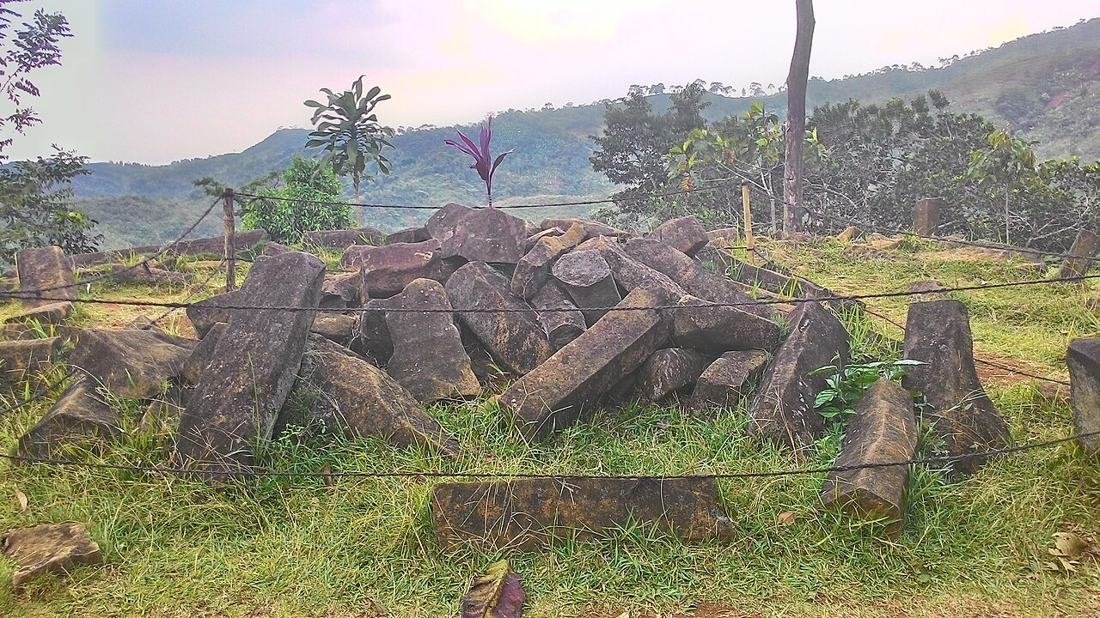
The site is a stepped series of five terraces, one rectangular and four roughly trapezoid-shaped, climbing the hilltop. Visitors reach them by a stairway of about 370 andesite steps that rises roughly 95 meters. The terraces are edged and littered with thousands of columnar andesite blocks. Each block is a natural six-sided column formed when lava cooled, usually between one and three meters long.
The people who arranged these stones left no writing on them. Archaeologists generally think local communities built the terraces as a ceremonial site sometime in the last two thousand years. Pottery fragments and radiocarbon results tied to the terraces point to use around the early centuries CE. The Indonesian government made it a national heritage site in 2014, protecting about 29 hectares.
Gunung Padang is famous worldwide because of a fight over its age. Since the 2010s, geologist Danny Hilman Natawidjaja and colleagues have argued that the hill hides a buried stepped structure tens of thousands of years old. A 2023 journal paper making that case was retracted in 2024. The dispute has made the site a favorite of lost-civilization and ancient-astronaut writers.
The ancient-alien case
In the eyes of lost-civilization writers, Gunung Padang may be the oldest pyramid on Earth. In the Ancient Aliens episode 'Hidden Pyramids', Andrew Collins and Robert Schoch present the site as evidence for an advanced culture from the end of the last Ice Age. The show links it to the legend of Mu, a lost Pacific continent.
Their argument rests on Natawidjaja's drilling and ground-scanning surveys. Supporters say these show layered, man-made structures deep inside the hill, including possible chambers or cavities. They say radiocarbon dates from the lower layers run back more than 20,000 years, long before farming began.
If true, theorists argue, standard history would be badly wrong. Someone would have been shaping hills with stone long before the first cities, perhaps a people wiped out when sea levels rose at the end of the Ice Age. Graham Hancock made the same case in the first episode of his 2022 Netflix series Ancient Apocalypse. Ancient Aliens goes a step further, asking whether such early builders had help from beyond Earth.
What archaeologists say
Most archaeologists see a natural volcanic hill with a megalithic terrace site built on its top. The hexagonal columns are ordinary columnar basalt-andesite that forms naturally when lava cools slowly. Outcrops like this occur on and near the hill, so builders only had to pry the columns loose and move them a short way.
The 2023 paper was retracted because its old radiocarbon dates came from soil deep in the hill with no artifacts, charcoal from fires or other signs of human work. Critics note that old soil does not show old construction. Natural processes can explain the layers the scans picked up. Artifacts from the terraces point to the early centuries CE.
Indonesian scholars remain divided, and national pride plays a part. Government support has swung between backing the dramatic claims and calling for careful study. The ministry's 2025 excavation collected new carbon samples from each terrace. Researchers say these should be dated only where they are tied to human activity.
Timeline
- Early centuries CE (mainstream view)Local communities arrange the andesite columns into ceremonial terraces on the hilltop.
- 1890-1891M. De Corte visits the site; Dutch historian Rogier Verbeek records it in an 1891 report.
- 1914Archaeologist N. J. Krom describes the terraces in a Dutch survey.
- 1979Local farmers draw attention to the site again, starting modern archaeological study.
- 2011-2014A government-backed team including geologist Danny Hilman Natawidjaja and archaeologist Ali Akbar drills and surveys the hill, claiming much older buried layers.
- 2014Indonesia declares Gunung Padang a national heritage site.
- October 2023Natawidjaja and colleagues publish a paper in Archaeological Prospection calling the hill a buried prehistoric pyramid.
- March 2024The publisher retracts the paper, saying the dated soil samples had no link to human-made artifacts.
- 2025Culture Minister Fadli Zon calls for new research; in October a ministry team led by Ali Akbar collects carbon samples and works to stabilize terraces 4 and 5 against landslides.
Still unanswered
- When exactly were the terraces built, and did building happen in one phase or several?
- Is there any human-made structure beneath the surface terraces, or only natural volcanic rock and soil?
- What will the carbon samples collected in 2025 show once full results are published?
- Who were the builders, and what ceremonies took place on the terraces?
Did you know?
- The six-sided stone columns form naturally when thick lava cools and cracks, the same process that made Ireland's Giant's Causeway.
- The 2023 'oldest pyramid' paper drew worldwide headlines before its retraction a few months later.
- Dutch colonial records described the site more than a century before it became famous online.
On Ancient Aliens
- S09E10 Hidden Pyramids Andrew Collins and Robert Schoch present Gunung Padang as possibly the world's oldest pyramid (History numbers this S07E15).
Episode numbers follow Wikipedia's episode list; History and some reviewers number a few seasons differently.
Visiting
Getting there. Cianjur Regency, West Java. Most visitors drive from Jakarta or Bandung, several hours by road, the last stretch on narrow country lanes.
What you can see. Visitors can climb the stairway and walk the terraces. Local guides are available at the entrance. Parts of the upper terraces may be fenced off for excavation or landslide repair, as work resumed in 2025.
Tip. Go early in the day in the dry season: the stone steps are steep and slick after rain, and afternoon clouds often hide the views.
Sources
- Gunung Padang - Wikipedia en.wikipedia.org
- Gunung Padang Paper Retraction: A Roundup - Southeast Asian Archaeology southeastasianarchaeology.com
- Minister urges renewed study into Gunung Padang - The Jakarta Post thejakartapost.com
- New Findings Unearthed at Gunung Padang - Indonesia Sentinel indonesiasentinel.com
- A new archaeological discovery in Gunung Padang (2014) - Yahoo News sg.news.yahoo.com
- Review of Ancient Aliens 'Hidden Pyramids' - Jason Colavito jasoncolavito.com
Research notes: what we could not confirm
- Lab results from the October 2025 carbon samples could not be found; they may not yet be published.
- The old entry's S21E01 'The Top Ten Extraordinary Discoveries' is wrong: Colavito's review lists its ten sites and Gunung Padang is not among them. No second Ancient Aliens episode on Gunung Padang could be confirmed.
- The claim of hidden chambers found by radar is a general fringe claim; it was not confirmed as said in the Ancient Aliens episode.
- Colavito's review calls the site medieval and mentions a statue inscribed 1341 CE; this conflicts with Wikipedia's early-centuries-CE dating and was not confirmed.
- The meaning of the name, its status as a local pilgrimage site, Hancock's Ancient Apocalypse coverage, and the Giant's Causeway comparison come from general knowledge, not pages opened this session.
- Travel times from Jakarta and Bandung are approximate.