What it is
Hampi is a village in the state of Karnataka, southern India, set among the ruins of Vijayanagara, the capital of one of India's great empires. The ruins spread over about 4,100 hectares on the banks of the Tungabhadra River. The landscape is strange and beautiful: rounded granite boulders stacked into hills, with temples, gateways, markets and water channels tucked between them. About 1,600 monuments survive.
The empire was founded in 1336 by two brothers, Harihara I and Bukka I of the Sangama dynasty. Over the next two centuries the capital grew rich on trade in cotton, spices and gems. By around 1500 it may have held about half a million people, making it one of the largest cities in the world. It reached its peak under King Krishnadevaraya, who ruled from 1509 to 1529.
The site is also far older than the empire. The Virupaksha temple has roots going back to around the 7th century and is still in daily worship. Hindu tradition links the area to Pampa, a local river goddess, and to Kishkindha, the monkey kingdom of the Ramayana. Edicts of the emperor Ashoka from the 3rd century BCE have been found in the wider region.
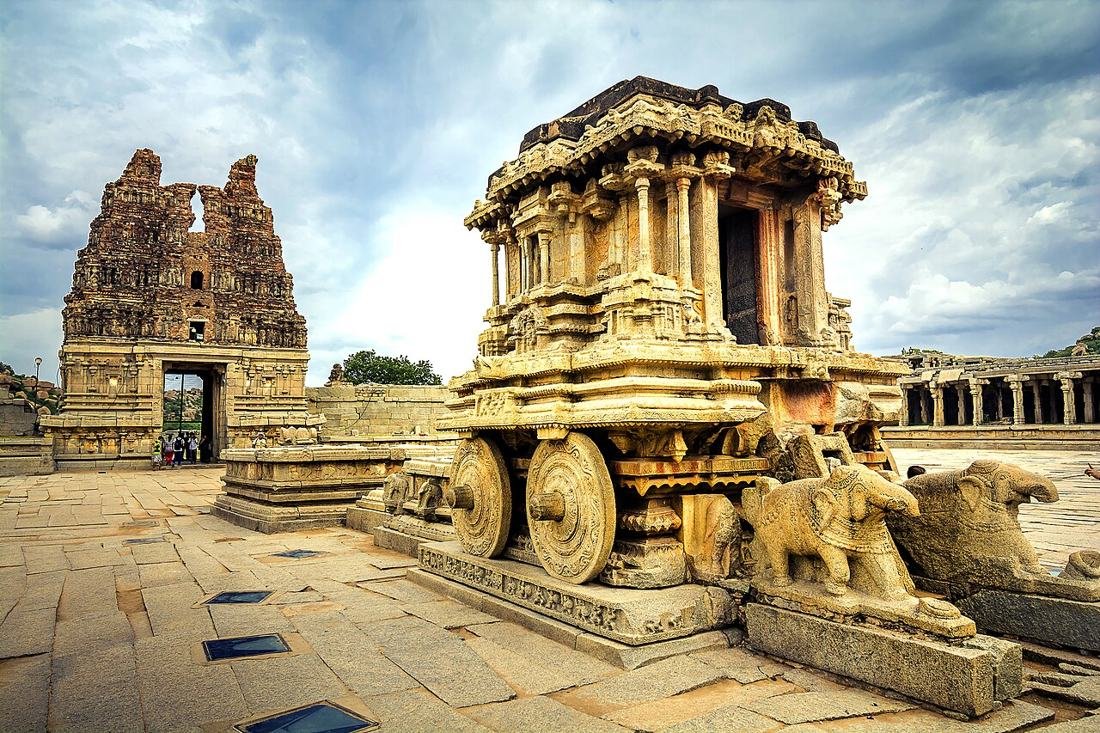
In 1565 a coalition of Deccan sultanates defeated Vijayanagara at the Battle of Talikota. The capital was looted and burned for about six months and then abandoned. Today its standout sights include the Vittala temple, with its stone chariot and its famous musical pillars, and the royal enclosure with its stepped tank and Lotus Mahal. Many other temples, bazaars and bathing tanks lie scattered across the boulder hills.
The ancient-alien case
Ancient Aliens came to Hampi in the 2011 episode Aliens and Ancient Engineers. David Childress argues there that the site is much older than its 14th-century founding. He points to Hindu legends that set events here in a distant age, including the Ramayana story of the monkey god Hanuman, and suggests the ruins may sit on something far more ancient.
The same episode ties Hampi to the vimanas, the flying palaces and chariots of Sanskrit epics. Childress and the show suggest that the area may once have served as a kind of spaceport for these craft. The idea draws on the wider claim, popular in ancient-astronaut writing, that the Vedic texts describe real flying machines.
Theorists also point to the temples' design. The episode presents Vastu Shastra, the traditional Indian science of architecture, as a system for tapping cosmic energy, and says the temples were laid out to follow it. In the 2017 episode The Alien Frequency, the show turns to the Vittala temple's musical pillars. It claims the slim stone columns were each tuned to a different note, and asks how builders could shape solid granite to ring so precisely unless they had outside knowledge of sound.
What archaeologists say
Historians say Hampi's building history is unusually well recorded. Inscriptions on the temples name kings, donors and dates. Portuguese travelers Domingo Paes and Fernão Nunes and the Persian envoy Abdur Razzaq described the city while it was alive. The visible temples and palaces fit the Vijayanagara style and period, and older phases, such as the early Virupaksha shrines, are dated and understood.
The musical pillars are real, but archaeologists say they reflect skilled stonework rather than lost technology. The granite here is dense and uniform. Slender columns cut from it will ring when struck, and their pitch depends on their thickness and length, which carvers could adjust by ear. Colavito notes that the episode never actually tests the claimed notes.
Scholars treat Vastu Shastra as a traditional set of design rules, not a working energy system; Indian rationalist groups call its energy claims pseudoscience. The vimanas of the epics belong to poetry and myth, and no physical trace of flying machines has ever been found at Hampi or anywhere else.
Timeline
- 3rd century BCEEdicts of the Mauryan emperor Ashoka show the region was part of his empire.
- c. 7th century CE onwardEarly shrines rise at the Virupaksha site; Chalukya and Hoysala rulers later build in the area.
- 1336Harihara I and Bukka I found the Vijayanagara Empire, with Hampi as its capital.
- 1509–1529Under Krishnadevaraya the city reaches its peak; Portuguese and Persian visitors describe its wealth.
- 1565The empire loses the Battle of Talikota; the capital is sacked for months and abandoned.
- 1800Colonel Colin Mackenzie surveys the ruins, starting modern study of the site.
- 1986UNESCO lists the Group of Monuments at Hampi as a World Heritage Site.
- 1999–2006Hampi sits on the List of World Heritage in Danger, largely over new bridges and building near the ruins.
- 2024Heavy rain brings down part of a pavilion at the Virupaksha temple, prompting a review of about 95 monuments.
- 2025A first-of-its-kind report ranks Hampi's monuments needing urgent repair over the next ten years.
Still unanswered
- How did the builders tune the Vittala temple pillars, and were the notes planned or a side effect of their shape?
- How large was Vijayanagara's population really at its peak?
- What lies beneath the imperial city from earlier periods of settlement?
- Can Hampi's crumbling monuments be protected from heavy monsoon rain and tourist pressure?
Did you know?
- Around 1500, Vijayanagara may have been the second-largest city in the world after Beijing.
- The stone chariot at the Vittala temple is actually a small shrine to Garuda, the eagle mount of Vishnu, built to look like a temple cart.
- Hampi's temples include Jain shrines and buildings in Indo-Islamic style, showing a mixed society in the imperial capital.
On Ancient Aliens
- S03E06 Aliens and Ancient Engineers David Childress argues Hampi is far older than its founding and suggests it was a spaceport for the vimanas of Hindu epics.
- S12E08 The Alien Frequency Presents the Vittala temple's slender stone pillars as tuned to different musical notes, as part of a theory of alien frequencies.
Episode numbers follow Wikipedia's episode list; History and some reviewers number a few seasons differently.
Visiting
Getting there. Hampi is in Karnataka's Vijayanagara district; the nearest city and rail hub is Hosapete (Hospet), a short drive away, and there is a small airport at Vidyanagar near Toranagallu.
What you can see. The ruins are open for walking, cycling and auto-rickshaw tours across a wide area; some sites, including the Vittala temple, need a ticket. The Virupaksha temple is an active place of worship, so dress modestly and remove shoes. The musical pillars are protected and visitors are not allowed to strike them.
Tip. Climb Matanga Hill or Hemakuta Hill at sunrise for the best view over the boulders and temples.
Sources
- Group of Monuments at Hampi – UNESCO World Heritage Centre whc.unesco.org
- Hampi – Wikipedia en.wikipedia.org
- Hampi monuments need urgent repairs: Report – Deccan Herald (April 2025) deccanherald.com
- Historic Monuments Restoration Ordered After Hampi Temple Mishap – Deccan Chronicle (May 2024) deccanchronicle.com
- Aliens and Ancient Engineers – Digging Up Ancient Aliens diggingupancientaliens.com
- Review of Ancient Aliens S12E08 'The Alien Frequency' – Jason Colavito jasoncolavito.com
- List of Ancient Aliens episodes – Wikipedia en.wikipedia.org
Research notes: what we could not confirm
- The old entry's S11E15 'Shiva the Destroyer' was not confirmed to cover Hampi and was dropped; S12E08 was added instead.
- S22E8 'Secrets of the Vedas' (June 2026) may touch on Indian sites, but Hampi coverage was not confirmed.
- The count of 56 musical pillars is a commonly cited figure (repeated in the S12E08 episode) and was not checked against the Archaeological Survey of India.
- The ban on striking the musical pillars, the Vidyanagar airport and the Matanga Hill tip rest on general travel knowledge, not a source opened here.
- Krishnadevaraya's reign is given as 1509–1529 in most histories; UNESCO gives 1509–1530.
- The 'Garuda shrine' description of the stone chariot comes from Wikipedia's summary.