What it is
This entry covers two Inca landmarks in Peru's Cusco Region that Ancient Aliens often treats together. Sacsayhuamán is a walled complex on a hill just above the city of Cusco, the old Inca capital, at about 3,700 m. Machu Picchu is a mountain-saddle estate about 80 km northwest of Cusco, at about 2,430 m, perched high above the Urubamba River where the Andes begin to fall away toward the Amazon.
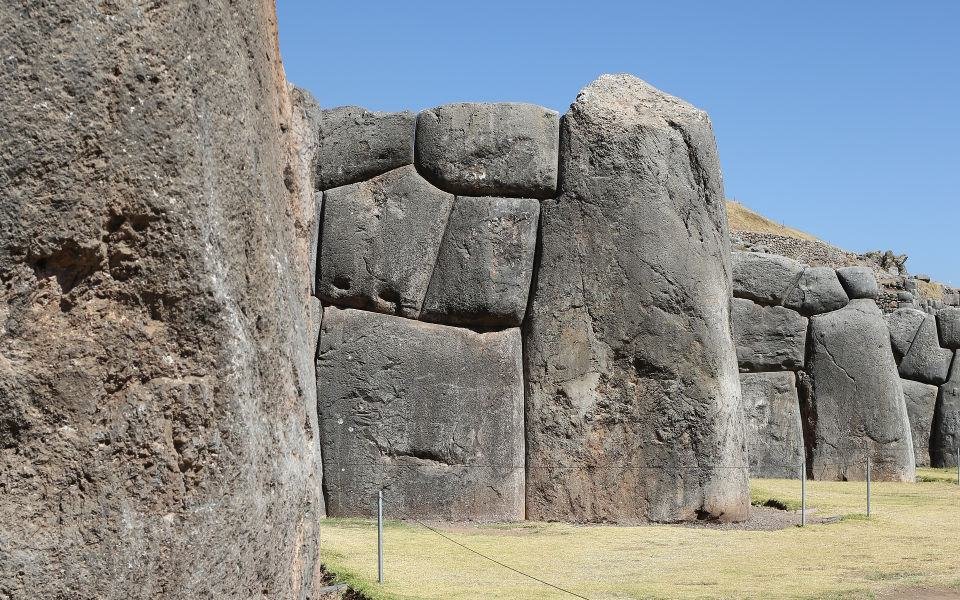
Inca oral history, written down by the Spanish, says Sacsayhuamán was begun under the ruler Pachacuti in the 1400s and continued by his successors. Its best-known feature is a set of three stacked terrace walls running roughly 400 m in a zigzag line. Some blocks are enormous, with estimates for the biggest ranging from about 128 to nearly 200 tonnes. The site also had towers and buildings, most of which the Spanish tore down for building stone.
Machu Picchu was a royal retreat, most likely built for Pachacuti's household. About 200 structures sit on terraces around a central plaza, including the Temple of the Sun, the Temple of the Three Windows and the carved Intihuatana stone. Its finest walls use cut blocks laid without mortar. Radiocarbon dates from human remains show people lived there from at least about 1420 until around 1530.
Both places matter because they show Inca engineering at its peak: huge polygonal walls that shrug off earthquakes, and a mountaintop estate with drainage, terracing and water channels that still work. Sacsayhuamán also saw one of the key battles of the Spanish conquest. For ancient-astronaut theorists, the tight joints of the stonework are among the most often cited clues of lost technology.
The ancient-alien case
Giorgio Tsoukalos has argued that Sacsayhuamán's giant blocks look as if they were shaped from molten rock, which would explain why their curved faces press together so tightly. To theorists, the joints are too perfect and the stones too big for people with bronze and stone tools. They point to rounded corners, blocks with a dozen or more angles, and walls where nothing thicker than paper fits between stones.
David Hatcher Childress and others on the show have suggested that visitors from overseas or from the sky gave early Peruvians a secret way to soften and shape stone. Writer and tour guide Brien Foerster, a frequent guest, argues more broadly that the finest megalithic masonry around Cusco is older than the Inca and was made by a lost earlier civilization; the Inca, he says, simply built on top of it.
At Machu Picchu, the show took up French explorer Thierry Jamin's 2012 ground-penetrating radar work, which he said showed a hidden chamber beneath one building. When Peruvian authorities did not allow a dig, the series framed the refusal as suspicious. William Henry went further, proposing that the sealed room might hold the remains and technology of Viracocha, the Andean creator god, whom he casts as an extraterrestrial who helped build the site.
Theorists also stress the setting. Machu Picchu sits on a ridge between two peaks with steep drops on every side, and they ask how its builders moved and placed stone there with such accuracy. Combined with Andean myths of gods who came from the sky and Lake Titicaca, they see a pattern of outside help that mainstream history, in their view, does not explain.
What archaeologists say
Archaeologists say both sites are Inca work of the 1400s, built on top of older local occupation in Sacsayhuamán's case. The quarries used for Cusco-area buildings, including Rumiqolqa and Kachiqhata, still hold partly worked blocks, drag roads and abandoned stones left on the way to building sites. Spanish writers such as Pedro Cieza de León described large labor forces for Sacsayhuamán; he wrote of about 20,000 workers split between quarrying, hauling and building.
Architect Jean-Pierre Protzen tested Inca methods by hand. He showed that river cobbles harder than the building stone can pound and dress blocks into shape, and that tight joints can be made by lowering a stone, marking where it touches its neighbor, lifting it and trimming, then repeating. No evidence of melted or poured rock has been found; the stones show the crystal structure of ordinary quarried limestone and andesite. The rounded, interlocking shapes and inward-leaning walls also help the walls ride out earthquakes.
At Machu Picchu, the 2021 radiocarbon study of 26 individuals refined the site's date without changing who built it. Jamin himself believed any hidden chamber was more likely a royal Inca tomb than anything exotic, and no such chamber has been excavated or confirmed. Some Sacsayhuamán foundations do predate the Inca, but that earlier Killke culture was also local and Andean.
Timeline
- c. 900-1200 CEKillke-period people occupy the Sacsayhuamán hill before the Inca empire rises.
- c. 1420Machu Picchu is already occupied, according to 2021 radiocarbon dating, about two decades earlier than Spanish-derived dates suggested.
- c. 1438Pachacuti takes power, according to Spanish chronicles, and launches the expansion of Cusco, including Sacsayhuamán.
- 1536During Manco Inca's siege of Spanish-held Cusco, fierce fighting takes place at Sacsayhuamán before the Spanish capture it.
- Later 1500sColonial builders dismantle much of Sacsayhuamán to supply stone for Spanish Cusco; the largest blocks are left because they are too big to move.
- 1911Yale lecturer Hiram Bingham visits Machu Picchu and brings it to international attention; Peruvian explorer Agustín Lizárraga had already reached it in 1902 and left his name on a wall.
- 1983UNESCO lists the Historic Sanctuary of Machu Picchu and the City of Cuzco, which includes Sacsayhuamán, as World Heritage Sites.
- 2021Yale's Richard Burger and colleagues publish AMS radiocarbon dates showing Machu Picchu was occupied from at least about 1420.
- Sept 2025A bus concession dispute and protests strand tourists, and the New7Wonders foundation warns Machu Picchu's standing is at risk over crowding and management.
- Sept 2026One visitor circuit route to the Inca Bridge is closed for about a week for emergency repair of a pre-Hispanic wall and an unstable path.
Still unanswered
- How the largest Sacsayhuamán blocks were moved uphill and fitted, and how long each one took.
- How much of Sacsayhuamán predates Pachacuti's rebuilding and what the Killke-period complex looked like.
- What Sacsayhuamán was mainly for: a fortress, a temple, a royal storehouse, or all three.
- Whether anything lies behind the anomaly Thierry Jamin reported under Machu Picchu, and whether Peru will ever allow a test.
- What the Inca actually called Machu Picchu; some researchers argue the original name was closer to Huayna Picchu.
Did you know?
- Machu Picchu is one of only a few dozen World Heritage Sites listed for both cultural and natural value.
- The largest Sacsayhuamán stones survived mainly because they were too heavy for Spanish builders to haul away for churches and houses.
- A 2021 radiocarbon study pushed Machu Picchu's start date back by roughly 20 years, showing that Spanish chronicles got the timing wrong.
On Ancient Aliens
- S08E02 Mysterious Structures Special-edition episode in which Tsoukalos claims Sacsayhuamán's blocks were shaped from molten rock.
- S11E04 The New Evidence Covers Thierry Jamin's radar survey at Machu Picchu, with William Henry linking a hidden chamber to Viracocha as an alien.
- S17E01 The Lost City of Peru Centers on Caral but also argues that Peru's megalithic stonework reflects outside help, with Childress, Henry and Tsoukalos.
- S22E06 Mysterious Monuments A 2026 clip show whose final segment revisits Sacsayhuamán using footage from a 2022 episode.
Episode numbers follow Wikipedia's episode list; History and some reviewers number a few seasons differently.
Visiting
Getting there. Cusco, Peru, reached by air from Lima. Sacsayhuamán is a steep walk or short taxi ride above the city center. Machu Picchu is reached by train from Cusco or Ollantaytambo to Aguas Calientes, then a shuttle bus or a hike up, or on foot via the Inca Trail with a licensed operator.
What you can see. Machu Picchu entry is by timed ticket on set circuits with a daily visitor cap, and routes can be closed at short notice for conservation. Huayna Picchu and the Inca Trail have their own separate limits. Sacsayhuamán is part of Cusco's tourist ticket system and hosts the Inti Raymi festival each June 24, when large crowds gather.
Tip. Book Machu Picchu entry and train seats well ahead in the dry season, buy only from official sellers, and check for strikes or route closures a few days before you go.
Sources
- Sacsayhuamán - Wikipedia en.wikipedia.org
- Machu Picchu - Wikipedia en.wikipedia.org
- Historic Sanctuary of Machu Picchu - UNESCO World Heritage Centre whc.unesco.org
- Radiocarbon dating reveals Machu Picchu is older than previously thought - Smithsonian Magazine smithsonianmag.com
- Jean-Pierre Protzen - Wikipedia en.wikipedia.org
- Machu Picchu risks losing World Wonder status as protests persist - UPI (2025) upi.com
- Machu Picchu route closure ran through 25 September 2026 - ad-hoc-news ad-hoc-news.de
- Review of Ancient Aliens S11E04 The New Evidence - Jason Colavito jasoncolavito.com
- Review of Ancient Aliens S17E01 The Lost City of Peru - Jason Colavito jasoncolavito.com
- Review of Ancient Aliens Special Edition Mysterious Structures - Jason Colavito jasoncolavito.com
Research notes: what we could not confirm
- Colavito labels 'Mysterious Structures' as S06E21 (special edition); Wikipedia and TVmaze list it as S08E02 (June 20, 2014). The molten-rock claim likely first aired in an earlier episode that was recycled here.
- The old entry credited the 'beings from overseas or from the sky' line to Childress and Foerster; Colavito's S17E01 review credits it to Childress and 'Newman', and places Foerster on video discussing Caral. Foerster's pre-Inca megalith view is his well-known general position, not confirmed as said in a specific episode.
- The old entry described S17E01 as about Machu Picchu; it is mainly about Caral (c. 2600-2000 BCE).
- The quarry names Rumiqolqa and Kachiqhata come from Protzen's fieldwork list; which quarry supplied which Sacsayhuamán blocks was not checked.
- The Sept 2026 route closure is reported by a single news site and was not confirmed with Peru's Ministry of Culture.
- The 1536 siege details (fighting at Sacsayhuamán, Spanish capture) are standard history but were not confirmed in a source opened for this entry.
- Other Sacsayhuamán and Machu Picchu episode hits in the old entry (S1E1, S3E13, S4E1, S4E2, S6E11, S16E6, S20E12, S20E19, S21E2, S22E1) were not re-verified.