What it is
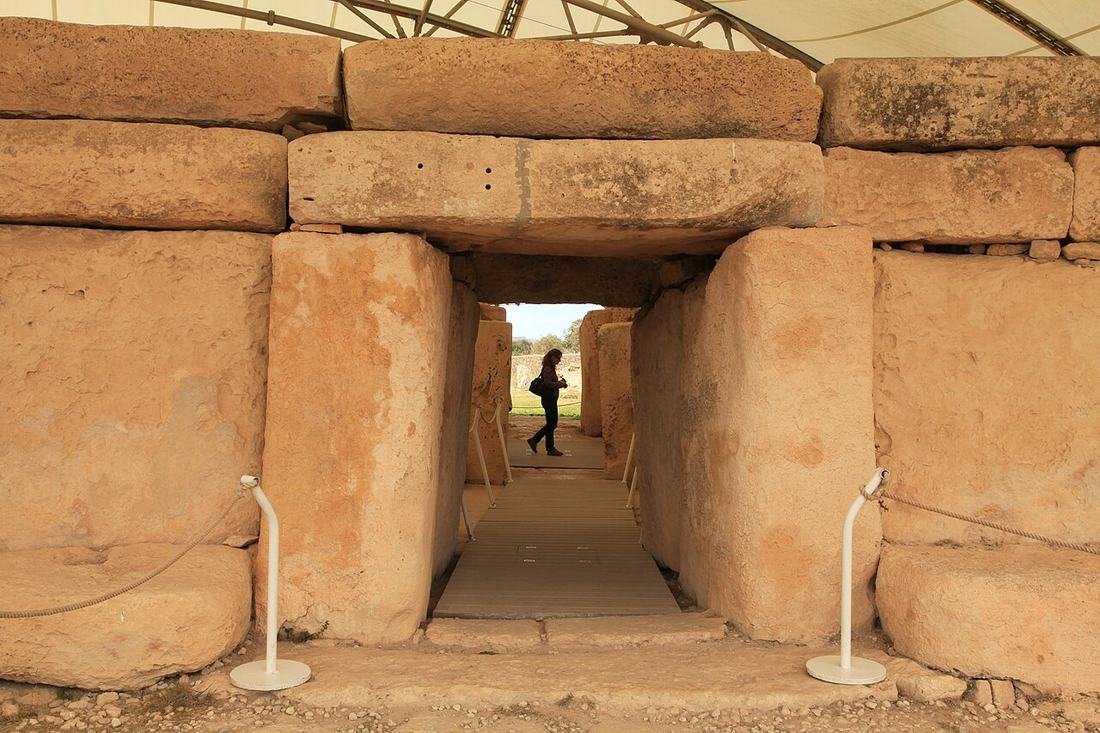
The Maltese islands hold some of the oldest free-standing stone buildings on Earth. Between about 3600 and 2500 BCE, farming communities on Malta and Gozo raised dozens of temples from huge limestone blocks. The best-preserved temple sites, including Ġgantija on Gozo and Ħaġar Qim, Mnajdra and Tarxien on Malta, share a single UNESCO World Heritage listing. Nearby, in the town of Paola, the Ħal Saflieni Hypogeum is a separate World Heritage Site: an underground complex cut into the rock.
The temples share a family plan. A concave facade opens onto a paved forecourt. Inside, a central passage leads through pairs of rounded chambers, often called apses, which give many plans a lobed, clover-like shape. Builders used tough coralline limestone for outer walls and softer globigerina limestone, which carves easily, for doorways, altars and decorated panels. Spirals, animal friezes and pitted patterns cover many surfaces.
Ġgantija, on the Xagħra plateau of Gozo, is among the oldest. Its two temples share one massive outer wall that still stands several meters high. Ħaġar Qim sits on a ridge above the sea, and Mnajdra lies about 500 meters downhill. At Mnajdra's southern temple, the rising sun shines straight through the doorway at the equinoxes and lights the edges of carved slabs at the solstices. Tarxien, near the Hypogeum, is the most richly decorated and held the lower half of a giant stone figure.
The Hypogeum was found by accident in 1902, when builders digging cisterns broke through its roof. It has three levels of chambers carved over many centuries and covers about 500 square meters. It served as both burial ground and shrine. The bones of thousands of people were found inside, along with the small clay figure called the Sleeping Lady, now one of Malta's national treasures. Visitor numbers are strictly limited to protect its fragile climate.
The ancient-alien case
Ancient-astronaut writers see Malta as a place built by giants, or by beings who were more than human. The Gozitan name Ġgantija comes from the Maltese word for giant, and local legend credits a giantess with raising the walls. On Ancient Aliens, Giorgio Tsoukalos has argued that the Mediterranean holds a striking cluster of giant stories and that so many tales must reflect something real. David Childress has said the heaviest blocks could not have been moved by ordinary people.
In The Giants of Malta, Childress went further and reread a well-known female statue from the temples. Where archaeologists see a fertility or ancestor figure, he suggested a hybrid giant with extraterrestrial roots. The episode also asked whether a people who, as Tsoukalos put it, had only just invented tools could have planned temples this complex. Its narration suggested a separate race may have done the work.
The Hypogeum draws two more lines of argument. The first is sound. Researcher Linda Eneix and others say the so-called Oracle Room resonates strongly near 110 Hz, a frequency they link to changes in brain activity, and The Alien Frequency placed Malta among sites supposedly tuned to the same note. The second is bones. Theorists point to long, narrow skulls found in the Hypogeum and suggest they came from beings who were not fully human, adding that most of them are no longer on public display.
Some voices argue the sites are far older than the textbooks say. Geologist Robert Schoch has suggested that some of Malta's famous cart ruts, grooves cut into bedrock that run into the sea, predate the last Ice Age sea-level rise. Graham Hancock, in his 2002 book Underworld, also explored the idea that parts of Malta's prehistory now lie under water.
What archaeologists say
Archaeologists say the temples were built by the descendants of farmers who came from Sicily, using stone, bone and wood tools. Stone balls found beside the Tarxien temples were probably used as rollers under the heavy slabs, and levers, ramps, ropes and large work crews could have done the rest. Radiocarbon dates from the Cambridge and Queen's University Belfast FRAGSUS project place the rise and fall of the temple culture across roughly 1,500 years. Its end came after centuries of soil erosion, a harsher climate and signs of malnutrition in the skeletons.
The giant story is not ancient evidence. The legend is a later folk explanation for huge ruins, and Victorian writers were already linking Malta's temples to giants long before modern alien theories. Large fossil bones once shown as giants' remains were identified as dwarf elephants and other extinct animals in the early 1800s. Heritage Malta says the Hypogeum skulls are no more elongated than modern skulls. Damp conditions distorted some bones, and where heads really were reshaped, binding in infancy is a well-documented human custom.
The acoustics are real but not mysterious. A careful study led by music technologist Rupert Till in 2014 measured the Oracle Room with test tones and found its strongest resonances near 41, 72 and 76 Hz, not 110 Hz. Long echoes in rock-cut rooms are normal. Researchers think the builders probably did value the sound for ritual, but nothing about it requires outside help.
Timeline
- c. 5900 BCEThe first farmers reach the Maltese islands from Sicily.
- c. 4000-2500 BCEThe Hypogeum is carved and used over many centuries as a burial place and sanctuary.
- c. 3600-3000 BCEĠgantija phase: the earliest temples, including Ġgantija on Gozo, are built.
- c. 3000-2500 BCETarxien phase: the temple culture reaches its peak in size and decoration.
- c. 2500-2350 BCEThe temple culture ends; researchers link its end to soil loss, climate stress and new arrivals.
- 1839J.G. Vance of the Royal Engineers makes the first formal excavation at Ħaġar Qim.
- 1902-1911The Hypogeum is discovered by builders; Manuel Magri and then Themistocles Zammit excavate it.
- 1915-1919Zammit excavates the Tarxien temples after a farmer reports large stones in his field.
- 1980 and 1992Ġgantija and the Hypogeum are listed by UNESCO in 1980; the temple listing is extended to five more temples in 1992.
- 2017The Hypogeum reopens after an upgrade to its climate-control and visitor systems.
Still unanswered
- Why did a thriving island culture that built temples for a thousand years vanish in what may have been a couple of generations?
- How many people were actually buried in the Hypogeum, given that much early material was thrown away without records?
- Were the large carved figures from the temples meant as goddesses, ancestors, or something else entirely?
- When and how were Malta's cart ruts cut, and why do some run straight into the sea?
- Did the temple builders deliberately design rooms for sound, or were the effects a lucky byproduct of the shapes they chose?
Did you know?
- Early excavators at the Hypogeum discarded much of what they dug up, so a great deal of evidence was lost within a few years of discovery.
- Tarxien's giant stone figure, when complete, is thought to have stood well over two meters tall, the largest human figure known from Neolithic Europe.
- Heritage Malta has publicly addressed the tale of a school class that vanished in the Hypogeum and found no record that it ever happened.
On Ancient Aliens
- S12E08 The Alien Frequency Features the Hypogeum as one of many sites said to resonate at the same special frequency.
- S16E04 Giants of the Mediterranean Uses Malta's temples and cart ruts as evidence for a race of giants moving huge stones.
- S19E10 The Giants of Malta A full episode on the temples, the Hypogeum, the skulls and the idea of giant hybrid builders.
- S22E04 Extraterrestrial Engineering A compilation episode that replays the Malta megalith segment.
Episode numbers follow Wikipedia's episode list; History and some reviewers number a few seasons differently.
Visiting
Getting there. Malta is reached by air through Malta International Airport near Luqa. Ħaġar Qim and Mnajdra are near Qrendi on Malta's south coast; Tarxien and the Hypogeum are in the Paola area near the Grand Harbour; Ġgantija is at Xagħra on Gozo, reached by ferry from Ċirkewwa.
What you can see. Heritage Malta manages the sites. Ħaġar Qim, Mnajdra, Tarxien and Ġgantija are open to walk through on paths and walkways, with visitor centers at Ħaġar Qim and Ġgantija. The Hypogeum takes only small guided groups each day and books up far ahead. Photography is not allowed inside the Hypogeum. The original statues and the Sleeping Lady are in the National Museum of Archaeology in Valletta.
Tip. Book the Hypogeum well before you travel, often weeks or months ahead, and pair it with Tarxien, a short walk away.
Sources
- Wikipedia: Megalithic Temples of Malta en.wikipedia.org
- Wikipedia: Ħal Saflieni Hypogeum en.wikipedia.org
- Wikipedia: Ħaġar Qim en.wikipedia.org
- Heritage Malta: Ġgantija Archaeological Park heritagemalta.mt
- Heritage Malta: Ħaġar Qim and Mnajdra Archaeological Park heritagemalta.mt
- Heritage Malta: Debunking Urban Legends, the Hypogeum Myths heritagemalta.mt
- Till, R. Archaeoacoustic study of the Ħal Saflieni Hypogeum (University of Huddersfield) eprints.hud.ac.uk
- Nautilus: Why a thriving civilization in Malta collapsed 4,000 years ago nautil.us
- MaltaToday: Hypogeum's elongated skulls to get cutting-edge study maltatoday.com.mt
- Jason Colavito: Review of Ancient Aliens S19E10 The Giants of Malta jasoncolavito.com
Research notes: what we could not confirm
- The 57-tonne figure for the largest stone at Ħaġar Qim comes from Wikipedia; other sources give about 20 tonnes for a 7-meter slab there, and the two may be different stones.
- The exact list of sites added in the 2015 extension of the UNESCO listing was not confirmed from UNESCO directly.
- The results of the 2019 Macquarie University skull study were not found published as of September 2026.
- S3E6 appears in the old entry via a fan wiki but was not re-verified, so it is left off the episode list.
- The 2017 date for the Hypogeum's reopening after upgrades comes from general sources and was not checked against Heritage Malta records.
- The arrival date of Malta's first farmers (about 5900 BCE) is a commonly cited figure and was not checked against a primary study.
- The estimated original height of the Tarxien giant figure was not confirmed from a museum source.