What it is
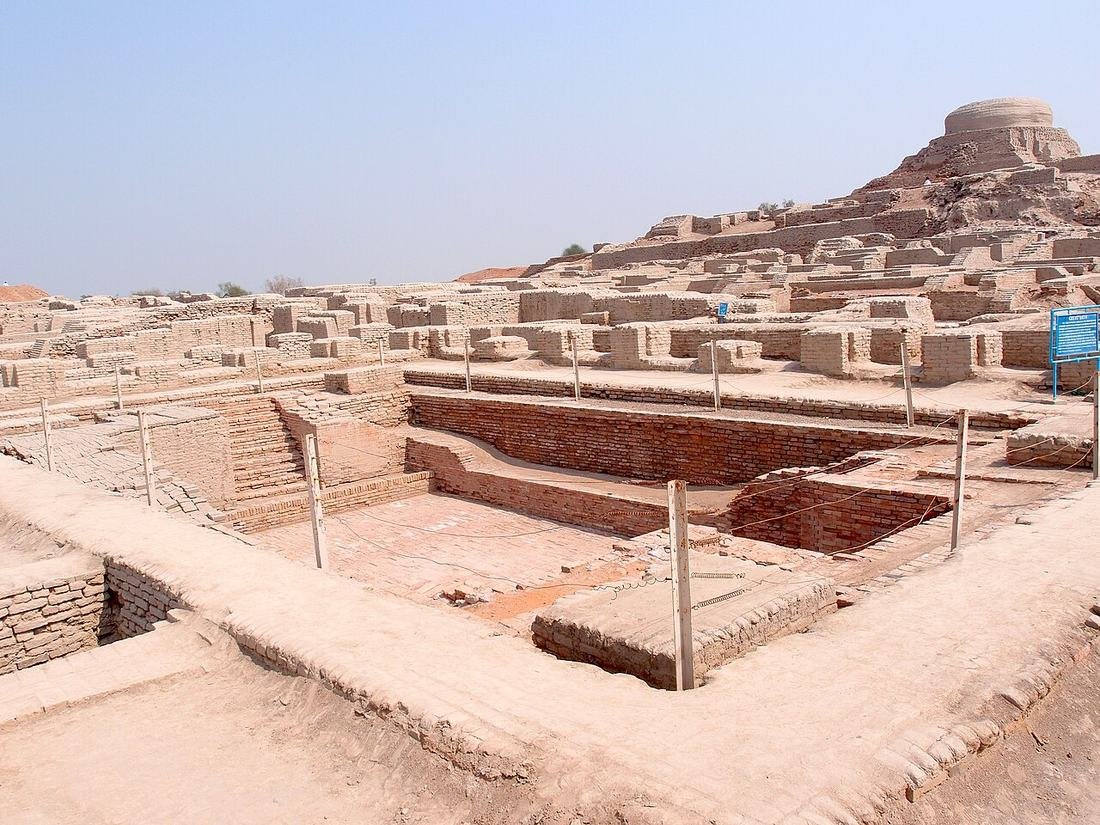
Mohenjo-daro is the ruin of one of the largest cities of the Indus Valley Civilization, in Larkana District of Sindh province, Pakistan, near the right bank of the Indus River. The name is usually translated as Mound of the Dead, a label given by locals long after the city was abandoned. The site covers roughly 240 to 300 hectares, and only about a third of it has ever been excavated.
The city was built by the people of the Indus, or Harappan, civilization, a Bronze Age culture that stretched across much of today's Pakistan and northwest India. Its peak is usually placed around 2600 to 1900 BCE. New radiocarbon dates published in 2026 show people were already living here, inside a mud-brick city wall, several centuries earlier, around 3300 to 2600 BCE.
Mohenjo-daro has two main parts. A raised western mound, often called the Citadel, holds the Great Bath, a large brick building long called a granary, and assembly halls. A much later Buddhist stupa stands on top. To the east lies the Lower Town, where straight streets cross at right angles and brick houses line covered drains. Hundreds of wells supplied water, roughly one for every few houses.
The city matters because it shows urban planning on a scale few Bronze Age places matched: standardized bricks, public water works and sanitation that rivals far later cities. Its seals carry a script that is still undeciphered. Famous finds include the small bronze Dancing Girl and the stone bust known as the Priest-King. Fringe writers also made it the center of a story about an ancient nuclear war.
The ancient-alien case
Ancient Aliens has repeatedly presented Mohenjo-daro as the scene of an ancient atomic blast. David Hatcher Childress has told viewers that excavators found large numbers of people lying dead in the streets, as if struck down in an instant, and that the skeletons were radioactive. William Henry has described bodies found arm in arm where they supposedly fell.
Theorists add that parts of the city were vitrified, meaning heat fused material into glass, a sign they read as an explosion hotter than any ordinary fire. They see the site's apparently sudden end, and the early archaeologists' talk of a violent finish, as fitting that picture.
The textual link is the Mahabharata, the great Sanskrit epic. Theorists read its descriptions of divine weapons, blinding light and warriors whose hair and nails fall out as eyewitness accounts of nuclear war and radiation sickness. In their view, the gods of Indian myth were technologically advanced beings, and Mohenjo-daro is the physical scar left by their wars.
The theme is a staple of the series, turning up in episodes about ancient nuclear knowledge and ancient wars of the gods. Proponents also cite earlier writers such as Charles Berlitz, who helped popularize the atomic-war story in the West in the 1970s.
What archaeologists say
Archaeologists say the evidence points the other way. Only about 37 skeletons have been recovered in a century of digging, not thousands. They come from different time periods, and George Dales showed in the 1960s that they were not victims of one event. The city's brick buildings stand unburned and uncracked, which is hard to square with a blast. The vitrified material is pottery waste and kiln debris from a dumping area.
The radioactivity story has been traced by researcher Jason Colavito to a chain of misreadings. A 1960 British study measured normal radiation in an Egyptian bone. Soviet scientists cited it in 1962 with an inflated figure and a nearby mention of Indian monazite sands; Soviet author Alexander Gorbovsky then turned the bone into an Indian skeleton, and later Western writers moved it to Mohenjo-daro. No published measurement of a radioactive Mohenjo-daro skeleton exists.
The Mahabharata was composed and compiled many centuries after Mohenjo-daro was abandoned, and scholars read its weapons as poetic and religious imagery. The city's decline is linked to shifting rivers, changing monsoons, flooding and the breakdown of trade, and it happened over generations. The 2025-26 excavations add a different kind of surprise: the city is centuries older than thought.
Timeline
- c. 3300-2600 BCEEarly (Kot Diji phase) settlement on the site, according to radiocarbon dates published in 2026.
- c. 2700-2600 BCEA mud-brick perimeter wall is built along the western edge of the mound.
- c. 2600-1900 BCEMature Harappan period: the planned city of fired brick, drains and the Great Bath flourishes.
- c. 1900-1700 BCEThe city declines and is gradually abandoned as the wider Indus civilization breaks into smaller regional cultures.
- 1922R. D. Banerji of the Archaeological Survey of India identifies the site's ancient remains; major digs under John Marshall and others follow through the 1920s and 1930s.
- 1950Mortimer Wheeler excavates on the Citadel and promotes the idea of a violent end, which later work does not support.
- 1960sAmerican archaeologist George F. Dales excavates and shows the scattered skeletons are not victims of a single massacre; the 1965 war interrupts foreign work. The same decade, Soviet writer Alexander Gorbovsky publishes a radioactive-skeleton claim that fringe authors later tie to Mohenjo-daro.
- 1980UNESCO lists the Archaeological Ruins at Moenjodaro as a World Heritage Site.
- 2025New excavations resume after a long gap, including joint Pakistani-American work that reopens deep trenches below the water table.
- 2026A Pakistani-American team including Asma Ibrahim and Jonathan Mark Kenoyer reports that the western wall is an early city wall, not a flood bund, and that occupation reaches back to about 3300 BCE.
Still unanswered
- What the Indus script says, since it has never been deciphered.
- What the Great Bath was used for, with ritual bathing the leading idea.
- Why the Indus cities declined and how quickly, and how much climate change and river shifts drove it.
- How the city was governed, since no clear palaces, royal tombs or temples have been identified.
- How much more of the earliest city lies below the water table, where excavation is hardest.
Did you know?
- Mohenjo-daro was among the first places in South Asia added to the World Heritage List, in 1980.
- Rising groundwater and salt crystals are slowly eating the ancient bricks, which is why the site's managers have long favored conservation over new digging.
- The earliest levels of the city now sit below the water table, so the 2025-26 team had to dig through waterlogged ground to reach them.
On Ancient Aliens
- S14E14 The Nuclear Agenda Childress claims crowds were found dead in the streets and the skeletons were radioactive, and the show calls the city vitrified by a nuclear blast.
- S09E12 The Alien Agenda William Henry describes bodies found arm in arm where they fell in a nuclear blast (Colavito numbers this episode S07E17; it aired in 2015).
Episode numbers follow Wikipedia's episode list; History and some reviewers number a few seasons differently.
Visiting
Getting there. Near the town of Larkana in Sindh, Pakistan, about 28 km from Larkana; Moenjodaro Airport lies close by, and many visitors come by road from Larkana or Sukkur.
What you can see. Visitors can walk the Citadel mound with the Great Bath and stupa, and the streets of the Lower Town. An on-site museum shows seals, pottery and replicas; the most famous originals are in museums in Karachi and New Delhi. Walking on fragile walls is discouraged because salt and moisture damage the brick.
Tip. Go in the cooler months between November and February, since summer heat on the Sindh plain is extreme; check current travel advisories before planning.
Sources
- Mohenjo-daro - Wikipedia en.wikipedia.org
- Archaeological Ruins at Moenjodaro - UNESCO World Heritage Centre whc.unesco.org
- Fresh studies trace Mohenjo Daro's urban roots to 3300 BC - Dawn (March 2026) dawn.com
- Preservation over excavation leaves Mohenjo Daro questions unanswered - Dawn (July 2026) dawn.com
- Excavation resumes at Mohenjo Daro after 18 years - The Nation (May 2025) nation.com.pk
- The Radioactive Skeleton of Mohenjo-daro - Jason Colavito jasoncolavito.com
- Review of Ancient Aliens S14E14 The Nuclear Agenda - Jason Colavito jasoncolavito.com
- Review of Ancient Aliens S07E17 The Alien Agenda - Jason Colavito jasoncolavito.com
- Ancient Aliens S14E14 The Nuclear Agenda - TVmaze api.tvmaze.com
Research notes: what we could not confirm
- The old entry listed 'The Science Wars' (S12E06) based on a History YouTube clip titled 'Ancient Atomic Blasts (Season 12, Episode 6)'; the clip could not be opened to confirm it covers Mohenjo-daro, so it is left out.
- Old-entry hits S1E4, S3E10, S3E13 and S22E9 were not re-verified.
- 'The Alien Agenda' has inconsistent numbering across sources (Colavito S07E17; other guides list it as 7.12, aired 2015), so no episode ID is given.
- The TVmaze synopsis of S14E14 focuses on UFOs at nuclear sites; the Mohenjo-daro segment is confirmed only through Colavito's review.
- Sources differ on the abandonment date (Wikipedia about 1700 BCE, UNESCO up to 1500 BCE); this entry gives a range.
- The Charles Berlitz link rests on Colavito's article; Berlitz's 1972 book was not opened directly.
- The 28 km distance and airport access are from general references and were not checked with Pakistani tourism authorities.