What it is
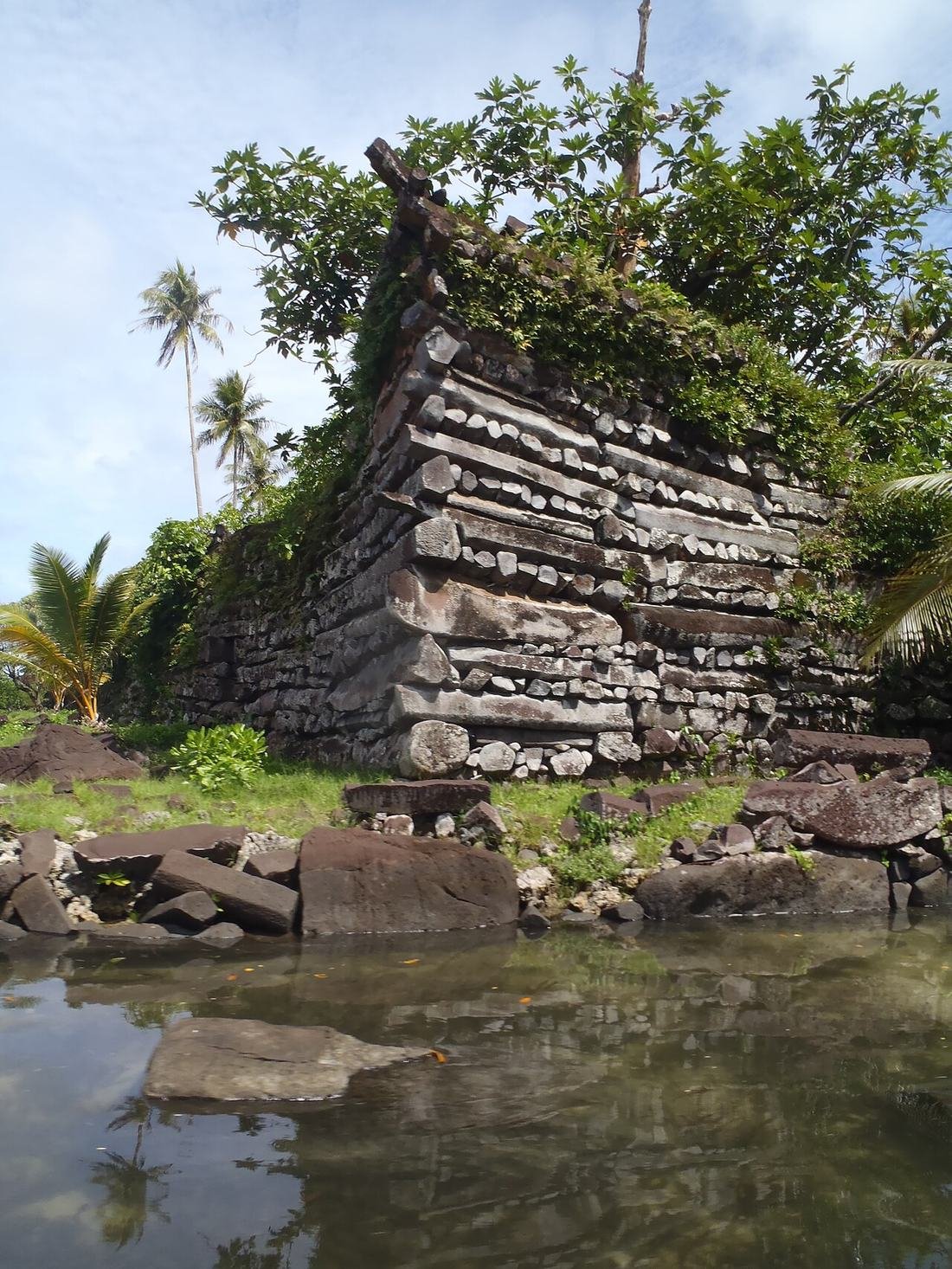
Nan Madol sits in a shallow lagoon off Temwen Island, on the southeast coast of Pohnpei in the Federated States of Micronesia. The core of the site covers about 1.5 by 0.5 kilometers and holds 92 artificial islets built on the reef flat. Narrow channels run between them, which is why the ruins are often nicknamed the Venice of the Pacific. It is the only surviving ancient city known to be built on top of a coral reef.
Each islet is a platform of coral rubble held in by retaining walls of long, six- or eight-sided basalt columns. Builders stacked the columns in alternating header and stretcher courses, like a log cabin, with no mortar. The most famous enclosure, Nandauwas, is a royal mortuary with outer walls about 5.5 to 7.5 meters high. Estimates put the total stone moved at around 750,000 tonnes, with single pieces reaching several dozen tonnes.
Archaeologists credit the site to the Saudeleur dynasty, the first rulers to unite all of Pohnpei under one chief. Nan Madol served as their political and religious center. The islets are split into two halves: Madol Powe, the mortuary and priestly sector, and Madol Pah, where rulers lived and held ceremonies. Only a few hundred to perhaps a thousand people ever lived there, and all food and fresh water came in by canoe.
The Saudeleur rule ended around 1628, when, according to Pohnpeian history, the warrior Isokelekel overthrew the last Saudeleur. Today the ruins are overgrown and silting up. UNESCO listed the site in 2016 and put it straight onto its List of World Heritage in Danger, a status it still holds, because mangroves and silt in the channels are undermining the walls.
The ancient-alien case
Theorists argue that the scale of the work does not fit the setting. Hundreds of thousands of tonnes of basalt were cut, shipped and stacked on a reef by a small island population with no metal tools, pulleys or draft animals. On Ancient Aliens, Giorgio Tsoukalos and David Childress have said the site is thousands of years older than archaeologists allow, and Childress has questioned whether Pacific Islanders could have built it at all.
The show leans heavily on Pohnpeian legend. In the story, two sorcerer brothers, Olisihpa and Olosohpa, came from overseas and raised the city by magic, with a flying dragon helping lift the stones. Theorists read this as a memory of foreign visitors using sound or anti-gravity to float the columns, and they recast tales of stones carried by birds as descriptions of aircraft.
The 2020 episode went further. It claimed a second, sunken Nan Madol lies offshore and dates to around 12,500 BCE, and it suggested the site was a naval base and airport on a route linking Asia, Mexico and Peru. The basalt was described as magnetized, which the program linked to an anti-gravity scheme. Tsoukalos also argued that the angled walls and doorways needed advanced mathematics to design.
What archaeologists say
Archaeologists say the dating is clear. In 2016 Mark McCoy of Southern Methodist University and colleagues dated coral used in the Nandauwas tomb with uranium-thorium methods, which are precise to within years. The results put construction at about 1180 to 1200 CE, making it the earliest firm evidence of a paramount chief in the Pacific. Radiocarbon dates show people were in the area a thousand years earlier, but nothing supports a city from the Ice Age, and the claimed underwater ruins are natural rock.
The same team used portable X-ray fluorescence to match the basalt columns chemically to outcrops on Pohnpei itself. Columnar basalt splits naturally into long prisms, so it needed little shaping. Most researchers think crews moved the columns by raft at high tide and levered them up ramps, possibly with vines or ropes. Basalt is naturally a little magnetic because it contains magnetite, so a compass twitch near the walls is expected.
Anthropologists see the site as the work of the Saudeleur state, which could draw labor and tribute from the whole island. The founding legend of two brothers who arrive from overseas mirrors how many Pacific peoples explain the origin of a ruling line. Critics such as Jason Colavito point out that denying Pohnpeians credit for their own city echoes older colonial attitudes.
Timeline
- c. 80–200 CERadiocarbon dates show people were already using the reef area near Temwen Island.
- c. 1180–1200 CECoral dating shows the Nandauwas royal tomb was being built, the earliest firm date for the megalithic city.
- c. 1200–1600sThe Saudeleur dynasty rules all of Pohnpei from Nan Madol, adding islets over several centuries.
- c. 1628Isokelekel defeats the last Saudeleur and a new system of chiefs, the Nahnmwarki, takes over; the city is gradually abandoned.
- 1907German colonial governor Victor Berg dies after visiting the ruins, sparking a local curse story; the recorded cause was sunstroke and exhaustion.
- 1974–1985Nan Madol is added to the US National Register of Historic Places (1974) and made a National Historic Landmark District (1985), when Pohnpei was under US administration.
- 2016A team led by Mark McCoy publishes uranium-thorium dates and basalt sourcing results; UNESCO inscribes the site and places it on the In Danger list.
- 2020Ancient Aliens devotes an episode, 'The Mystery of Nan Madol', to the site.
- 2026Nan Madol reappears in the Ancient Aliens clip episode 'Extraterrestrial Engineering'; UNESCO continues to monitor it as a site in danger.
Still unanswered
- Exactly which Pohnpei outcrops supplied each part of the city, and how far the columns traveled, is still being mapped.
- Researchers still debate the precise transport method, whether rafts, ramps, ropes or a mix, since no direct evidence of the technique survives.
- How the site will survive rising seas, silt and mangrove growth is an open conservation question.
- How many workers were needed, and over how many generations the islets were added, is not settled.
Did you know?
- Fewer than a thousand people probably lived at Nan Madol at its height, and every drop of fresh water had to be brought in by canoe.
- The uranium-thorium dates from 2016 pushed the start of the megalithic building back by more than a century, from about 1300 to about 1180 CE.
- When Smithsonian magazine profiled the site, Pohnpei had just one archaeologist, Rufino Mauricio, who wrote his doctorate on Nan Madol.
On Ancient Aliens
- S15E01 The Mystery of Nan Madol Claims the site is far older than archaeologists say, reads the sorcerer-brothers legend as sound-wave levitation, and adds a sunken 12,500 BCE city.
- S22E04 Extraterrestrial Engineering A 2026 clip episode hosted by Giorgio Tsoukalos that revisits Nan Madol alongside Puma Punku and Malta as possible alien engineering.
Episode numbers follow Wikipedia's episode list; History and some reviewers number a few seasons differently.
Visiting
Getting there. Pohnpei, Federated States of Micronesia. Fly into Pohnpei's airport near the capital area of Kolonia, then drive to the Madolenihmw area on the southeast coast; the ruins sit off Temwen Island.
What you can see. The ruins are on land under traditional ownership, and access is managed by local landowners and representatives of the Nahnmwarki, the paramount chief; expect a small landowner fee. You can reach the main Nandauwas enclosure by a short walk and wade, or explore more islets by boat at high tide through local tour operators. Much of the site is overgrown, and walls are fragile, so do not climb them.
Tip. Time your trip around the tide: high water lets a boat slip into the canals, while lower water makes wading to Nandauwas easier.
Sources
- UNESCO World Heritage Centre: Nan Madol, Ceremonial Centre of Eastern Micronesia whc.unesco.org
- Wikipedia: Nan Madol en.wikipedia.org
- McCoy et al. 2016, Quaternary Research: Earliest direct evidence of monument building at Nan Madol cambridge.org
- ScienceDaily: Age of first chief's ancient tomb reveals Pacific Islanders invented new kind of society sciencedaily.com
- Smithsonian Magazine: Nan Madol, the City Built on Coral Reefs smithsonianmag.com
- US National Park Service: Nan Madol nps.gov
- Jason Colavito: Review of Ancient Aliens S15E01 'The Mystery of Nan Madol' jasoncolavito.com
- Jason Colavito: Capsule review of Ancient Aliens S22E04 'Extraterrestrial Engineering' jasoncolavito.com
- Apple TV: Ancient Aliens S22E04 'Extraterrestrial Engineering' tv.apple.com
Research notes: what we could not confirm
- The Ancient Aliens claims are taken from Jason Colavito's episode review, not from a transcript, so the exact on-screen wording and speaker for each claim may differ.
- S6E09 'Aliens and Forbidden Islands' mentions megalithic ruins in the middle of the ocean, but its synopsis does not name Nan Madol, so it is not listed.
- Other possible episodes (S16E6, S19E13 'The Top Ten Mysterious Islands', S22E3) were not confirmed.
- The raft-and-ramp transport method is the leading explanation, but it rests on reconstruction and local tradition rather than direct evidence.
- Details of landowner fees and walking versus boat access change over time and were drawn from general visitor reports, not an official current source.
- Stone weight estimates vary: Smithsonian cites 50–60 tons for the heaviest cornerstone, while the US National Park Service says up to 100,000 pounds.