What it is
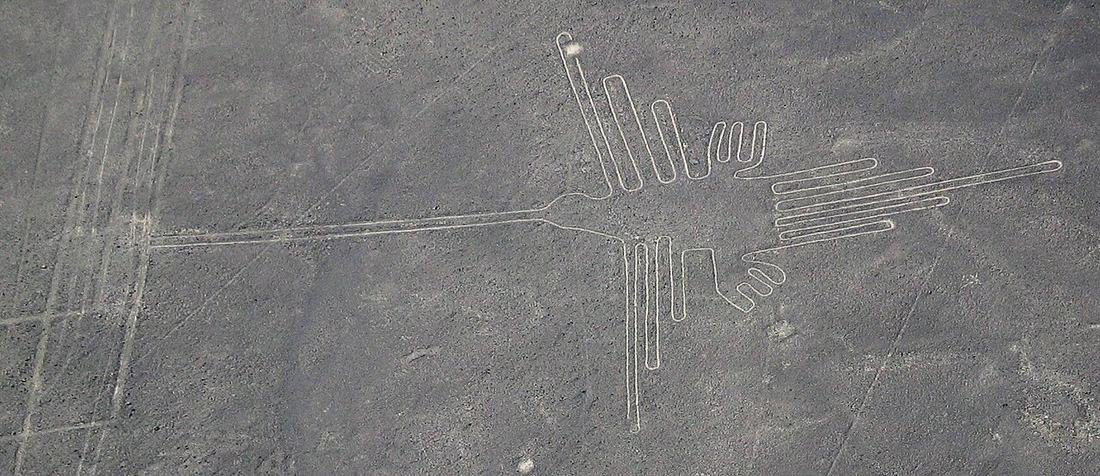
The Nazca Lines are a vast set of ground drawings, or geoglyphs, spread across the dry plains between the towns of Nazca and Palpa in southern Peru, roughly 400 km south of Lima. They include ruler-straight lines that run for kilometers, huge trapezoids and triangles, spirals, and around seventy animal and plant figures. The best known are the hummingbird, the monkey with its coiled tail, the spider, and the condor. The whole protected area covers more than 750 square kilometers.
Archaeologists credit the drawings to two peoples who lived along the river valleys here. The Paracas culture made the earliest figures, mostly on hillsides, starting around 500 BCE. The Nazca culture that followed carried the tradition onto the flat pampa and kept at it until about 500 CE. That means the drawings were made and remade over something like a thousand years, not in one burst.
The method was simple. The desert surface is covered in reddish-brown stones darkened by iron oxide. Workers raked these stones aside to expose the pale, yellowish ground underneath, then piled the stones along the edges. Most lines are only 10 to 15 cm deep. They have lasted because this is one of the driest places on Earth, with little rain and little wind at ground level.
The lines matter because of their sheer scale and because the question of purpose has never been closed. They have been read as star calendars, sacred walkways, water rituals, and messages to the gods. They are also where the modern ancient-astronaut idea found its most famous image. Since 2019, AI-assisted surveys have nearly doubled the count of known figures, so the story is still being written.
The ancient-alien case
The modern alien reading of Nazca starts with Erich von Däniken. In his 1968 bestseller he argued that the long straight lines and wide trapezoids look like the runways of an airfield. His point was that people on the ground had no reason to make pictures they could never see whole. Ancient Aliens opened its 2009 pilot with this idea and has returned to it many times.
Giorgio Tsoukalos has shaped the argument into its best-known form. He says the figures only make sense when viewed from high above, so they must have been meant for someone in the sky. He does not push the runway idea hard, since he admits the soft ground would not hold a heavy craft. Instead he suggests the lines worked as guides or signals for visitors flying over the plateau, and that the local people drew them to call those visitors back.
Other theorists add their own layers. On the episode Beyond Nazca, Jason Martell proposed that the region was an alien mining outpost for nitrates and other minerals. David Childress suggested Nazca was a stop on an ancient air route that linked it with Tiwanaku in Bolivia. Mike Bara tied the spider figure to the stars of Orion. Some also point to a hillside figure nicknamed the Astronaut, with its round head and raised hand.
More recent episodes widen the frame. The Desert Codes compares Nazca with geoglyphs in Kazakhstan, Chile and elsewhere, asking why different cultures all made art that reads best from the air. Theorists argue that the worldwide pattern hints at a shared source of knowledge. They also note that the new AI discoveries show how much of the desert was still hidden, and they ask what else is out there.
What archaeologists say
Archaeologists say the lines are well understood as human work. Wooden stakes found at the ends of some lines have been radiocarbon dated, and pottery styles match the Nazca culture. In 1982 investigator Joe Nickell and a small team copied a large figure at full size using only wooden stakes, string and a simple scaled grid. Figures can also be seen from the foothills around the pampa, so no flight was needed to lay them out or to judge them.
Most researchers now see the lines as ritual spaces. In 1985 Johan Reinhard linked them to worship of mountains and water, which was the key to survival in this desert. Many straight lines point toward water sources or were walked as sacred paths. Earlier, Paul Kosok and Maria Reiche argued that some lines tracked the rising and setting points of the sun and stars, though later studies found only a few true alignments.
The AI surveys led by Masato Sakai have sharpened the picture. The 2024 study found that the new small relief figures sit beside footpaths and often show people and domestic animals, so they seem meant for travelers on foot. The giant line figures cluster near the ritual routes and look like places for group ceremonies. On this view the lines are a kind of shared map of belief, drawn over many generations.
Timeline
- c. 500–200 BCEParacas people make the earliest geoglyphs, many of them human-like figures on hillsides near Palpa.
- c. 200 BCE–500 CEThe Nazca culture builds the famous animal figures, long lines and trapezoids on the open pampa.
- 1553Spanish chronicler Pedro Cieza de León mentions markings in the desert, the first written reference.
- 1927Peruvian archaeologist Toribio Mejía Xesspe notices the lines while hiking and later presents them at a 1939 conference in Lima.
- 1940s–1990sPaul Kosok studies the lines as a possible calendar; German mathematician Maria Reiche spends decades mapping and guarding them.
- 1968Erich von Däniken's Chariots of the Gods? popularizes the idea that the lines were landing strips.
- 1994UNESCO lists the Lines and Geoglyphs of Nasca and Palpa as a World Heritage Site.
- 2014Greenpeace activists damage the ground beside the hummingbird while laying out a banner; Peru prosecutes.
- 2019–2025Yamagata University and IBM use machine learning to find new figures: 143 announced in 2019, 303 in a 2024 PNAS paper, and 248 more in August 2025.
- 2025–2026Peru briefly moves to shrink the protected zone in mid-2025, then reverses after public protest; in August 2026 a sightseeing plane crash near the lines kills 13 people.
Still unanswered
- Why did the Nazca keep making figures so large that no one on the ground could take them in at a glance?
- How many geoglyphs are still undiscovered, given that AI surveys nearly doubled the known figures in a few years?
- Did the straight lines and trapezoids serve a different purpose from the animal figures, or were they part of one ritual system?
- How much of the astronomical theory survives, now that only a handful of lines show clear alignments?
- Can the lines be protected from mining, squatting, vehicles and floods as pressure on the desert grows?
Did you know?
- Maria Reiche swept the lines by hand for years and used her own money to pay guards to keep people off them.
- The first person to report the lines in modern times noticed them on foot, not from the air.
- One of the figures found by AI shows an orca holding a knife, a sea creature drawn far out in the desert.
On Ancient Aliens
- Chariots, Gods & Beyond (2009 pilot) The 2009 pilot presents von Däniken's view and names the Nazca Lines among the core evidence for ancient visitors.
- S05E08 Beyond Nazca Covers the runway idea, Tsoukalos's suggestion that an alien rover or probe scratched lines across the plateau, Martell's mining outpost and Childress's air-route link to Tiwanaku.
- S13E05 The Desert Codes Compares Nazca with geoglyphs worldwide and covers newly found Paracas figures, with Tsoukalos arguing they were made to contact someone above.
Episode numbers follow Wikipedia's episode list; History and some reviewers number a few seasons differently.
Visiting
Getting there. The town of Nazca, in Peru's Ica region, is about 400 km south of Lima along the Pan-American Highway; most people come by long-distance bus or on a tour from Lima, Ica or Paracas.
What you can see. Walking on the pampa is forbidden. Visitors see the figures on small-plane overflights from Nazca, Ica or Pisco, or from a roadside viewing tower on the Pan-American Highway that looks down on a few figures; there are also viewpoints over the Palpa geoglyphs. The Maria Reiche house museum sits nearby.
Tip. If you take a flight, check the operator's safety record first and skip a heavy meal beforehand, since the tight banking turns upset many stomachs.
Sources
- Lines and Geoglyphs of Nasca and Palpa – UNESCO World Heritage Centre whc.unesco.org
- Nazca Lines – Wikipedia en.wikipedia.org
- How hundreds of mysterious Nasca lines have been uncovered, with the help of AI – National Geographic nationalgeographic.com
- More than 200 geoglyphs discovered in Nazca Desert with help of AI – The Art Newspaper (Aug 2025) theartnewspaper.com
- Police say 13 killed as small plane viewing Nazca Lines in Peru crashes – Al Jazeera (Aug 2026) aljazeera.com
- Review of Ancient Aliens S05E08 'Beyond Nazca' – Jason Colavito jasoncolavito.com
- Review of Ancient Aliens S13E05 'The Desert Codes' – Jason Colavito jasoncolavito.com
- Ancient Aliens: Chariots, Gods & Beyond (pilot) – TVmaze tvmaze.com
- List of Ancient Aliens episodes – Wikipedia en.wikipedia.org
Research notes: what we could not confirm
- The pilot aired March 8, 2009 as a stand-alone special, so it has no standard season/episode code.
- The old entry's episodes S3E8, S11E4, S13E14, S17E1 (The Lost City of Peru), S20E5 and S22E12 were not confirmed to discuss Nazca and are left out.
- The PNAS paper itself could not be opened (403); its figures come from National Geographic and Wikipedia summaries.
- Whether Peru suspended Nazca sightseeing flights after the August 2026 crash was not confirmed.
- The 'Astronaut' hillside figure is mentioned from general knowledge of the theory; no source opened here ties it to a specific episode.
- The Nickell reconstruction year (1982) is from general knowledge; Wikipedia confirms the reconstruction but the year was not checked.