What it is
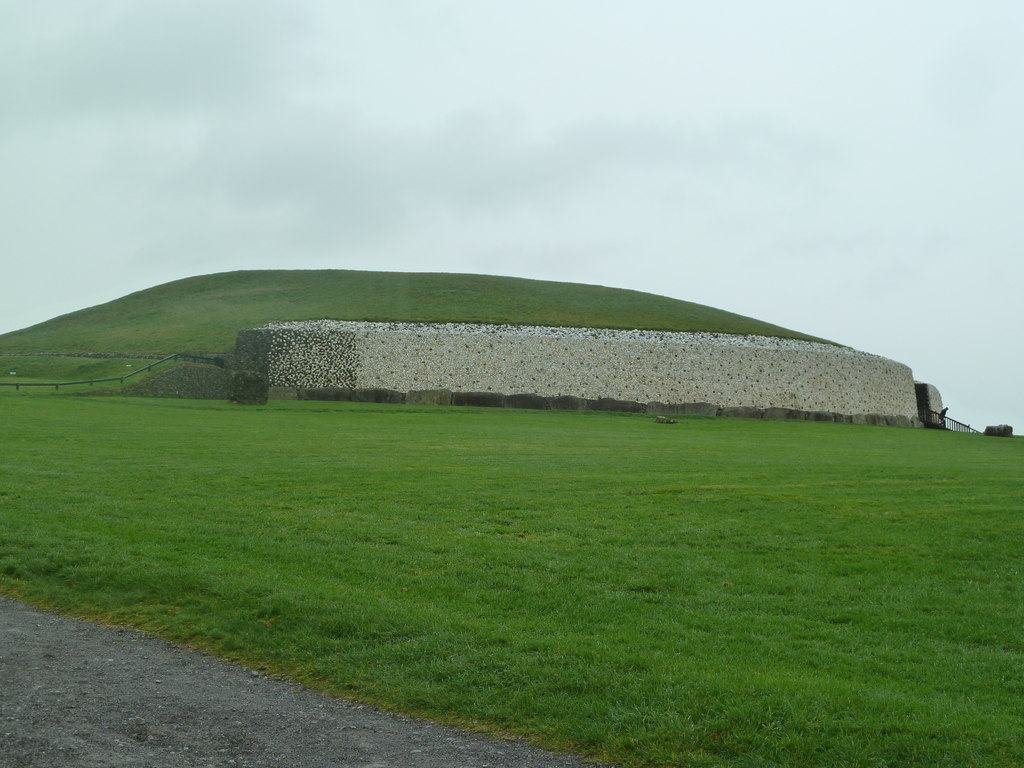
Newgrange is a huge Stone Age passage tomb in County Meath, Ireland, about 50 km north of Dublin, on a ridge above a bend in the River Boyne. It is the best known of three great mounds in the Brú na Bóinne landscape, alongside Knowth and Dowth, surrounded by dozens of smaller tombs, henges and enclosures. Irish tradition knew it long before archaeologists did, as the home of gods.
It was built around 3200 to 3100 BCE by Neolithic farming communities, which makes it older than the Great Pyramid of Giza and older than the main stone phase at Stonehenge. The builders heaped up roughly 200,000 tonnes of earth and stone into a mound about 85 m across, ringed at its base by a kerb of large stones, many of them carved.
Inside, a stone-lined passage about 19 m long runs to a cross-shaped chamber under a corbelled roof that has kept out rain for five millennia. Above the entrance sits a small opening called the roof-box. At sunrise around the winter solstice, light enters through that slot, travels up the passage and lights the chamber floor for roughly 17 minutes. It was first recorded in modern times in 1967.
Newgrange matters as one of the great achievements of prehistoric Europe, combining engineering, astronomy and art. The spirals, lozenges and zigzags carved on its stones, especially the triple-spiral entrance stone, have become symbols of Ireland. The white quartz front added in modern reconstruction is striking and still debated. Ancient-astronaut writers see the solstice alignment as a sign of knowledge from the sky.
The ancient-alien case
In the 2019 episode 'The Star Gods of Sirius', Ancient Aliens linked Newgrange to Sirius, the brightest star in the night sky. The show claimed the monument was aligned to Sirius and floated the idea that the Irish god the Dagda came from that star system, making Newgrange an alien outpost. Giorgio Tsoukalos has built on a word pattern he sees worldwide, arguing that god names beginning with sounds like Dag or Dog point to Sirius, the Dog Star.
Theorists also ask how Stone Age farmers without writing could set a roof-box to catch the solstice sunrise so exactly, and hold that alignment for five thousand years. To them, the precision suggests astronomical knowledge handed down from teachers who came from the sky, a theme also found in the older Sirius writings of Robert Temple.
A 2022 episode, 'The Shining Ones', returned to Newgrange through Irish myths of radiant beings, the Tuatha Dé Danann, who were said to have arrived from the sky and later lived inside the mounds. The show also repeated the idea, which Colavito traces to author Andrew Collins, that the monument's layout reflects the constellation Cygnus, the swan.
Supporters argue that the mounds' role in legend as gateways to an otherworld, combined with their star alignments, fits their larger picture of gods who were physical visitors remembered as supernatural beings.
What archaeologists say
Archaeologists say Newgrange was built by Neolithic farmers who had already settled the rich Boyne valley. Dates from material in the mound place construction around 3200 to 3100 BCE. The builders sourced most stone locally and from the coast, and brought white quartz and dark cobbles from farther away. Human remains, both burned and unburned, were found in the chamber, and the art matches that found across Irish and Atlantic European passage tombs.
The solstice alignment is real and well documented, but it is to the sun, not to Sirius. Farming people who watched the sunrise shift along the horizon each year could mark the midwinter turning point with posts or stones and build toward it. No study has shown a deliberate Sirius alignment. The Dagda and Aengus stories were written down in medieval Ireland, thousands of years after the mound was built, and mythologists treat them as later explanations for an ancient landmark.
The 2020 genome study adds a very human picture. A man buried in the chamber was the child of a first-degree incestuous union, a pattern seen in some ancient ruling families that set themselves apart from ordinary people. That points to a powerful local elite who could organize the labor for such a project.
Timeline
- c. 3200-3100 BCENeolithic communities build Newgrange with its passage, chamber, roof-box and carved kerb.
- c. 2900 BCEA large timber and ditch ceremonial enclosure is built nearby, one of several later henges in the bend of the Boyne.
- Iron Age to early medieval periodRoman-era coins and ornaments are left at the mound as offerings, and Irish myth names it the home of the Dagda and his son Aengus.
- 1699Workers taking stone for a local landowner uncover the entrance, and the Welsh scholar Edward Lhuyd visits and describes the chamber.
- 1962-1975Michael J. O'Kelly of University College Cork excavates and restores the monument.
- 21 December 1967O'Kelly becomes the first person known in modern times to see the solstice sunlight enter the chamber.
- 1993UNESCO lists Brú na Bóinne, including Newgrange, Knowth and Dowth, as a World Heritage Site.
- 2018During a summer drought, crop marks reveal a previously unknown henge near Newgrange and other ceremonial enclosures across the valley.
- 2020Ancient DNA from a man buried in the chamber shows his parents were first-degree relatives, hinting at an elite ruling lineage.
- 2025-2026The winter solstice sunrise is broadcast live, and the Office of Public Works runs its yearly lottery for places inside the chamber.
Still unanswered
- Whether Newgrange was mainly a tomb, a temple, a calendar, or all three.
- How accurate O'Kelly's reconstruction of the white quartz front is; some archaeologists think the quartz lay as a flat surface in front of the entrance instead.
- What the carved spirals and other symbols meant to their makers.
- How the builders were organized and how many generations the work took.
- How the newly found henges and enclosures around Newgrange were used alongside it.
Did you know?
- Newgrange's roof has stayed watertight for about 5,000 years, thanks to overlapping slabs and grooves cut to shed rainwater.
- The Brú na Bóinne area holds the largest concentration of prehistoric megalithic art in Europe.
- Fake booking websites for Newgrange are common enough that the Irish heritage service warns visitors about them.
On Ancient Aliens
- S14E04 The Star Gods of Sirius Claims Newgrange is aligned to Sirius and suggests the Dagda came from that star system, making the mound an alien outpost.
- S18E17 The Shining Ones Ties Newgrange to Irish myths of shining sky beings and repeats the claim that its design mirrors the constellation Cygnus.
Episode numbers follow Wikipedia's episode list; History and some reviewers number a few seasons differently.
Visiting
Getting there. Near Donore, County Meath, about 50 km north of Dublin; most people drive or take a coach tour from Dublin to the Brú na Bóinne Visitor Centre.
What you can see. All access to Newgrange and Knowth is through the Brú na Bóinne Visitor Centre, by shuttle bus and guided tour only. Tickets are limited and should be booked ahead only through the official Heritage Ireland site. The passage is low and narrow. Around the winter solstice, regular tours change and entry to the chamber at dawn is by free lottery.
Tip. Tour guides recreate the solstice sunrise with electric light inside the chamber, so you can see the effect on any day of the year.
Sources
- Newgrange - Wikipedia en.wikipedia.org
- Brú na Bóinne - Archaeological Ensemble of the Bend of the Boyne - UNESCO World Heritage Centre whc.unesco.org
- Brú na Bóinne Visitor Centre: Newgrange, Knowth and Dowth - Heritage Ireland heritageireland.ie
- Archaeological Discoveries at the Brú na Bóinne World Heritage Property - World Heritage Ireland worldheritageireland.ie
- Newgrange News and Events newgrange.com
- Review of Ancient Aliens S14E04 The Star Gods of Sirius - Jason Colavito jasoncolavito.com
- Review of Ancient Aliens S18E17 The Shining Ones - Jason Colavito jasoncolavito.com
- Ancient Aliens S18E17 The Shining Ones - HISTORY history.com
- Ancient Aliens S14E04 The Star Gods of Sirius - TVmaze api.tvmaze.com
Research notes: what we could not confirm
- The old entry listed a rerun in S22E04 'Extraterrestrial Engineering'; the TVmaze synopsis names Puma Punku, Malta and Nan Madol but not Newgrange, so it is left out.
- Colavito's S14E04 review does not clearly say that Tsoukalos personally made the Dagda/Sirius claim; it attributes the Dog/Dag word idea to the show and its regular contributors.
- The kerbstone count (97), the Roman-era offerings, the 1699 discovery details and the watertight roof design are standard facts that were not checked in a source opened for this entry.
- The Tuatha Dé Danann link to S18E17 is inferred from HISTORY's synopsis about Irish shining sky beings plus Colavito's review.
- Wikipedia gives the mound height as about 12 m; other sources give up to about 13.5 m.