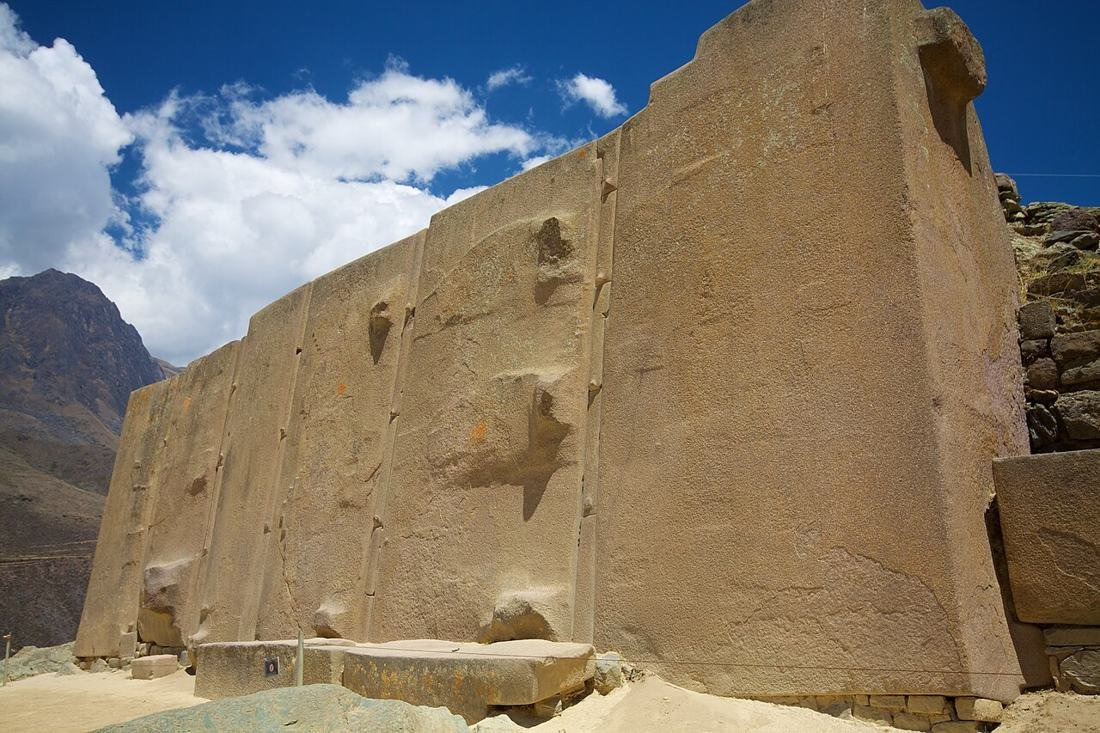
What it is
Ollantaytambo is a town and Inca site at the lower end of Peru's Sacred Valley, about 72 km northwest of Cusco and 2,792 m above sea level. It sits where the Patacancha stream meets the Urubamba River. Pachacuti, the ruler who turned the Inca into an empire, took the area in the mid-1400s and made it a royal estate. Its builders reshaped the valley with terraces, canals, a planned town and a hill of temples.
The town below the ruins still follows its Inca street plan: four long streets crossed by seven shorter ones, lined with walled house compounds built around shared courtyards. Water still runs in stone channels along the lanes. Around three thousand people live there today, which is why it is often called a living Inca town. On the mountainside opposite, the Inca built storehouses where cool winds helped keep food.
The hill above town is known as the fortress, but archaeologists see it mainly as a sacred complex. Long flights of terraces climb to the Sun Temple, whose centerpiece is the Wall of the Six Monoliths. These tall slabs of pink rhyolite are set side by side with thin filler strips between them, a style seen nowhere else in the empire. The stone was quarried at Kachiqhata, about 5 km away across the Urubamba, and dragged up a long ramp.
Ollantaytambo also has a place in the Spanish conquest. In 1537 the Inca leader Manco Inca used the site as his stronghold and drove back a Spanish force under Hernando Pizarro by firing from the high terraces and flooding the plain below. The temple was never finished. Half-shaped blocks still lie along the route from the quarry, making the site a rare open-air record of how the Inca built.
The ancient-alien case
For ancient-astronaut writers, Ollantaytambo is a showcase of stonework they say is too big and too precise for the Inca. In 'Aliens and Ancient Engineers' (2011), researcher Brien Foerster argues that the site is about 12,000 years old, far older than the Inca, and that its builders had some kind of technology we have lost. In his view the question is one of know-how, not muscle.
Erich von Däniken frames the stone as the key problem. He argues that the rock is too hard for Stone Age tools, so the builders must have had diamond-tipped tools or help from outside. The episode described the temple hill as built with laser-like tools.
Theorists also point to details. Giorgio Tsoukalos and others highlight a carved niche with a fine crisscross pattern as evidence of machine-like precision. Supporters of an older civilization note the thin filler strips between the monoliths, found nowhere else in the Inca world, and a stepped symbol on one slab that echoes Tiwanaku, a much older site near Lake Titicaca.
The unfinished state of the site is read as a sign that an older project was abandoned and later reused. Some alternative writers argue that the Inca simply inherited and patched megalithic walls that were already ancient when they arrived.
What archaeologists say
Archaeologists say the Inca built the temple complex in the 1400s and early 1500s. Radiocarbon dates fall between about 1450 and 1530 CE, matching the time of Pachacuti and his heirs. Colonial-era accounts link the estate to the Inca royal family, and the building styles fit other Inca sites around Cusco.
The best evidence for how they did it is the site itself. Architect Jean-Pierre Protzen studied the Kachiqhata quarry, the ramps and the abandoned blocks. He found that quarry workers chose boulders that had already fallen from the cliffs, shaped them with hammerstones, and slid them down chutes and along prepared roads. Digs under stranded 'tired stones' found clay and gravel road beds, and wooden rollers were found under one block. Hammerstones have turned up at both the quarry and the site.
On the Tiwanaku-style motif, scholars note that the Inca claimed ancestry from the Lake Titicaca region and may have used its symbols, or brought in stoneworkers from there. They also point out that people have long carved hard stone with simple tools and abrasives, given time and labor, so a choice between diamonds and aliens is a false one.
Timeline
- Before c. 1440 CELocal groups farm the valley before Inca expansion.
- c. 1440–1460 CEPachacuti conquers the area and makes it a royal estate; large-scale building begins.
- c. 1450–1530 CERadiocarbon dates place construction of the temple complex in this window.
- 1537Manco Inca defeats a Spanish force led by Hernando Pizarro from the terraces, then withdraws to Vilcabamba.
- 1975–1980A UNESCO-backed project led by architect Roberto Samanez starts modern restoration work.
- 1993Jean-Pierre Protzen publishes his study of Inca building methods at the site, based on work at the quarry and ramps.
- 2000Local leaders warn that a planned highway could cut through about 100 terraces in the archaeological zone.
- 2011Ancient Aliens airs 'Aliens and Ancient Engineers,' bringing the Six Monoliths to a wide TV audience.
Still unanswered
- Why were the six monoliths joined with thin filler strips, a method not used anywhere else in the empire?
- Did the Inca bring stonemasons from the Lake Titicaca region, and is that why a Tiwanaku-style motif appears here?
- How much, if any, of the temple hill was built before Pachacuti's time?
- Exactly how did workers get the largest blocks across the Urubamba River?
Did you know?
- Blocks abandoned between the quarry and the temple are known as 'tired stones,' and one still lies at the foot of the great ramp.
- A sunken terrace system at the site stays a few degrees warmer than the land above, letting farmers grow crops suited to lower valleys.
- Ollantaytambo is the setting of Ollantay, a colonial-era drama in Quechua about a rebel general and an Inca princess.
On Ancient Aliens
- S03E06 Aliens and Ancient Engineers Foerster dates the site to about 12,000 years ago, and von Däniken and Tsoukalos argue the monoliths could not have been cut with ancient tools.
Episode numbers follow Wikipedia's episode list; History and some reviewers number a few seasons differently.
Visiting
Getting there. In the Sacred Valley, about 72 km northwest of Cusco. Visitors come by road from Cusco or the valley towns; Ollantaytambo is also the main rail station for trains to Machu Picchu.
What you can see. The archaeological park covers the temple hill, terraces and water shrines, reached by steep stone stairs. The Inca streets of the town are free to walk. Guided hikes lead to the Kachiqhata quarry and to the storehouses on the mountain across town. The park is managed by Peru's Ministry of Culture and entry is part of the regional tourist ticket system.
Tip. Spend a night in town instead of passing through on the Machu Picchu train; the ruins are quieter early and late, and the evening light on the monoliths is worth the wait.
Sources
- Ollantaytambo (Wikipedia) en.wikipedia.org
- Archaeological Restoration and Heritage Actions in Ollantaytambo (Heritage, MDPI) mdpi.com
- Inka site of Ollantaytambo in Peril (Archaeology Magazine) archive.archaeology.org
- Cachicata Quarry: The Tired Stones of Ollantaytambo (ollantaytambo.org) ollantaytambo.org
- Lost civilizations of the Andes, part 2 (David Pratt) davidpratt.info
- Aliens and Ancient Engineers (Digging Up Ancient Aliens) diggingupancientaliens.com
- List of Ancient Aliens episodes (Wikipedia) en.wikipedia.org
- Review of Ancient Aliens S17E01 'The Lost City of Peru' (Jason Colavito) jasoncolavito.com
Research notes: what we could not confirm
- The old entry listed 'The Lost City of Peru' (S17E01); Colavito's review shows that episode is about Caral and does not cover Ollantaytambo, so it was dropped.
- Only one episode was confirmed; the show has likely returned to the site with Brien Foerster, but no other episode was verified.
- The 50-tonne weight and 4.3 m height for the largest monolith come from an alternative-history writer (David Pratt) summarizing other sources; mainstream figures were not found.
- Whether any part of the site falls within the Qhapaq Ñan (Inca road) World Heritage listing was not checked.
- The Ollantay drama and the Pinkuylluna storehouses are from general knowledge, not a page opened this session.
- The ollantaytambo.org page puts the quarry about nine miles away, likely by trail; the dossier uses Wikipedia's 5 km.