What it is
Palenque is a Classic Maya city in the rainforest foothills of Chiapas, in southern Mexico, about 8 km from the modern town that shares its name. People lived there from a few centuries BCE, but the city reached its peak in the 600s and 700s CE as the seat of a strong royal dynasty. By around 800 CE it held close to 8,000 people. Within another century it was largely abandoned, and the forest closed over it.
The city's most famous ruler was K'inich Janaab' Pakal, often called Pakal the Great. He took the throne in 615 CE at age twelve and ruled for 68 years, one of the longest reigns on record anywhere. He rebuilt Palenque after defeats by its powerful rival Calakmul and filled it with some of the finest buildings and carvings the Maya ever made. His son K'inich Kan Bahlam II carried the building program forward.
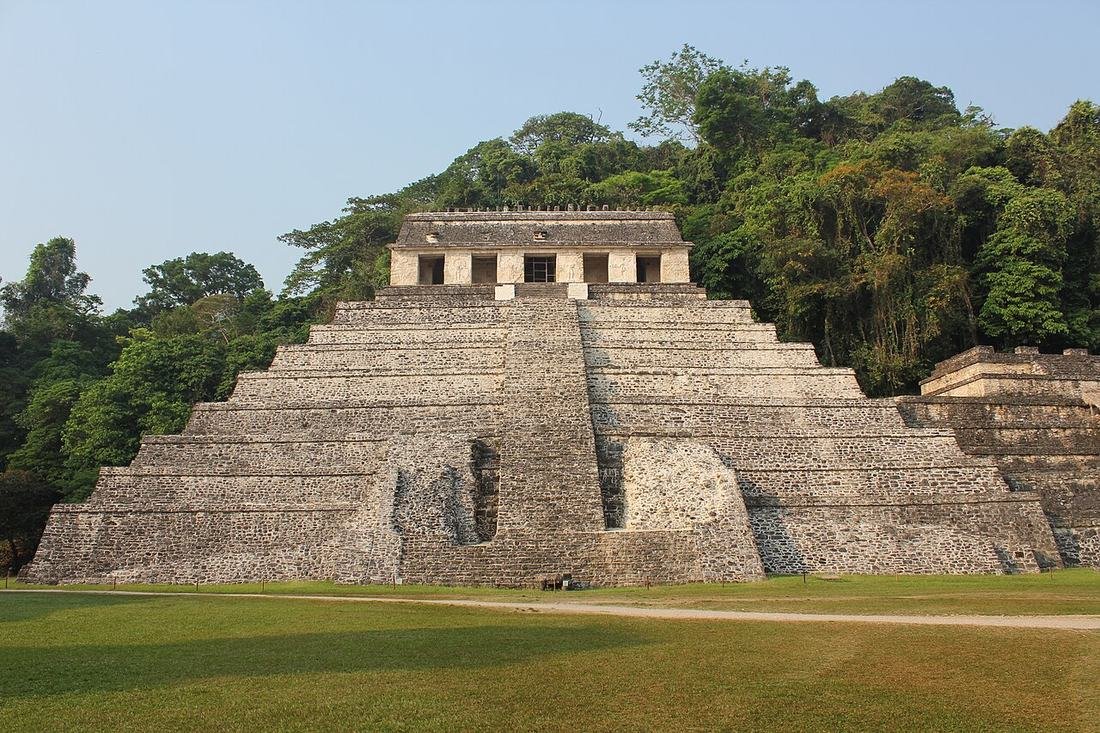
The Temple of the Inscriptions is Pakal's funeral monument, a stepped pyramid about 27 m tall with a temple on top. Its walls carry three stone tablets with 617 glyphs, one of the longest Maya texts known. In 1949 Mexican archaeologist Alberto Ruz Lhuillier noticed a floor slab with finger holes, lifted it, and found a stairway packed with rubble. After several seasons of digging, in 1952 he reached a vaulted chamber holding a massive stone sarcophagus.
Inside lay Pakal, wearing a mosaic mask of jade and strings of jade beads. The carved lid shows him reclining at the base of a cross-shaped tree, framed by symbols of the sky and the underworld. It was the richest royal burial then known in the Americas. Palenque is now a national park and World Heritage Site, and the lid has become one of the most debated images in the ancient-astronaut world.
The ancient-alien case
The ancient-astronaut reading of the lid goes back to Erich von Däniken, who argued in 1968 that Pakal sits like a pilot inside a craft, leaning forward over controls, with flames pouring out below. For theorists, the carving is too technical in feel to be only a religious scene.
Ancient Aliens took the idea further in 'The Mayan Conspiracy' (2012). Giorgio Tsoukalos says Pakal's pose matches the one astronauts use at liftoff. David Childress calls him 'the original rocket man.' The episode built a 3D model that turned the carving into a working spacecraft, and Tsoukalos welcomed the result as a long-held dream made real.
Theorists also point to the texts and symbols around the lid. The show has described the inscriptions as telling of a journey into the heavens. In 'Mysteries of the Maya' (2024), Tsoukalos argues that Xibalba, the Maya underworld, is really the Milky Way, so a king who travels there is a king who flew into space.
For many fans the lid is the single strongest piece of evidence on the show. It has been featured again and again, and 'Top Ten Alien Artifacts' (2021) ranked it second of all the objects the series has covered.
What archaeologists say
Mayanists say the lid is a death scene written in a well-understood visual language. Pakal appears in the guise of a young maize god, dropping into or rising from the open jaws of a great serpent that marks the entrance to the underworld. Above him grows the World Tree, a cross-shaped symbol of the center of the cosmos, topped by a celestial bird. The 'controls' and 'exhaust' are standard Maya signs found on many other carvings.
The glyphs on the lid's edges and the temple tablets have been read. They list Pakal's ancestors, the dates of their deaths, and his own rites, and they tie the king to gods and to the rebirth of maize. Nothing in them describes a machine. The skeleton inside shows a normal-sized man with shaped skull and filed teeth, both known Maya customs of rank.
Archaeologists add that the reading only works if you turn the lid sideways and ignore the rest of Maya art. Colavito and other critics note that the show's 3D model needed parts the carving does not have. Excavation at Palenque keeps adding detail on the city's kings, water systems and rival states, all of it pointing to a human story.
Timeline
- c. 226 BCEEarliest traces of settlement at the site.
- 603 CEK'inich Janaab' Pakal is born.
- 615 CEPakal becomes king at age twelve and begins rebuilding the city.
- 683 CEPakal dies at about 80 and is laid in the tomb beneath the Temple of the Inscriptions.
- c. 683–702 CEHis son K'inich Kan Bahlam II finishes the temple above the tomb.
- c. 800–900 CEPalenque declines and is abandoned to the jungle.
- 1949–1952Alberto Ruz Lhuillier clears the hidden stairway and opens Pakal's tomb.
- 1968Erich von Däniken's Chariots of the Gods? popularizes the idea that the lid shows an astronaut.
- 1987 and 1994Palenque is inscribed as a World Heritage Site (1987); the Red Queen's tomb is found in nearby Temple XIII (1994).
- 2010 and 2024Specialists lower the lid back onto the sarcophagus after decades on metal props (2010); a Tren Maya station opens at Palenque on January 1, 2024.
Still unanswered
- How much of Palenque's buried city, with over 1,000 structures still under forest, will change what we know about its rise and fall?
- Who was the Red Queen buried in Temple XIII? Many scholars favor Pakal's wife, Ix Tz'akbu Ajaw, but the identity is not settled.
- Why was Palenque abandoned around 800–900 CE: warfare, drought, political collapse, or all of these?
- What was the exact purpose of the stone duct that links Pakal's tomb to the temple floor above?
Did you know?
- Alberto Ruz Lhuillier spent parts of four years clearing the rubble-filled stairway before he reached Pakal's tomb.
- Five sacrificed people were buried at the entrance to Pakal's crypt.
- Pakal's teeth were filed into the shape of the Maya glyph for wind or breath.
On Ancient Aliens
- S04E01 The Mayan Conspiracy The classic segment: Pakal as a pilot at liftoff, the 'rocket man' tag and a 3D spacecraft model of the lid.
- S17E07 Top Ten Alien Artifacts Ranks Pakal's tomb lid number two, reusing footage from 2012.
- S20E11 Mysteries of the Maya Tsoukalos argues Pakal flew into space because Xibalba is the Milky Way.
Episode numbers follow Wikipedia's episode list; History and some reviewers number a few seasons differently.
Visiting
Getting there. In the state of Chiapas, Mexico, about 8 km from the town of Palenque. Visitors arrive by road or on the Tren Maya, which has a station at Palenque; the nearest airports are Palenque's regional field and Villahermosa.
What you can see. The ruins are run by Mexico's national heritage institute, INAH, and are open to visitors on marked paths through the Palace, the Cross Group and other temples. Pakal's tomb has been sealed and is not open to the public. A full replica of the sarcophagus and lid is shown in the Alberto Ruz Lhuillier site museum.
Tip. See the replica lid in the site museum before or after the ruins, since you cannot enter the real tomb.
Sources
- Palenque (Wikipedia) en.wikipedia.org
- K'inich Janaab' Pakal (Wikipedia) en.wikipedia.org
- Temple of the Inscriptions (Wikipedia) en.wikipedia.org
- Palenque archaeological zone (INAH) lugares.inah.gob.mx
- Museo de Sitio de Palenque Alberto Ruz Lhuillier (INAH) lugares.inah.gob.mx
- Mayan king's sarcophagus cover replaced on tomb (The History Blog) thehistoryblog.com
- Palenque railway station (Wikipedia) en.wikipedia.org
- Review of Ancient Aliens S04E01 'The Mayan Conspiracy' (Jason Colavito) jasoncolavito.com
- Review of Ancient Aliens S17E07 'Top Ten Alien Artifacts' (Jason Colavito) jasoncolavito.com
- Review of Ancient Aliens S20E11 'Mysteries of the Maya' (Jason Colavito) jasoncolavito.com
Research notes: what we could not confirm
- Lid dimensions are converted from the History Blog's figure of about 12 by 7 feet; published figures vary slightly.
- The identity of the Red Queen as Pakal's wife is a leading theory from general knowledge, not a page opened this session.
- Pakal very likely appears in other episodes (the Pilot and several later seasons), but only the three listed were confirmed.
- The 'journey to the Milky Way' wording is from History's synopsis as cited in the old entry; the synopsis page itself was not opened this session.