What it is
The Paracas culture lived on the dry south coast of Peru, in what is now the Ica Region, from roughly 800 BCE until about 100 BCE, with its traditions running on into the early Nasca era. Its people farmed river valleys, fished the rich coastal waters and buried their dead in the desert, where the arid sand preserved bodies, hair and cloth for more than two thousand years.
In 1925 Peruvian archaeologist Julio C. Tello first examined the Paracas Peninsula, and from 1927 he excavated cemeteries on and around a hill called Cerro Colorado. Two kinds of burial stood out. The older Paracas Cavernas tombs were bottle-shaped shafts holding many people. The later Wari Kayan necropolis held more than 400 seated bodies, each wrapped in layer after layer of cloth. Tello counted 429 mummy bundles.
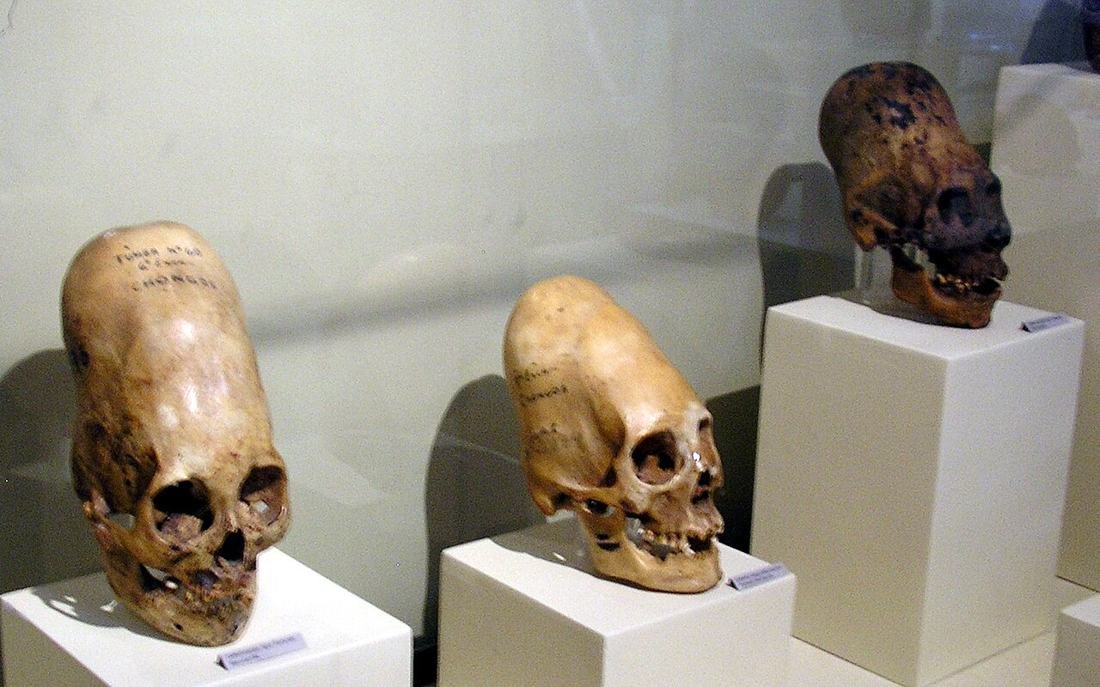
Many of the skulls from these tombs are strikingly long. A 2022 study of 159 individuals from Paracas Cavernas found intentional shaping in 98 percent of them. The most common form pushes the head back and up into a tall, sloping cone; another style, more common in women, gives the skull two lobes. Many of the bundles also contained some of the finest textiles ever made in the ancient Americas.
The skulls matter to scholars because they show how a whole society marked identity on the body from birth. They matter to ancient-astronaut fans because the extreme shapes look unlike any normal human head. Several skulls are displayed in Peruvian museums, and a private museum in the town of Paracas has made them famous through television and online video. Visitors to those museums can judge the shapes for themselves.
The ancient-alien case
Theorists argue that the most extreme Paracas skulls are not just reshaped human heads. Brien Foerster, who has studied and filmed the skulls for years, says some have a cranial volume up to 25 percent larger than normal human skulls and are heavier than expected. On Ancient Aliens he has suggested that beings from elsewhere may have mixed with local people, and he has proposed calling the population a separate subspecies, Homo sapiens paracas.
L.A. Marzulli has argued that the anatomy rules out head binding. He points to the claimed absence of the sagittal suture, the seam that runs along the top of the skull, and says the foramen magnum, where the spine enters, sits farther back than normal. In his view binding cannot move that opening or erase that seam.
DNA is the other pillar. Marzulli commissioned tests, and Foerster reported in 2016 and 2017 that some samples carried maternal lineages linked to Europe and the Near East rather than only Native American ones. Early publicity even spoke of mutations unknown in any known species. Theorists take this as a sign of an outside population arriving in ancient Peru.
Giorgio Tsoukalos has gone furthest, saying on the show that the skulls belong to extraterrestrials themselves. David Childress has compared a facial reconstruction to the pharaoh Akhenaten and to modern descriptions of gray aliens, while William Henry links the skulls to the Nephilim of Genesis.
What archaeologists say
Archaeologists say the skulls were shaped on purpose. Parents bound babies' heads with pads, boards and cloth while the bones were still soft, guiding growth upward and backward. The practice appears across the world, from ancient Europe to the Pacific Northwest, and in the Andes the shape often signaled group identity. The 2022 Paracas study found different styles for men and women, which fits a cultural rule, not a different species. Reshaping changes the form of the braincase, not the amount of brain inside it.
The anatomical claims have explanations. Medical research going back more than a century shows that binding can cause the sagittal suture to fuse early, so a missing seam is a known side effect. Critics such as Jason Colavito note that the foramen magnum argument fails to account for how binding pushes the face forward, which shifts every measurement taken from the front. No peer-reviewed study has found a skull that falls outside the human range.
The DNA tests promoted by Foerster and Marzulli were never published in a scientific journal, and the full reports appear in a popular book. Some of the reported results matched Native American lineages. Old bone is easy to contaminate with modern DNA, which is why ancient-DNA labs follow strict protocols and publish their data. Without that, geneticists treat the claims of European or unknown ancestry as unproven.
Timeline
- c. 800 BCEThe Paracas culture emerges on Peru's south coast.
- c. 300–200 BCEThe Wari Kayan necropolis on Cerro Colorado is in use, with hundreds of wrapped, seated burials.
- c. 100 BCE onwardParacas traditions flow into the Nasca culture, which shares its religion and textile art.
- 1927Julio C. Tello, who first visited the peninsula in 1925, begins excavations at Cerro Colorado and recovers 429 mummy bundles.
- 1939Tello becomes first director of a new anthropology museum in Lima built to house the Paracas collection, today's National Museum of Archaeology, Anthropology and History of Peru.
- 1964The Julio C. Tello site museum opens inside what is now the Paracas National Reserve; it reopens in a new building in 2016.
- 2015Ancient Aliens features the skulls in 'The Alien Evolution', with a 3D facial reconstruction.
- 2016–2017Brien Foerster and L.A. Marzulli promote privately commissioned DNA tests on skull samples; the results are released through books and videos, not peer-reviewed journals.
- 2022A study in the Journal of Archaeological Science: Reports finds deliberate head shaping in 98% of a 159-person Paracas Cavernas sample.
- January 2026Ancient Aliens opens season 22 with 'Skulls of the Gods', centered on the Paracas skulls.
Still unanswered
- Why the Paracas people shaped heads so intensely, and what each style meant socially, is still being studied.
- How the Paracas population relates genetically to later Nasca and other Andean groups awaits more published ancient-DNA work.
- Whether the privately tested samples were contaminated has never been checked independently.
- How Paracas surgeons achieved survival rates of around 40 percent in trepanation is a live topic in the history of medicine.
Did you know?
- The Paracas people also practiced skull surgery, and many patients survived, as healed bone around the holes shows.
- In the Paracas Cavernas sample, the two-lobed skull shape was found much more often in women than in men.
- Tello's Paracas finds were so important that Peru built a new national museum to house them.
On Ancient Aliens
- S10E05 The Alien Evolution Features Tello's 1928 finds and the claim of skulls with cranial volumes at least 25 percent larger than normal, plus a 3D facial reconstruction.
- S22E01 Skulls of the Gods Foerster, Marzulli, Tsoukalos and William Henry argue the skulls show a separate or even alien lineage.
Episode numbers follow Wikipedia's episode list; History and some reviewers number a few seasons differently.
Visiting
Getting there. The town of Paracas, on the coast about 250 km south of Lima along the Pan-American Highway, near Pisco in the Ica Region; the regional capital of Ica lies farther inland.
What you can see. The Cerro Colorado cemeteries lie inside the Paracas National Reserve, where there is little to see of the tombs themselves. The Julio C. Tello site museum in the reserve shows Paracas pottery, textiles and early human remains. The elongated skulls made famous on television are shown at a private museum in Paracas town, and examples are also displayed at the regional museum in Ica. The largest Paracas collection is in the national museum in Lima.
Tip. Pair the skulls with the textiles: the cloth in the same burials, best seen in Lima, shows the skill of the people who shaped those heads.
Sources
- Wikipedia: Paracas culture en.wikipedia.org
- Wikipedia: Julio C. Tello en.wikipedia.org
- Gómez-Mejía et al. 2022, Intentional cranial modification as a marker of identity in Paracas Cavernas (Journal of Archaeological Science: Reports) sciencedirect.com
- CuscoPeru.com: Site Museum Julio C. Tello, Paracas cuscoperu.com
- Ancient Origins: How DNA testing revealed European ancestry in elongated Paracas skulls (theorist-side report) ancient-origins.net
- Ancient Origins: Paracas Skulls, alien mystery or human ingenuity? ancient-origins.net
- Jason Colavito: Review of Ancient Aliens S22E01 'Skulls of the Gods' jasoncolavito.com
- TheTVDB: Ancient Aliens 'Alien Evolution' thetvdb.com
- Ancientalienpedia: 'The Alien Evolution' episode notes ancientalienpedia.wordpress.com
Research notes: what we could not confirm
- Correction to the old entry: Tello began excavating in 1927 (first visit 1925), not 1928, though the show and many articles say 1928. The skull museum famous from TV is in Paracas town near Pisco, not near Ica city; Ica's regional museum also shows skulls.
- The old entry said DNA shows ordinary Native American ancestry. I found no peer-reviewed ancient-DNA study focused on the elongated Paracas skulls that I could open; the claim that published genomics confirms Native American ancestry comes from a popular article, so it is stated here only as the absence of evidence for anything else.
- 'The Alien Evolution' is S10E05 in Wikipedia's list, but it aired on August 21, 2015, and some fan guides number it S08E05.
- Other skull-related episodes (for example 'Star Children' segments) may show Paracas skulls but were not confirmed.
- The name and ownership of the private museum in Paracas town vary between sources (Paracas History Museum, Museo Arqueológico Paracas).
- The 250 km distance from Lima is approximate.