What it is
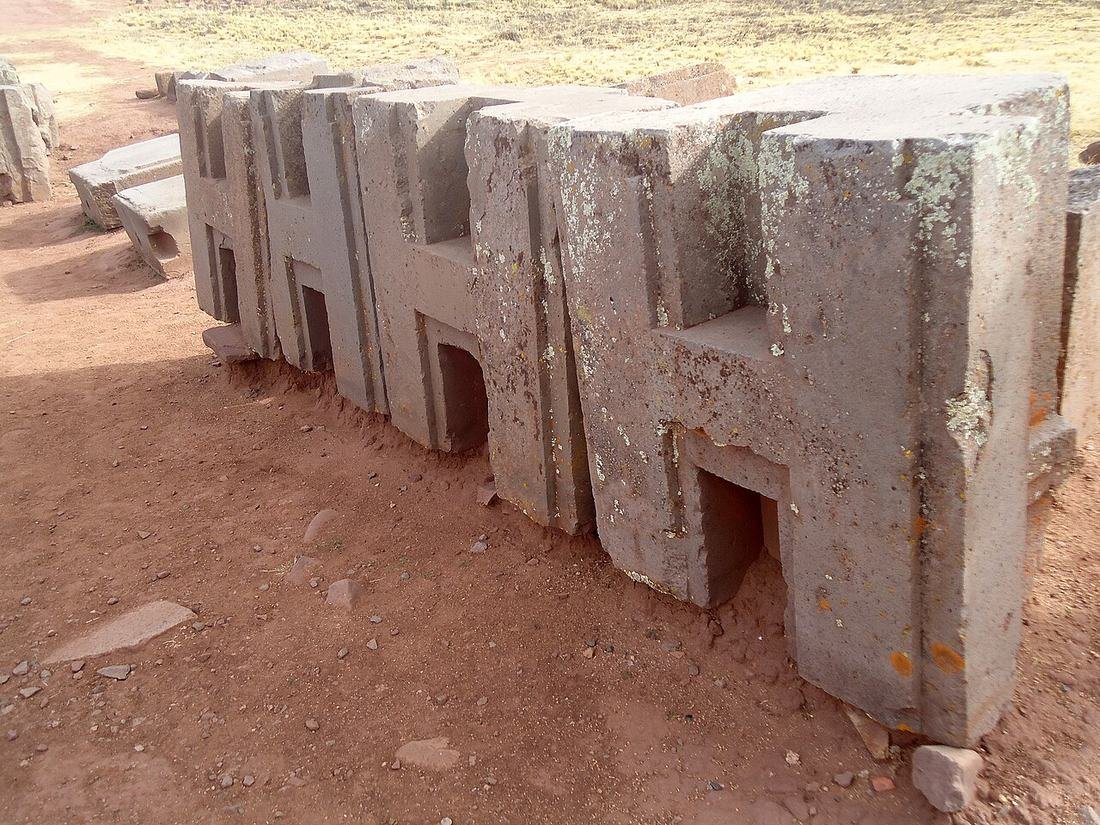
Puma Punku is a terraced earthen platform at Tiwanaku, a major ancient city in western Bolivia, a short distance south of Lake Titicaca. It sits nearly 3,850 meters above sea level on the treeless Altiplano. The name means Gate of the Puma in Aymara. Today it looks like a field of wreckage, with carved stones scattered across a low mound. Not one block is thought to still sit where its builders placed it.
Archaeologists credit the Tiwanaku culture, a highland society that flourished from roughly 500 to 1000 CE and drew pilgrims and trade from across the southern Andes. Radiocarbon dates from the platform's lowest fill point to work starting in the mid-500s CE. Excavations show it went through several building phases, with repairs and remodeling along the way, rather than being raised all at once.
Two kinds of stone dominate. Red sandstone makes up the huge slabs, the largest weighing roughly 131 tonnes. Gray andesite, a hard volcanic rock, was cut into smaller pieces with crisp edges, flat faces and repeated shapes, including the famous H-blocks. Some blocks carry T-shaped slots where molten metal cramps once locked neighboring stones together, a detail that has fueled speculation for more than a century.
Puma Punku matters because it shows how far Andean builders pushed stonework centuries before the Inca. Its standardized pieces suggest templates, planning and a trained workforce. The Inca later treated Tiwanaku as a sacred place tied to the creation of the world. For ancient-astronaut writers, it has become the single most cited site on Earth. It is also one of the most photographed ruins in South America.
The ancient-alien case
Giorgio Tsoukalos has singled out Puma Punku as the one place he believes was built directly by extraterrestrials. His main argument is the H-blocks. Theorists point out that several share the same profile, the same inner right angles and the same recessed steps, as if stamped from one master pattern. To Tsoukalos, that sameness looks like prefabrication, the kind of modular parts a factory turns out, not the work of people using stone hammers.
David Hatcher Childress has gone further, describing the edges as cut to precise angles and floating the idea that a giant flying factory, stocked with power tools, set down on the plain to process the stone. Engineer and author Christopher Dunn, who studies ancient machining, has joined Childress in suggesting that diamond-tipped drills or saws were needed to produce the smooth faces and tiny drilled holes.
Erich von Däniken, who first made the site famous in the ancient-astronaut world, argues that such a project demanded detailed planning and written measurements, and asks where that knowledge came from. Theorists also note that the metal cramps holding the blocks together were poured in place, which they read as a sign of on-site metalworking beyond what they expect of the period.
The show has also leaned on early claims that the site is extremely old. Its 2012 episode synopsis described the ruins as nearly 14,000 years old, an idea drawn from Arthur Posnansky's astronomical dating. Theorists connect this deep age to local legends that Tiwanaku was raised in a single night by the creator god Viracocha, and ask whether that story preserves a memory of visitors with advanced tools. A 2024 episode revisited the site with digital reconstruction as its focus.
What archaeologists say
Archaeologists say Puma Punku was built by the Tiwanaku people over several centuries beginning in the 500s CE. Radiocarbon dates from organic material in the platform's lowest layers anchor that timeline, and excavations led by Alexei Vranich traced distinct building phases and repairs. The quarries are known: the sandstone came from about 10 km away, and the andesite was brought roughly 90 km from the far side of Lake Titicaca, likely partly by reed boat.
Architect Jean-Pierre Protzen and architectural historian Stella Nair spent years measuring the stones. They found that the Tiwanaku masons worked andesite and sandstone with harder hammerstones and abrasives, and that the repeated shapes were probably laid out with templates and set squares. The pieces are strikingly regular, but not machine-perfect when checked closely. The metal cramps were a copper-based alloy, and Tiwanaku metalworkers could melt and pour such metal. Neither stone is granite, and no diamond-tool marks have been documented.
The 2018 reconstruction, which used 3D-printed miniatures of 140 andesite pieces and 17 sandstone slabs, suggested the blocks formed a system of doorways and wall panels arranged so that repeated gateways lined up in a deliberate visual effect. That fits the view of Puma Punku as a ritual building where standardized parts made a grand design easier to plan and build. Posnansky's great age for the site has long been set aside.
Timeline
- c. 500 CETiwanaku grows into a planned ceremonial city and regional power on the southern Altiplano.
- c. 536-600 CEBuilders lay the first earthen fill of the Puma Punku platform, according to radiocarbon dates.
- c. 600-1000 CEThe platform is expanded and remodeled in several phases while Tiwanaku is at its height.
- c. 1000-1100 CETiwanaku declines and is largely abandoned; later the Inca revere it as a place of creation.
- 1500s onwardTreasure hunters, colonial builders and later railway and village construction strip and scatter the stones.
- Early 1900sEngineer Arthur Posnansky studies Tiwanaku and argues from astronomy that it is many thousands of years old, a dating later rejected by archaeologists.
- 2000Tiwanaku, including Puma Punku, is added to the UNESCO World Heritage List.
- 2012Ancient Aliens airs a full episode on the site, 'The Mystery of Puma Punku' (S04E06).
- 2018Archaeologist Alexei Vranich and UC Berkeley colleagues publish a reconstruction built from 3D-printed scale models of the scattered blocks.
- 2025A Penn State-led team reports Palaspata, a Tiwanaku temple about 210 km from the capital, showing how far the state's religious reach extended.
Still unanswered
- Exactly how the original building looked, since no stone survives in its first position and many were carried off long ago.
- How much of the precise shaping was done at the quarries versus on site.
- How the heaviest sandstone slabs were moved across the Altiplano, and how many workers it took.
- Why Tiwanaku, including Puma Punku, lost its power and was abandoned around 1000-1100 CE; drought is a leading but not settled explanation.
- What still lies under the unexcavated parts of the complex, which remote sensing suggests is much larger than the dug area.
Did you know?
- The Inca, who arrived centuries after Tiwanaku fell, believed the site was where the creator god made the world and its peoples.
- Despite frequent claims about granite on TV, Puma Punku's stones are red sandstone and gray andesite.
- Only a small fraction of the Tiwanaku complex has been excavated; drone and ground surveys point to buried platforms not yet dug.
On Ancient Aliens
- S04E06 The Mystery of Puma Punku A full hour on the site, with Tsoukalos calling it built directly by aliens and Childress and Dunn arguing for power tools.
- S08E02 Mysterious Structures A special-edition roundup of megalithic sites that includes Puma Punku alongside Carnac, Göbekli Tepe and Coral Castle.
- S17E02 Top Ten Mysterious Sites Ranks Puma Punku's precisely cut stones among the world's most puzzling places.
- S20E20 Resurrecting Puma Punku Asks whether modern reconstruction technology can reveal the site's original form and hint at alien involvement.
- S22E04 Extraterrestrial Engineering Revisits Puma Punku alongside Malta's temples and Nan Madol as possible signs of ancient contact.
Episode numbers follow Wikipedia's episode list; History and some reviewers number a few seasons differently.
Visiting
Getting there. Tiwanaku village, about 70 km west of La Paz, Bolivia; most visitors come by tour bus or minibus from La Paz on a day trip.
What you can see. Puma Punku is part of the Tiwanaku archaeological park, a short walk from the main complex of Akapana, Kalasasaya and the Gate of the Sun. Visitors walk around the scattered blocks; climbing on stones is not allowed. The site museums hold carvings and artifacts.
Tip. The site is almost 3,850 m up, so spend a day or two in La Paz first to adjust, and bring sun protection and a warm layer.
Sources
- Pumapunku - Wikipedia en.wikipedia.org
- Tiwanaku: Spiritual and Political Centre of the Tiwanaku Culture - UNESCO World Heritage Centre whc.unesco.org
- 3D-printed reconstructions provide clues to ancient site - ScienceDaily (UC Berkeley) sciencedaily.com
- Jean-Pierre Protzen - Wikipedia en.wikipedia.org
- Lost Tiwanaku temple unearthed in Bolivia - Archaeology Magazine (2025) archaeologymag.com
- Review of Ancient Aliens S04E06 - Jason Colavito jasoncolavito.com
- Ancient Aliens S04E06 The Mystery of Puma Punku - TVmaze api.tvmaze.com
- Ancient Aliens S20E20 Resurrecting Puma Punku - TVmaze api.tvmaze.com
- List of Ancient Aliens episodes - Wikipedia en.wikipedia.org
Research notes: what we could not confirm
- Colavito's review is titled 'The Mysteries of Puma Punku', but Wikipedia and TVmaze give the episode title as 'The Mystery of Puma Punku' (S04E06, March 16, 2012); the latter is used here.
- The idea that andesite was partly moved by reed boat across Lake Titicaca is a common scholarly suggestion, not a proven fact.
- The Palaspata distance (about 210 km, reported as 130 miles) is from a news summary of the Antiquity paper and was not checked against the paper itself.
- The driving distance from La Paz (about 70 km) is a commonly cited figure not checked against an official source.
- The old entry's other episode hits (Pilot, S4E5, S5E1, S5E3, S12E4, S13E10, S13E14, S16E6, S17E1) were not re-verified and are left out.