What it is
The Serapeum is an underground burial complex at Saqqara, the vast cemetery of the ancient capital Memphis, about 20 km south of modern Cairo. It was the resting place of the Apis bulls. Each Apis was a living bull chosen for special markings and honored as a sign of the creator god Ptah. When one died, it was mummified and buried with great ceremony, and priests began searching for the next.
The complex grew over more than a thousand years. Burials began in the New Kingdom, in the reign of Amenhotep III. Prince Khaemwaset, a son of Ramesses II and high priest of Ptah, dug a gallery with side chambers now called the Lesser Vaults. Under Psamtik I in the 7th century BCE, work started on the Greater Vaults, which later Ptolemaic rulers extended to roughly 350 m.
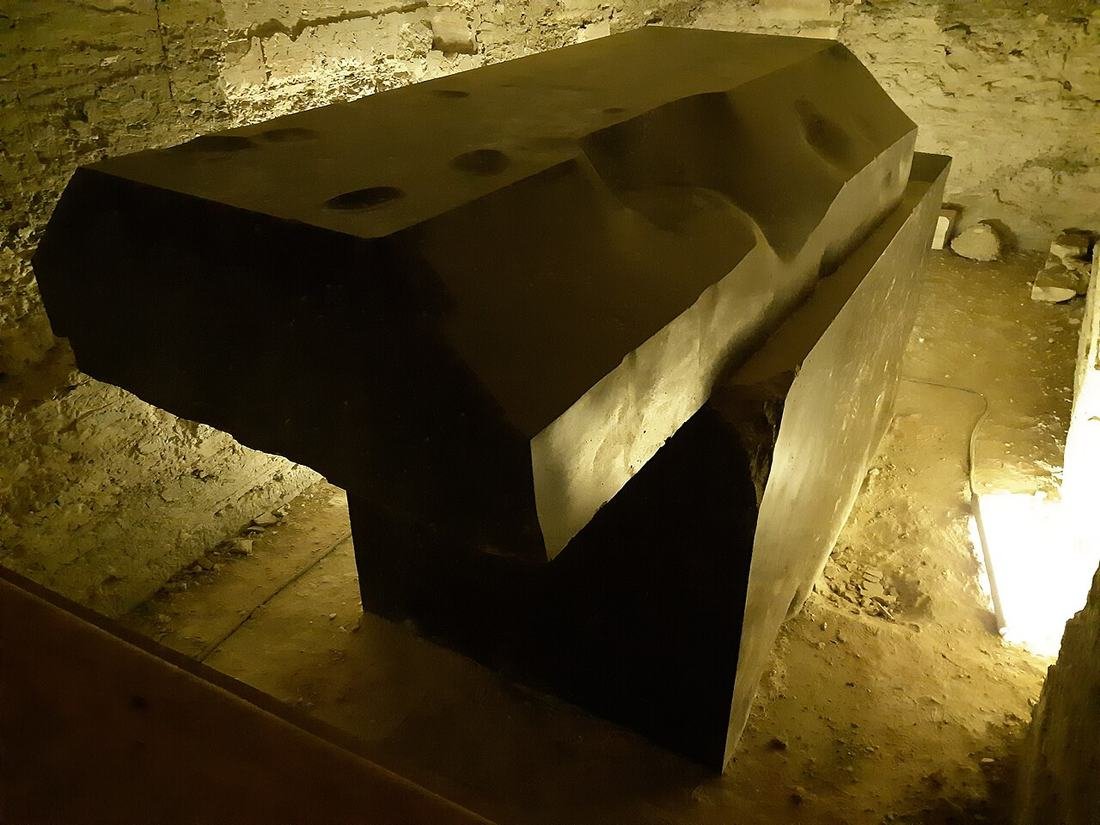
The Greater Vaults are what draw crowds. A long, arched corridor cut in bedrock is lined with side rooms, and 24 enormous stone chests still sit in them. Most are granite, with others of basalt or diorite. A typical box stands over 2 m high and nearly twice as long, weighs around 40 tonnes, and once had a lid weighing about half as much again.
French scholar Auguste Mariette found the site in 1850 after spotting a sphinx head poking out of the sand. He followed an avenue of sphinxes to the buried entrance. Most chambers had been robbed in antiquity, but he recovered thousands of objects, including dated memorial stones now in the Louvre. The galleries were closed for decades for safety work and reopened to visitors in 2012.
The ancient-alien case
The ancient-astronaut argument starts with sheer bulk. On Ancient Aliens, guest Ramy Romany says boxes the show puts at about 70 tons could not have been moved into such tight tunnels (Egypt's Giant Tombs, S20E17). Theorists ask how anyone steered a giant granite block through a corridor barely wider than the box itself.
Precision is the second pillar of the case. Geologist Robert Schoch claims on the show that the boxes are cut to within "a thousandth of an inch" and that their inner corners are almost perfectly square (S20E17). Engineer Christopher Dunn argues the work looks machined rather than hand-made. Supporters also point to the glassy polish on the surfaces.
Giorgio Tsoukalos argues that hard stone like this could not be shaped with ancient tools, and suggests some lost method that softened or melted rock (S20E17). He also asks why anyone would sink so much effort into these boxes unless there were a pressing reason.
As for what the boxes held, David Childress and William Henry say they are too big for bulls and may have contained genetic hybrids made by visitors from elsewhere. Dunn suggests they once stored radioactive material, while other voices on the episode propose that the granite's quartz produced vibrations or served as a gateway to other dimensions (S20E17).
Theorists also stress that no bull mummy was found inside the big granite boxes and that only a few carry inscriptions, which they say were cut later and more crudely than the boxes themselves. To them, this suggests the boxes are older than the dynasties that claimed them.
What archaeologists say
Egyptologists say the dating is solid. Three boxes carry dedications to named kings of the 26th Dynasty, the Persian period and the 4th century BCE, and hundreds of memorial stones left by priests and pilgrims record individual Apis burials by regnal year. The layout also shows growth over time: Khaemwaset's older gallery, then the Greater Vaults begun under Psamtik I and lengthened under the Ptolemies.
On technique, archaeologists point to well-known Egyptian methods for hard stone: pounding with harder dolerite balls, sawing and drilling with copper tools fed with quartz sand, and grinding and polishing with abrasives, with iron tools available in the later periods. Moving the boxes needed sledges, rollers, levers and patient teams, the same approach used for obelisks and colossal statues. An unfinished box that never reached its chamber still sits in the corridor, a snapshot of work in progress.
The emptiness of the boxes has a plain explanation too. Robbers stripped the site long before Mariette arrived, and he did find intact Apis burials elsewhere in the complex. Measurements quoted by the show have not been published in a peer-reviewed study, and the show's 70-ton figure is well above the roughly 40-tonne body weight usually given.
Timeline
- c. 1390–1352 BCEApis bull burials at Saqqara begin under Amenhotep III.
- 13th century BCEPrince Khaemwaset, son of Ramesses II, creates the Lesser Vaults gallery for Apis burials.
- 664–610 BCEPsamtik I starts the Greater Vaults.
- c. 550–336 BCEBoxes dedicated in the names of Amasis II, the Persian king Cambyses II and the rebel ruler Khababash.
- Ptolemaic periodThe Greater Vaults are extended; a late uninscribed box may date to the last Ptolemies.
- c. 30 BCEThe complex falls out of use around the Roman takeover of Egypt.
- 1850–1853Auguste Mariette uncovers the sphinx avenue and the catacombs and ships many finds to the Louvre.
- 1980s–2012Crumbling ceilings, made worse by the 1992 Cairo earthquake, keep the galleries closed for years; after long conservation work they reopen to visitors in 2012.
- 2020 onwardExcavation at the Serapeum resumes.
- 2024Ancient Aliens devotes a full episode to the site, Egypt's Giant Tombs.
Still unanswered
- How exactly were 60-tonne boxes and lids steered into side chambers with so little clearance?
- What tools and abrasives were used for the final polish on the inner faces?
- Why were only a handful of the 24 boxes ever inscribed?
- Were all 24 boxes actually used for bull burials, or were some left empty after the cult declined?
- What will the renewed excavations since 2020 reveal about the unfinished parts of the complex?
Did you know?
- Mariette found the complex only after spotting the head of a single sphinx sticking out of the sand.
- One of the inscribed boxes was dedicated under Cambyses II, the Persian king whom later Greek writers accused of killing an Apis bull.
- Wooden props put in during 1985 held the crumbling ceilings up for years before a proper restoration was finished.
On Ancient Aliens
- S20E17 Egypt's Giant Tombs The main Serapeum episode, featuring Romany, Schoch, Tsoukalos, Childress, Henry and Dunn on the boxes' weight, precision and purpose.
- S21E01 The Top Ten Extraordinary Discoveries Ranks the Serapeum sixth, using footage from Egypt's Giant Tombs.
- S22E06 Mysterious Monuments A compilation that reruns the Serapeum segment from Egypt's Giant Tombs.
Episode numbers follow Wikipedia's episode list; History and some reviewers number a few seasons differently.
Visiting
Getting there. Saqqara, on the desert edge west of the Nile about 20 km south of Cairo; most visitors come by car or tour, often combined with the Step Pyramid of Djoser and Memphis.
What you can see. Visitors walk the Greater Vaults on a raised wooden floor that protects the original ground; steel supports hold up the vaults. Many small finds are in the Louvre in Paris.
Tip. The tunnel is dim and can be stuffy, so allow time for your eyes to adjust and bring a small light for photos of the box interiors.
Sources
- Wikipedia – Serapeum of Saqqara en.wikipedia.org
- Egypt Ministry of Tourism and Antiquities – Serapeum egymonuments.gov.eg
- Archaeology Wiki – The Apis tombs at Saqqara back on the tourist map archaeology.wiki
- Jason Colavito – Review of Ancient Aliens S20E17 'Egypt's Giant Tombs' jasoncolavito.com
- Jason Colavito – Review of Ancient Aliens S21E01 'The Top Ten Extraordinary Discoveries' jasoncolavito.com
- Jason Colavito – Capsule review of Ancient Aliens S22E06 'Mysterious Monuments' jasoncolavito.com
- Chacaruna – The Serapeum of Saqqara, Part 2: The Boxes (alternative-history view) chacaruna.net
- Wikipedia – List of Ancient Aliens episodes en.wikipedia.org
Research notes: what we could not confirm
- The '70-ton' box weight is the show's figure; the published figure is about 40 tonnes for a box body, with the lid adding roughly half again.
- No peer-reviewed study was found confirming the 'thousandth of an inch' precision claims.
- The number of sphinxes on Mariette's avenue is given as 370–380 in some sources; not independently confirmed.
- The exact source quarry for each box (Aswan granite versus other hard stones) was not confirmed box by box; the 800 km figure is an approximate river distance.
- Earlier episodes in the old entry (S1E1, S13E10, S20E7, S20E19, S21E14, S22E11, S22E12) were not confirmed as covering the Serapeum.
- The claim that no bull remains were ever found in any of the 24 Greater Vault boxes was not confirmed in a primary source.