What it is
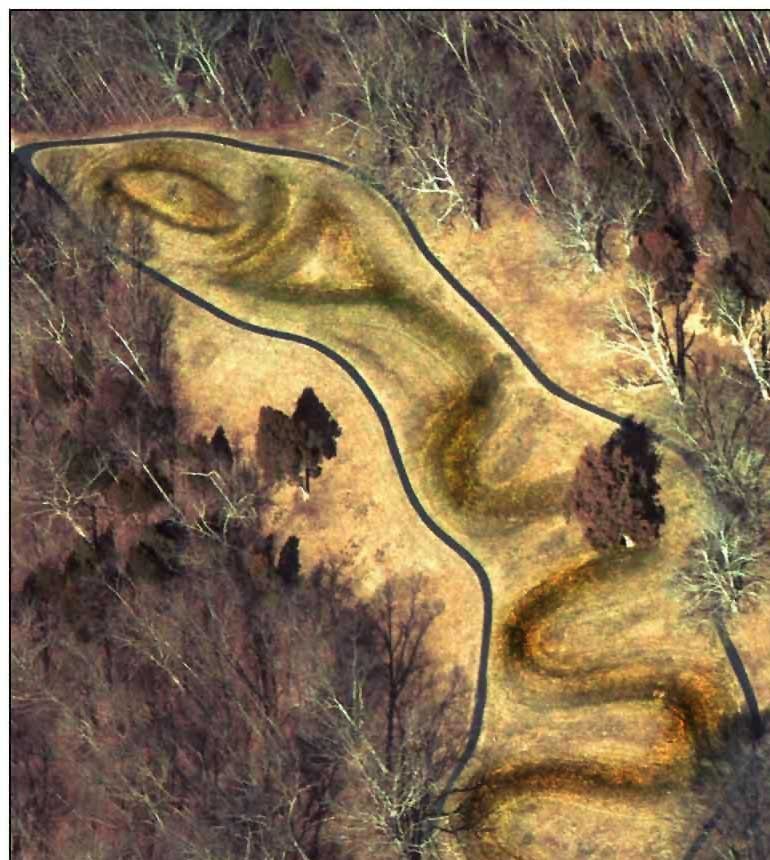
Serpent Mound is a long, low earthwork in the shape of a snake, set on a wooded ridge above Ohio Brush Creek near the village of Peebles in Adams County, southern Ohio. From the tip of its triple-coiled tail to its head it runs about 411 meters, or 1,348 feet. The body is only about a meter high in most places. It is the largest known snake effigy mound in the world.
The snake was built by Native Americans, but which people and when is still argued. Two cultures lived here. The Adena built burial mounds in the area from about 800 BCE to 100 CE, and two of their mounds stand nearby. The Fort Ancient culture lived here from about 1000 to 1650 CE and left a village and another burial mound. Radiocarbon dates have been used to support both builders.
The builders shaped the body from yellow clay and ash over a base of stones and soil. At the head, the snake's open jaws seem to hold an oval shape that has been read as an egg, an eye, or the sun. The head points toward the setting sun on the longest day of the year, and some of the curves may line up with other solar and lunar events.
The setting is unusual too. The mound sits on the edge of a rare geological structure, a crater left by an asteroid or comet strike hundreds of millions of years ago. That combination of sky, stone and serpent has made it a favorite of both archaeologists and ancient-astronaut theorists. It is also a sacred place for many Native American nations today, and it is a candidate for World Heritage status.
The ancient-alien case
Ancient Aliens first visited Serpent Mound in the 2011 episode Aliens and the Old West. There, author Ross Hamilton argued that the serpent mirrors the constellation Draco, the dragon stars once used to align the Great Pyramid in Egypt. He suggested this shows knowledge shared across the ancient world. Hamilton also floated the idea that stones placed in the mound were meant to draw lightning and gather power.
The crater is central to the theory. In the same episode, the show suggested that visitors from space were drawn to the impact site, perhaps to mine metals like iridium. Guests claimed compasses behave strangely on the ridge. Giorgio Tsoukalos asked why the builders chose this one spot, sitting on a rare scar from space, for their greatest work.
In the 2014 episode Aliens in America, Tsoukalos and David Childress place Serpent Mound among Native American sites said to have been visited by star beings. They argue that many Native traditions describe sky people who brought knowledge, and that the mound may record such a visit. For theorists, the precise solar alignment is another hint that the builders had help reading the sky.
What archaeologists say
Archaeologists see Serpent Mound as a Native American ceremonial site, not a mystery needing outside help. Snakes appear often in the art of the Eastern Woodlands and the Mississippian world. The Fort Ancient culture in particular used serpent imagery and made other effigies, which is why archaeologist Brad Lepper argues they are the likeliest builders. The Adena case rests on newer radiocarbon dates from soil under the mound.
The solstice alignment is real but modest. Farming and ritual calendars across the Americas tracked the sun closely, and a sunset alignment is well within what naked-eye observers could plan. The Draco and pyramid link has no support in Native tradition or in archaeology.
Geologists say the crater is old beyond human reckoning, formed hundreds of millions of years before people reached the Americas. Its jumbled rock does create an odd landscape, and some researchers think that landscape may have made the site feel special. That is a far cry from alien mining. Critics such as archaeologist Ken Kinkella also note that claims about Shawnee beliefs made on the show are not backed by Shawnee sources.
Timeline
- 252–330 million years agoAn asteroid or comet strike creates the Serpent Mound crater, later filled and worn down.
- c. 800 BCE–100 CEAdena people build burial mounds near the site; one team dates the serpent itself to about 300 BCE.
- c. 1000–1650 CEThe Fort Ancient culture lives here; charcoal dated to about 1070 CE supports them as the builders.
- 1848Ephraim Squier and Edwin Davis publish the first survey of the mound for the Smithsonian.
- 1886–1889Harvard's Frederic Ward Putnam excavates the site and, with funds from Boston donors, buys the land to save it.
- 1966Serpent Mound becomes a National Historic Landmark; the crater becomes a National Natural Landmark in 1980.
- 1991New excavation yields charcoal dated to about 900 years ago, pointing to the Fort Ancient culture.
- 2014–2018A new radiocarbon study argues for Adena construction around 300 BCE; other archaeologists push back in favor of Fort Ancient.
- 2023Ohio's Hopewell Ceremonial Earthworks join the World Heritage List; Serpent Mound stays on the US Tentative List for a separate bid.
- 2025–2026The US announces it will leave UNESCO at the end of 2026, putting Serpent Mound's nomination on hold.
Still unanswered
- Did the Adena or the Fort Ancient people build the serpent, or did one group rebuild what the other began?
- What is the oval shape at the snake's head meant to be: an egg, an eye, the sun, or a later addition?
- Did the builders know the ridge was unusual ground, and did that shape their choice of site?
- Will Serpent Mound ever reach the World Heritage List now that the US is leaving UNESCO?
Did you know?
- Serpent Mound was one of the first archaeological sites in the United States to be bought and set aside purely to protect it.
- The crater under the mound was once thought to be a 'sunken mountain' or an old volcano before shatter cones proved an impact.
- Serpent Mound was left out of Ohio's 2023 World Heritage listing because it was built by a different culture from the Hopewell earthworks.
On Ancient Aliens
- S03E01 Aliens and the Old West Ross Hamilton links the serpent to the Draco constellation and the crater, with Tsoukalos weighing in on the site's odd setting.
- S07E02 Aliens in America Tsoukalos and Childress list Serpent Mound among Native American sites said to have been visited by star beings.
Episode numbers follow Wikipedia's episode list; History and some reviewers number a few seasons differently.
Visiting
Getting there. Serpent Mound is near Peebles in Adams County, southern Ohio, about 120 km east of Cincinnati; you need a car to get there.
What you can see. The site is run by the Ohio History Connection. A paved path loops around the serpent, a viewing tower gives a higher look at the curves, and a small museum explains the mound and the crater. Two Adena burial mounds and a Fort Ancient mound are nearby. Walking on the mound itself is not allowed. Archaeology tours run on some days.
Tip. Visit near the summer solstice at sunset to see the alignment the head is thought to follow.
Sources
- Serpent Mound – Wikipedia en.wikipedia.org
- Serpent Mound – Ohio History Connection ohiohistory.org
- The Serpent Mound Impact Structure – Ohio Department of Natural Resources ohiodnr.gov
- Serpent Mound crater – Wikipedia en.wikipedia.org
- Serpent Mound Nomination – Ohio State University Earthworks earthworks.osu.edu
- As U.S. plans to exit UNESCO, Ohio earthwork may see years of delay – WYSO (July 2025) wyso.org
- Aliens in the Wild West, Part 1 – Digging Up Ancient Aliens diggingupancientaliens.com
- Review of Ancient Aliens 'Aliens in America' – Jason Colavito jasoncolavito.com
- List of Ancient Aliens episodes – Wikipedia en.wikipedia.org
Research notes: what we could not confirm
- The Digging Up Ancient Aliens host is referred to here as archaeologist Ken Kinkella based on the site's branding ('Dr. Kinkella'); his full name and credentials were not checked.
- The distance from Cincinnati (about 120 km) is approximate and was not checked against an official source.
- Colavito's 'S06E13 Aliens in America' is matched to History's S07E02 by air date (Jan 31, 2014) and review date (Feb 1, 2014).
- The rule against walking on the mound is standard at the site but was not confirmed on the page opened.
- Correction to the old entry: the Draco claim is confirmed (Ross Hamilton in S03E01), and S03E01 is now verified, not just plausible.