What it is
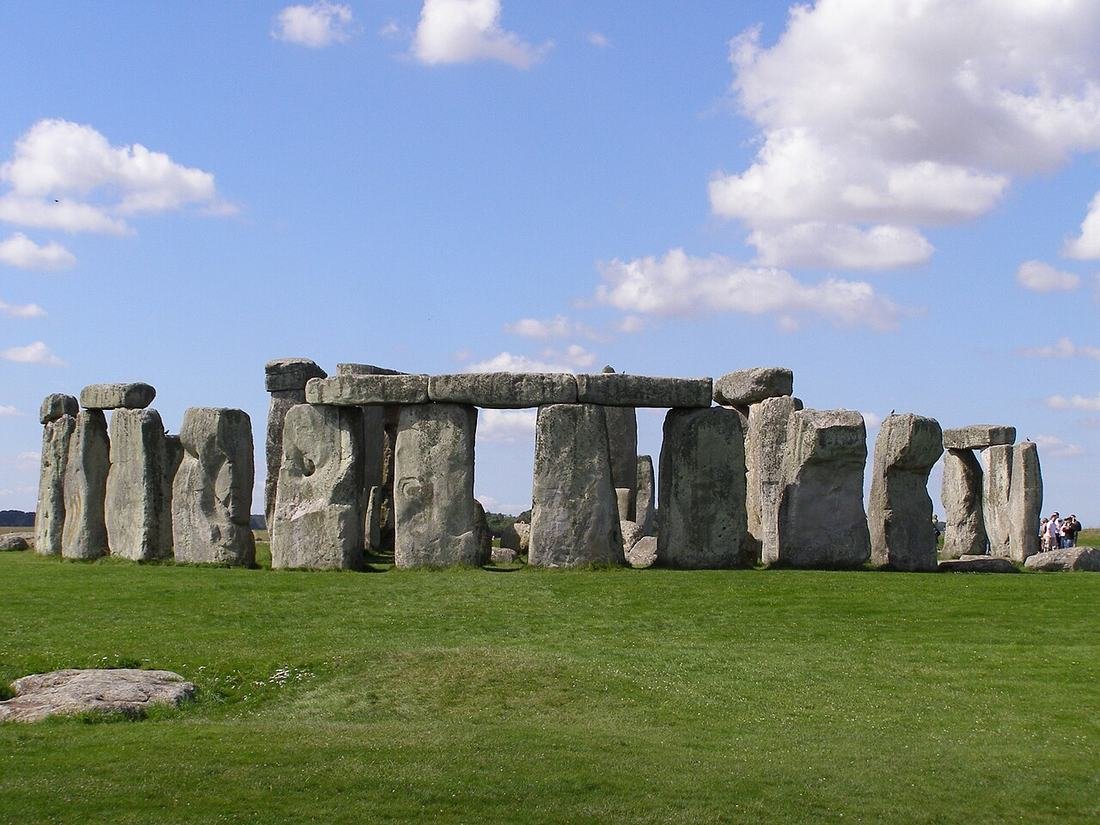
Stonehenge stands on Salisbury Plain in Wiltshire, in southern England, about 13 km north of the city of Salisbury. It is the best-known stone circle on Earth. The site grew in stages over more than a thousand years. It began around 3000 BCE as a round ditch and bank about 110 m across, with a ring of pits inside that held cremated human remains. For a time it was one of the largest burial grounds in Britain.
The big stones came later, around 2500 BCE. Builders set up a ring of huge sarsen sandstone uprights capped by a continuous circle of lintels. Inside that ring they raised five even bigger trilithons, each made of two uprights and a crosspiece, arranged in a horseshoe. Smaller stones known as bluestones were set in arcs between the two. The lintels are held on with carpentry joints, mortise and tenon on the uprights and tongue and groove along the ring.
Archaeologists credit the work to Neolithic farming communities of Britain. The sarsens came from West Woods, about 25 km to the north. The bluestones were hauled from the Preseli Hills of southwest Wales, some 225 km away. The central Altar Stone has now been traced to northeast Scotland. The monument's main axis lines up with sunrise at midsummer and sunset at midwinter, and a banked Avenue later linked it to the River Avon.
Stonehenge sits inside a dense ancient landscape of burial mounds, earthworks and the great timber-circle site of Durrington Walls about 3 km away. It is a World Heritage Site together with Avebury. The stones belong to the nation and are cared for by English Heritage. It matters because it shows how far Stone Age people could organize labor, share knowledge of the sky and move giant stones across a whole island.
The ancient-alien case
On Ancient Aliens, Stonehenge is treated as a machine rather than a temple. In 'The Secrets of Stonehenge' (2019), Giorgio Tsoukalos argues that the layout works as a scale model of the solar system, down to the dwarf planet Pluto. He and the show ask how Stone Age farmers could have known the shape of a planetary system that astronomers only mapped in modern times.
The same episode leans on the quartz in some bluestones. David Childress suggests that the biblical Nephilim, or giants after the Flood, may have used advanced technology to energize the quartz. Authors Andrew Collins and Graham Phillips describe stone circles as doorways between our world and another, and link the builders to the people behind Göbekli Tepe in Turkey. The episode's big claim is that the circle acted as a portal that carried its builders away, which the show offers as a reason their bloodline faded from Britain.
Sound is another thread. 'The Alien Frequency' (2017) presents the idea that stones like these could be lifted or tuned with sound, part of a wider theory that megaliths around the world were built to resonate. Theorists point to medieval legend, in which the wizard Merlin moved the stones by magic, as a garbled memory of that lost know-how.
Later episodes fold Stonehenge into UFO lore. 'Britain's UFO Files' (2025) casts ancient stone circles as hotspots for UFO activity and ties them to the crop circles of the Wiltshire countryside. Nick Pope, a former British defense official, argued in the 2019 Stonehenge episode that a 1996 crop formation near Stonehenge was a real message from beyond Earth. In the show's ranked specials, Stonehenge placed fifth among mysterious sites and first among mysterious monoliths.
What archaeologists say
Archaeologists say the evidence points squarely at Neolithic Britons. Geochemical testing matched most sarsens to West Woods, a short haul away. The bluestones have been traced to particular outcrops in the Preseli Hills, where digs found Neolithic quarry workings and stone wedges. Antler picks left in the ditches give radiocarbon dates that fit the building phases. Moving stones of this size on wooden sledges and rails is well within the reach of a large, organized workforce, and field experiments have shown it can be done.
The DNA story also has a plain explanation. Geneticists found that people linked to the Beaker culture, carrying ancestry from the steppes of eastern Europe, spread into Britain from about 2500 BCE. Over a few centuries they replaced most of the older farming population. Researchers see migration, mixing and probably disease at work, not a mass exit through a portal, and the new arrivals kept using and reshaping Stonehenge.
Astronomers note that the monument frames the midsummer sunrise and midwinter sunset, which an attentive farming people could track by eye over years. They reject the solar-system reading because planetary orbits are ellipses, not neat circles, and the stone rings do not match their spacing. Pluto was not known until 1930. No sound experiment has shown that acoustics could lift stones, and crop circles are widely documented as human-made.
Timeline
- c. 3000 BCEA circular ditch and bank are dug; a ring of pits (the Aubrey Holes) holds cremation burials.
- c. 2995–2900 BCEA cow whose tooth was later buried at the south entrance is raised in or near southwest Wales, hinting at early links to the bluestone region.
- c. 2500 BCEThe sarsen circle and the five trilithons are raised, with bluestones set between them.
- c. 2500 BCE onwardBeaker-culture newcomers from the continent arrive; within a few centuries most of Britain's ancestry changes.
- c. 2200 BCEThe Avenue, a banked path, is built to connect the monument with the River Avon.
- c. 1800–1500 BCETwo rings of pits, the Y and Z Holes, mark the last known prehistoric work at the site.
- 1882Stonehenge becomes one of Britain's first legally protected ancient monuments.
- 1986Stonehenge, Avebury and their surroundings are inscribed as a UNESCO World Heritage Site.
- 2024–2025A Nature study traces the Altar Stone to northeast Scotland (August 2024), and a cow-tooth isotope study strengthens the Welsh link (August 2025).
- 2026The long-debated A303 road tunnel is formally dropped in March when its planning consent is revoked; a new Learning Centre is due to open in autumn.
Still unanswered
- Why did builders go to the enormous effort of bringing bluestones from Wales and the Altar Stone from Scotland, when local stone was on hand?
- Were the bluestones first set up as a circle in Wales and later moved, as some researchers propose?
- How exactly were the stones moved, by land sledge, by boat along the coast, or with the help of cattle?
- What was the site mainly for: a burial ground, a solar calendar, a healing center, or a place to honor ancestors?
- How did the arrival of Beaker newcomers change who used the monument and what it meant to them?
Did you know?
- The central Altar Stone, a 6-tonne slab, came from the far northeast of Scotland, more than 750 km away.
- A cow's tooth buried at the entrance about 5,000 years ago carries chemical signs that the animal grew up in Wales, near the bluestone quarries.
- The lintels are fixed with joints borrowed from woodworking, as if the builders were thinking in timber while working in stone.
On Ancient Aliens
- S12E08 The Alien Frequency Presents Stonehenge as part of a worldwide network of megaliths built or raised with the power of sound.
- S14E17 The Secrets of Stonehenge The full treatment: a solar-system model including Pluto, energized quartz, portals and a vanished builder population.
- S17E02 Top Ten Mysterious Sites Ranks Stonehenge fifth and repeats the solar-system-model claim.
- S21E02 The Top Ten Mysterious Monoliths Ranks Stonehenge first, recycling earlier material on Merlin and portals.
- S21E15 Britain's UFO Files Frames stone circles as UFO hotspots and links Stonehenge to Wiltshire's crop circles.
Episode numbers follow Wikipedia's episode list; History and some reviewers number a few seasons differently.
Visiting
Getting there. On Salisbury Plain in Wiltshire, about 13 km north of Salisbury. Most visitors come by car or by tour bus from Salisbury or London; the visitor center sits a short shuttle ride or walk from the stones.
What you can see. The circle has been roped off since 1977, so visitors walk a path around the stones rather than among them. English Heritage offers limited early or late stone-circle access on booked tours, and opens the site for the summer and winter solstice gatherings. The wider landscape, including the Avenue, burial mounds and the Cursus, is open for walking.
Tip. Walk from the visitor center along the old Avenue and approach the stones from the northeast, the way the builders framed the solstice view.
Sources
- Stonehenge (Wikipedia) en.wikipedia.org
- History of Stonehenge (English Heritage) english-heritage.org.uk
- A Scottish provenance for the Altar Stone of Stonehenge (Nature, 2024) nature.com
- Prehistoric cow tooth supports Welsh origin of Stonehenge stones (UCL News, 2025) ucl.ac.uk
- List of Ancient Aliens episodes (Wikipedia) en.wikipedia.org
- Review of Ancient Aliens S14E17 'The Secrets of Stonehenge' (Jason Colavito) jasoncolavito.com
- Review of Ancient Aliens S12E08 'The Alien Frequency' (Jason Colavito) jasoncolavito.com
- Review of Ancient Aliens S17E02 'Top 10 Mysterious Sites' (Jason Colavito) jasoncolavito.com
- Review of Ancient Aliens S21E02 'The Top Ten Mysterious Monoliths' (Jason Colavito) jasoncolavito.com
- Review of Ancient Aliens S21E15 'Britain's UFO Files' (Jason Colavito) jasoncolavito.com
Research notes: what we could not confirm
- The old entry's link to 'Aliens and the Secret Code' (S3E13) and ley lines was not confirmed this session and has been left out.
- Stonehenge likely appears in other episodes (the Pilot, 'The Monoliths' S5E12 and others); these were not confirmed.
- The outer ring diameter and the claim that field experiments have moved multi-tonne stones on sledges are from general knowledge, not a page opened this session.
- Exact dates for the new Learning Centre opening in autumn 2026 were not confirmed.