What it is
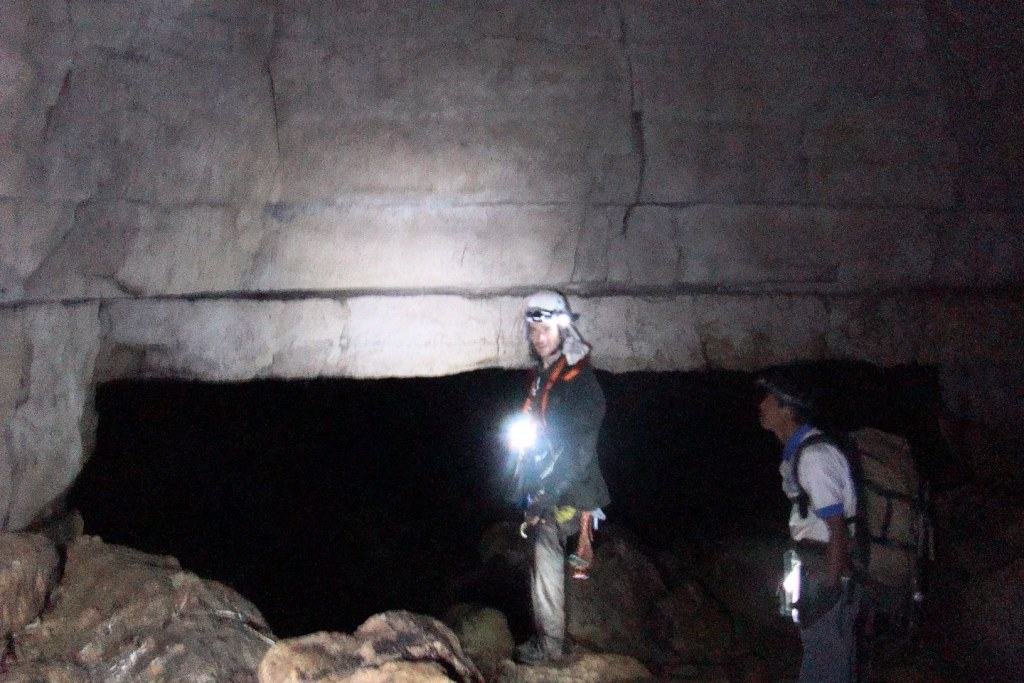
Cueva de los Tayos is a large limestone cave system in Morona-Santiago province, on the eastern slopes of the Andes in southeastern Ecuador. It lies near the Coangos River in forest belonging to the Indigenous Shuar people. The main entrance is a vertical shaft about 65 meters deep. Below it, passages and chambers stretch for more than 4 kilometers, some of them large enough to hold a cathedral.
The cave is named for the tayos, or oilbirds, that live in it by the thousands. They are the only night-flying, fruit-eating birds in the world, and they find their way in the dark using clicking calls, a kind of echolocation. For generations, Shuar families have climbed down into the cave on vine ladders with bamboo torches to collect young birds, and the site remains sacred to them.
The cave's fame outside Ecuador comes from a legend. In 1969, the Hungarian-Argentine explorer Juan Móricz claimed that tunnels in the region hid a treasure of metal plates engraved with the history of a lost civilization. Erich von Däniken made the story world famous in his 1972 book The Gold of the Gods, describing a metal library in the cave and suggesting it had extraterrestrial roots.
In 1976, a large British-Ecuadorian expedition explored and mapped the cave, with astronaut Neil Armstrong as its honorary president. The team recorded plants, animals and archaeological remains, including an ancient burial, but found no library, no gold and no cut tunnels. Visits still require permission from the Shuar, and the cave has never been developed for mass tourism. It remains a hard, wet trip into real wilderness.
The ancient-alien case
Ancient-astronaut theorists see Tayos as a place where a vanished civilization, possibly guided by visitors from space, hid its records. Erich von Däniken wrote that the cave held a library of thin metal sheets covered in unknown writing, along with statues and strange furniture. In his telling, the tunnels themselves were cut at clean right angles, too smooth and square to be natural.
Theorists point to the passages as physical evidence. Some chambers have flat ceilings, straight walls and corners that look cut. To them, water and time should not make shapes like these. They argue that some kind of cutting or melting tool, beyond anything available to ancient people, shaped the tunnels.
They also point to the treasures of Father Carlo Crespi, an Italian priest in the city of Cuenca. Local people brought him metal objects covered in odd symbols and images, some said to come from the caves. Theorists have presented these plates as surviving pages from the metal library.
Ancient Aliens took up the question early. Its 2010 episode Underground Aliens asked whether a cave in Ecuador holds metallic books recording the secrets of alien technology. Later episodes have mentioned von Däniken's golden library as part of a worldwide pattern of hidden underground knowledge, and the fact that Neil Armstrong himself went looking still fuels interest.
What archaeologists say
Scientists and historians say the cave is natural and the library has never existed. The 1976 expedition, which included cave specialists, scientists and British and Ecuadorian soldiers, mapped the system in detail. Armstrong and the team concluded the passages were natural formations. Geologists explain the flat ceilings and straight walls as the result of rock splitting along its layers and joints, then being smoothed by water.
The story fell apart at its source. Juan Móricz said publicly that von Däniken had never been inside the cave with him, and von Däniken later admitted adding what he called theatrical touches to his writing. The man whose account kept the legend alive, Petronio Jaramillo, told inconsistent versions, and the Shuar guide he named denied ever taking him inside.
The Crespi objects are not ancient books either. Investigators who looked at the collection, including skeptic James Randi, found that much of it was made from thin sheets of brass, copper and tin, including scrap, likely produced by local people to sell to the kindly priest. Some genuine pre-Columbian artifacts were in the collection, but nothing links them to a metal library.
Timeline
- Millions of years agoWater dissolves the limestone and shale of the Andean foothills, carving the cave system.
- c. 1500 BCEPeople bury their dead inside the cave; remains of this age were reported by the 1976 expedition.
- Centuries to presentShuar communities use the cave for oilbird harvests and as a spiritual place.
- 1969Juan Móricz announces that he has found underground metal plates and other treasures in the region and registers his claim with the authorities.
- 1972Erich von Däniken's The Gold of the Gods describes a metal library in the Tayos cave.
- 1973Móricz tells the German magazine Der Spiegel that von Däniken never went into the cave with him.
- 1976Stan Hall leads a British-Ecuadorian expedition with Neil Armstrong as honorary president; it finds no library and judges the passages natural.
- 1998Petronio Jaramillo, who claimed to have seen the library as a young man, is killed in Ecuador, leaving his story unconfirmed.
- 2018Josh Gates searches for the library on the TV series Expedition Unknown.
- 2020sEileen Hall, Stan Hall's daughter, promotes the cave for protection and heritage status amid mining pressure in the region.
Still unanswered
- Who was buried in the cave about 3,500 years ago, and what did the cave mean to them?
- Did any real find inspire Juan Móricz's claims, or was the whole story invented?
- What happened to the pieces of Father Crespi's collection that went missing after his death?
- How much of the cave system, and of the wider region, is still unmapped?
Did you know?
- Oilbirds were once boiled down for their fat, which people burned as lamp oil; that is how the birds got their English name.
- The main entrance shaft drops about 65 meters, roughly the height of a 20-story building, before the cave floor is reached.
- Juan Móricz said flatly that von Däniken had never been in the cave with him, which is part of why the 1976 expedition made headlines.
On Ancient Aliens
- S02E04 Underground Aliens The official synopsis asks whether a cave in Ecuador holds metallic books inscribed with alien technology.
- S09E01 Forbidden Caves Briefly mentions von Däniken's claimed golden library in Ecuador while discussing sacred caves.
Episode numbers follow Wikipedia's episode list; History and some reviewers number a few seasons differently.
Visiting
Getting there. Morona-Santiago province, southeastern Ecuador, in Shuar territory near the Coangos River. The usual starting points are the towns of Macas, Sucúa or Santiago de Méndez, followed by road travel and a hike through the forest.
What you can see. Entry requires permission from Shuar community authorities, and visits are normally arranged through local guides. Going down the main shaft involves a long rope or ladder descent, and passages can be wet, muddy and dark. Tours sometimes use a rope descent and a river crossing. This is an expedition, not a show cave.
Tip. Treat it as a caving trip: go with an experienced local operator that works with the Shuar, bring a headlamp and waterproof gear, and plan extra days for weather.
Sources
- Wikipedia: Cueva de los Tayos en.wikipedia.org
- Skeptoid 637: Cueva de los Tayos and the Lost Metal Library, Part 1 skeptoid.com
- Skeptoid 638: Cueva de los Tayos and the Lost Metal Library, Part 2 skeptoid.com
- Atlas Obscura: Cueva de los Tayos atlasobscura.com
- David Kushner: Journey to the Center of the Earth davidkushner.substack.com
- Jason Colavito: Remembering Neil Armstrong's brush with ancient astronauts jasoncolavito.com
- Jason Colavito: Review of Ancient Aliens Forbidden Caves jasoncolavito.com
- TVmaze: Ancient Aliens 2x04 Underground Aliens tvmaze.com
- TVmaze: Ancient Aliens 9x01 Forbidden Caves tvmaze.com
Research notes: what we could not confirm
- The date of about 1500 BCE for the burial found in 1976 comes from a journalist's account, not a published lab report.
- The size of the largest chamber (about 90 by 240 m) comes from Atlas Obscura and was not checked against the expedition survey.
- Colavito numbers Forbidden Caves as S07E06; Wikipedia and TVmaze list it as S09E01, which is used here.
- History's online clip about the metal library could not be matched to a specific broadcast episode.
- Whether the cave has any formal Ecuadorian protected status in 2026 was not confirmed.
- Móricz's 1969 claim is often said to have been formally registered with a notary in Guayaquil; this was not confirmed in a primary source.