What it is
Teotihuacan sits in a high valley about 40 kilometers northeast of Mexico City. At its height, between roughly 350 and 550 CE, it was one of the largest cities on Earth. Estimates of its population run from about 100,000 to as many as 200,000 people. The name is not its own. It comes from the Aztecs, who found the city abandoned centuries later and called it the place where the gods were born.
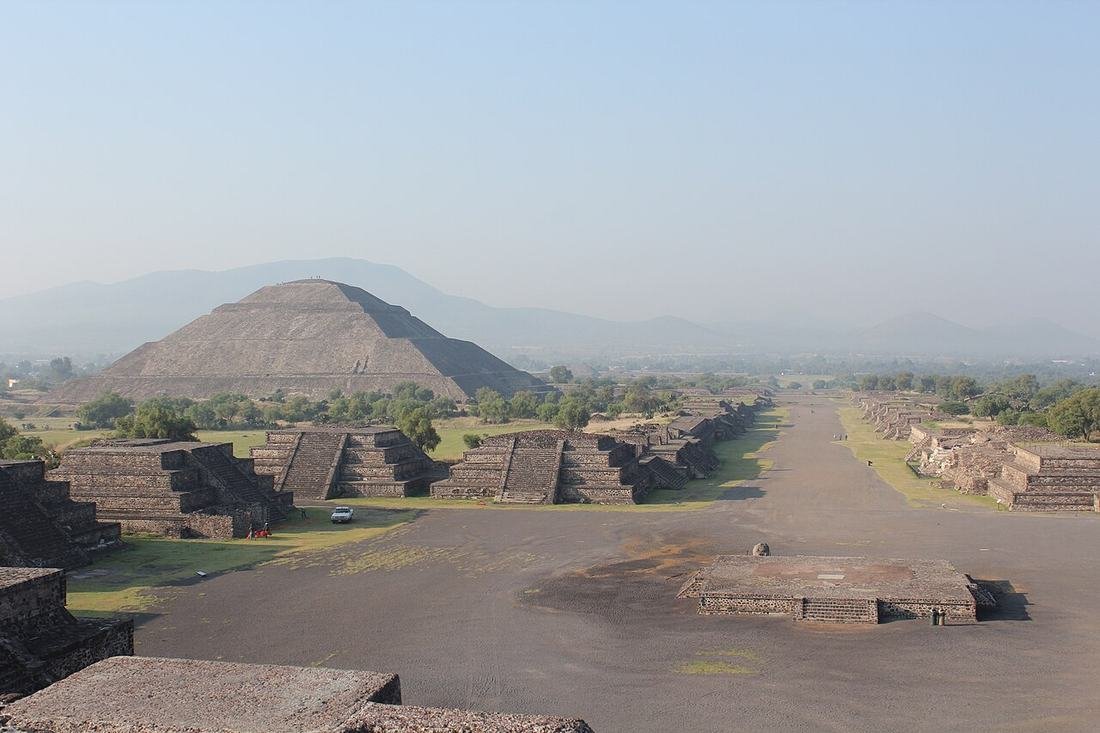
Archaeologists say the city was founded around 100 BCE and grew fast. Its builders laid it out on a grid tilted about 15 degrees east of north. A broad ceremonial road, later called the Avenue of the Dead, runs about 4 kilometers through the center. At its north end stands the Pyramid of the Moon. Halfway down, on the east side, rises the Pyramid of the Sun, about 65 meters tall today and one of the largest pyramids in the Americas.
At the south end lies the Ciudadela, a huge sunken plaza that frames the Temple of the Feathered Serpent. Its facade is covered with carved serpent heads and goggle-eyed faces. Around the monuments sprawled some 2,000 apartment compounds, many with painted walls. Craft workshops turned out obsidian blades and pottery. Whole neighborhoods held migrants from Oaxaca and the Maya lowlands. Many were rebuilt and repainted over generations.
Teotihuacan's reach was enormous. Its styles, trade goods and even its soldiers turn up hundreds of kilometers away, including at Maya cities such as Tikal. Around 550 CE, fires gutted the central temples and palaces, and the city slowly emptied. UNESCO named it a World Heritage Site in 1987. It remains one of the most-visited archaeological sites in Mexico. Excavations continue there every year, and new finds still reshape the story.
The ancient-alien case
Ancient-astronaut theorists see Teotihuacan as a city planned from the sky. On Ancient Aliens, commentators have said its three great pyramids line up like the belt stars of Orion, the same pattern some claim for Giza. Earlier episodes pushed a different idea that came from engineer Hugh Harleston Jr. in the 1970s. Harleston proposed a unit of measure he called the hunab, about 1.059 meters, and argued that the spacing of selected buildings forms a scale model of the solar system.
The mica is a favorite clue. Theorists point out that the sheets under the Viking Group floor came from far away, likely hundreds of kilometers, and were then hidden where nobody could see them. On the show they ask why anyone would bury a decorative stone. Their answer is that mica is an insulator used in modern electronics, and that the builders may have been shielding something, perhaps from the effects of a flying craft.
The tunnel under the Temple of the Feathered Serpent gave theorists even more to work with. Pools of liquid mercury and hundreds of shiny metallic-looking spheres were found near its end. David Childress has suggested on the program that the mercury could have fed some kind of propulsion system for spacecraft, and later episodes have called the site the remains of an energy device.
Other contributors have focused on the stonework and the underworld. Marco Vigato has pointed to sharp, precise corners as a sign of more advanced tools. Theorists also link the tunnels and the cave under the Pyramid of the Sun to origin myths about ancestors who emerged from the earth. In their reading, those myths may preserve a memory of visitors who came from somewhere else.
What archaeologists say
Archaeologists say Teotihuacan was built by the people who lived there, a mixed population drawn from across central Mexico and beyond. The Pyramid of the Sun is a mass of earth, rubble and adobe faced with stone and once coated in painted lime plaster. Excavations have found the homes, workshops, trash pits and burials of the ordinary workers who built and ran the city. Radiocarbon dates and pottery sequences place its rise and fall in the first seven centuries CE.
The famous finds have ordinary explanations. Tests show mica at Teotihuacan came mostly from Oaxaca, and it turns up widely, on incense burners, masks, figurines and in burial offerings, where its shine mattered. The spheres in the tunnel are clay balls coated with iron pyrite that later weathered to a yellowish mineral called jarosite. The mercury, likely made by heating cinnabar, sat in a small modeled landscape deep underground. Gómez Chávez reads it as a symbolic lake in a ritual underworld.
Scholars also reject the planet and star layouts. Critics have shown that the solar-system model only works by picking some small buildings and ignoring many others. Most archaeologists tie the city's grid to the sun's movements across the horizon on key dates of the farming year, a theme found across Mesoamerica.
Timeline
- c. 100 BCEFarming villages in the valley begin to grow into a planned city.
- c. 150-250 CEThe Pyramid of the Sun and the Temple of the Feathered Serpent are built; about 200 people, many dressed as warriors, are buried as sacrifices under the temple.
- c. 200-250 CEThe long tunnel beneath the Temple of the Feathered Serpent is filled in and sealed.
- c. 350-550 CEThe city reaches its peak in size and influence across Mesoamerica.
- c. 550 CEFires destroy temples and elite buildings along the Avenue of the Dead; the population declines over the next two centuries.
- 1944Pedro Armillas finds thick sheets of mica laid under a floor in the building complex now called the Viking Group.
- 1971A cave passage is found running under the Pyramid of the Sun from near its main stairway.
- 1987UNESCO inscribes the Pre-Hispanic City of Teotihuacan on the World Heritage List.
- 2003-2015Sergio Gómez Chávez's team opens the sealed tunnel under the Feathered Serpent temple, finding pyrite-coated spheres and traces of liquid mercury.
- 2025Linguists Christophe Helmke and Magnus Pharao Hansen argue that the city's signs record an early form of the Uto-Aztecan language family, the family that includes Nahuatl.
Still unanswered
- Who ruled Teotihuacan, and why are there no clear portraits or named kings like those of the Maya?
- What language did the city speak, and will the 2025 case for an early Uto-Aztecan language hold up?
- What set off the fires around 550 CE: revolt, invasion, drought or a mix of all three?
- Is there still an unopened royal tomb somewhere under the great pyramids?
- What exactly were the tunnel rituals meant to do, and why was the passage sealed so soon after it was built?
Did you know?
- The name Avenue of the Dead is an Aztec-era label; the Aztecs mistook the ruined platforms lining it for tombs.
- A rolling robot named Tlaloc II was used to map parts of the Feathered Serpent tunnel that were too tight or unsafe for people.
- Teotihuacan had a whole neighborhood of families from Oaxaca, who kept their home region's burial customs for centuries.
On Ancient Aliens
- S12E04 The Alien Architects Revisits the idea that the Teotihuacan pyramids mirror the belt stars of Orion.
- S12E07 City of the Gods A full hour on Teotihuacan covering the mica, the mercury, the spheres and claimed star and planet alignments.
- S21E04 The Top Ten Unexplained Technology Ranks the metallic spheres from under the city among its top ten technology mysteries.
- S21E07 Mysteries of the Aztecs Returns to the claim that the mercury and mica point to an ancient energy device.
- S22E04 Extraterrestrial Engineering A compilation episode that replays the segment on the spheres found beneath the site.
Episode numbers follow Wikipedia's episode list; History and some reviewers number a few seasons differently.
Visiting
Getting there. San Juan Teotihuacán, about 40 km northeast of Mexico City. Most visitors come by bus from the Terminal Autobuses del Norte in Mexico City, on a tour, or by car in about an hour.
What you can see. Visitors can walk the full Avenue of the Dead, the Ciudadela and several painted residential compounds, and there are site museums. Climbing the Pyramid of the Sun has been restricted in recent years to protect it, and the tunnels under the Feathered Serpent temple and the Pyramid of the Sun are closed to the public. Hot-air balloon flights operate from nearby towns.
Tip. Start at the south end near the Ciudadela and walk north, so the Pyramid of the Moon rises ahead of you along the avenue; bring sun protection, since there is almost no shade at 2,300 meters of altitude.
Sources
- UNESCO World Heritage Centre: Pre-Hispanic City of Teotihuacan whc.unesco.org
- Wikipedia: Teotihuacan en.wikipedia.org
- Wikipedia: Temple of the Feathered Serpent, Teotihuacan en.wikipedia.org
- Wikipedia: Pyramid of the Sun en.wikipedia.org
- La mica: usos y distribución de un recurso alóctono en Teotihuacan (Redalyc) redalyc.org
- Archaeology News: Teotihuacan murals reveal possible Uto-Aztecan language (2025) archaeologymag.com
- Live Science: Secret tunnel found beneath the Pyramid of the Moon livescience.com
- Plaza of the Columns Complex Project: Results 2025 ppcteotihuacan.org
- Jason Colavito: The Teotihuacan Solar System Revisited jasoncolavito.com
- History with the Szilagyis: review of Ancient Aliens City of the Gods historywiththeszilagyis.wordpress.com
Research notes: what we could not confirm
- The exact current rules for climbing the Pyramid of the Sun were not confirmed for 2026; check with INAH before a visit.
- The Pilot and Season 3 appearances listed in the old entry were not re-verified, so they are left out of the episode list.
- The idea that the mica was hidden as insulation against a flying craft comes from a secondhand episode review, not a transcript.
- Sources give different heights for the Pyramid of the Sun (about 65 m to about 71 m), partly because of the early-1900s reconstruction.