What it is
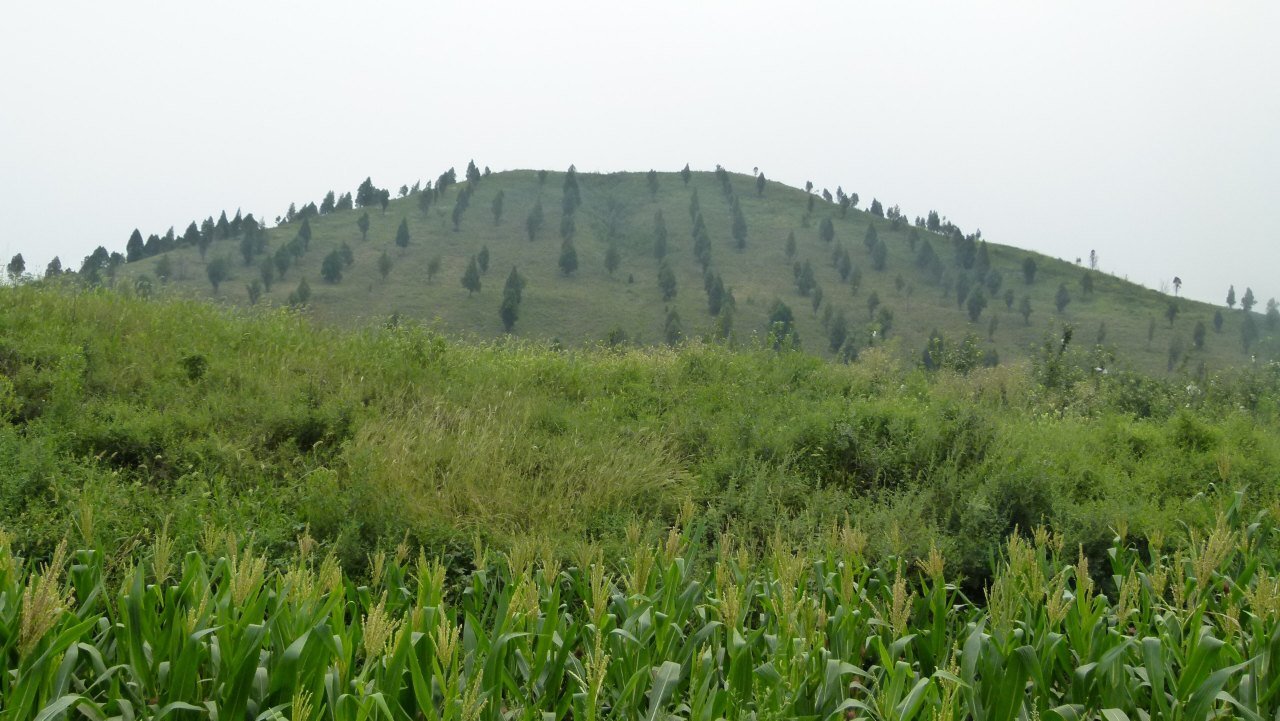
The so-called Chinese pyramids are imperial burial mounds on the Guanzhong Plain around Xi'an and Xianyang in Shaanxi Province, central China. About 38 of them cluster roughly 25 to 35 kilometers northwest of Xi'an, with more scattered across the region. They are flat-topped mounds of rammed earth, packed hard layer by layer, raised over the tombs of emperors, empresses and high officials.
The largest is the mound of Qin Shi Huang, the ruler who unified China in 221 BCE and called himself its First Emperor. Work began in 246 BCE and went on for decades. Ancient records say about 700,000 laborers took part. The mound is about 350 meters on each side and still dozens of meters high. It stands over a vast buried palace that has never been opened.
Around it lie hundreds of pits. The most famous hold the Terracotta Army, thousands of life-size clay soldiers found by farmers digging a well in 1974. The Han dynasty emperors who followed built their own mounds north of the Wei River. The biggest is Maoling, tomb of Emperor Wu, begun in 139 BCE and finished about 53 years later at his death in 87 BCE.
In the West these mounds gained a mystical reputation. Travelers photographed them in 1912. After World War II, stories spread of a huge white pyramid seen from the air. Ancient-astronaut writers later claimed China was hiding pyramids to be compared with Giza. Chinese archaeologists have studied the tombs for decades, and several now have museums. The mounds are well known in China and are marked on ordinary maps.
The ancient-alien case
Ancient-astronaut theorists see pyramids on several continents as one pattern with one source. In 'Secrets of the Pyramids', the show counts China's mounds among the world's pyramids. John DeSalvo claims the Chinese government has covered them up and says old Chinese rulers told of beings who came down from the sky bearing knowledge. Jason Martell points to trees the state planted on some mounds in the 1950s as a sign of concealment.
'Hidden Pyramids' returns to the theme, describing the mounds as off limits to tourists. Theorists ask what the sealed tombs might hold. They point to the mercury rivers Sima Qian described and ask why the Qin burial chamber stays closed after more than 2,000 years.
The most dramatic story is the Great White Pyramid. A U.S. pilot named James Gaussman is said to have seen a gleaming white pyramid with a jewel-like cap during a World War II flight. In 1947 airline executive Maurice Sheahan reported a pyramid about 1,000 feet tall southwest of Xi'an. Hartwig Hausdorf's 1994 book argued the white pyramid was real, hidden inside a military zone, and tied to beings from space.
What archaeologists say
Chinese archaeologists say the mounds are exactly what their records claim: tombs for the Qin and Han rulers and their families. The builders pounded earth in thin layers, a technique also used for city walls. Historical texts, excavated pits, inscriptions and grave goods identify many of the tombs by name. Maoling and the Terracotta Army have public museums, and research is published openly.
The White Pyramid story falls apart under close reading. The photo tied to it shows Maoling, a much smaller, eroded, flat-topped mound. Sheahan himself later revised his size estimate, blaming a mix-up in converting Chinese units. The Gaussman account appears only through later retellings. No survey or satellite image has found a giant pyramid in the Qinling Mountains.
The Qin burial chamber stays closed by choice. Chinese authorities say current methods cannot yet protect what is inside, including painted surfaces that fade within minutes of exposure. Soil tests over the mound have found raised mercury levels, which fits Sima Qian's account, though some scholars suggest later pollution may add to the readings.
Timeline
- 246 BCEWork begins on Qin Shi Huang's mausoleum; it expands after he unifies China in 221 BCE.
- 210 BCEThe First Emperor dies and is buried; the historian Sima Qian later writes that the tomb held rivers of mercury.
- 139-87 BCEHan Emperor Wu builds Maoling, the largest of the Han imperial mounds.
- 1912Western traders Fred Meyer Schroder and Oscar Mamen photograph and describe the mounds.
- 1947The New York Times reports Colonel Maurice Sheahan's sighting of a giant pyramid; a photo published days later is later identified as Maoling.
- 1974Farmers digging a well near the Qin mound find the first pieces of the Terracotta Army.
- 1987The Mausoleum of the First Qin Emperor is listed as a UNESCO World Heritage Site.
- 1994German author Hartwig Hausdorf publishes Die weiße Pyramide, linking the mounds to extraterrestrials.
- December 2024Archaeologists announce the first high-ranking commander figure ever found in Terracotta Pit 2.
- January 2025Reports describe ancient cinnabar mining sites in Shaanxi that may have supplied the mercury in the Qin tomb.
Still unanswered
- What does the unopened burial chamber of Qin Shi Huang contain, and are the mercury rivers real?
- When, if ever, will China's archaeologists judge it safe to excavate the chamber?
- Did Gaussman exist and see anything, or did the white pyramid story grow from Sheahan's Maoling sighting?
- How many smaller tombs and pits around the imperial mounds remain undiscovered?
Did you know?
- The farmers who found the Terracotta Army in 1974 were digging a well during a drought.
- A gilded bronze horse found near Maoling in 1981 is the largest of its kind ever found in China.
- Despite the name 'pyramids', the Chinese mounds are made of packed earth, not cut stone.
On Ancient Aliens
- S05E01 Secrets of the Pyramids John DeSalvo and Jason Martell claim China has hidden its pyramid mounds.
- S09E10 Hidden Pyramids Revisits the Chinese mounds as mysterious sites off limits to tourists (History numbers this S07E15).
Episode numbers follow Wikipedia's episode list; History and some reviewers number a few seasons differently.
Visiting
Getting there. Xi'an, reached by high-speed train or by air through Xi'an Xianyang International Airport. The Qin mausoleum is east of the city near Lintong; Maoling and the Han mounds are to the northwest near Xingping and Xianyang.
What you can see. The Emperor Qinshihuang's Mausoleum Site Museum includes the Terracotta Army pits and the park around the Qin mound; the mound can be seen but not climbed or entered. Maoling has an on-site museum, and the Hanyangling Museum lets visitors look into excavated pits under glass. Many smaller mounds stand in farmland and can be seen from the roadside.
Tip. Combine Maoling with the nearby tomb of general Huo Qubing, whose Han-era stone sculptures are among the oldest large carvings in China.
Sources
- Chinese pyramids - Wikipedia en.wikipedia.org
- Maoling - Wikipedia en.wikipedia.org
- Mausoleum of the First Qin Emperor - Wikipedia en.wikipedia.org
- Mausoleum of the First Qin Emperor - UNESCO World Heritage Centre whc.unesco.org
- Weiße Pyramide (China) - German Wikipedia de.wikipedia.org
- In Search of the Fabled White Pyramid of Xian - Ancient Origins ancient-origins.net
- New terracotta discovery at First Emperor's mausoleum - HeritageDaily heritagedaily.com
- New evidence reveals the source of mercury in the Qin mausoleum - Archaeology Magazine (archaeologymag.com) archaeologymag.com
- Review of Ancient Aliens S05E01 'Secrets of the Pyramids' - Jason Colavito jasoncolavito.com
- Review of Ancient Aliens 'Hidden Pyramids' - Jason Colavito jasoncolavito.com
Research notes: what we could not confirm
- Whether Ancient Aliens itself tells the WWII White Pyramid story on screen was not confirmed.
- Height figures for the Qin mound disagree between sources (about 47 m vs. 76 m); the original height is uncertain.
- The Gaussman sighting has no contemporary record that could be found; it appears only in later retellings.
- Details on fading painted surfaces, the drought behind the 1974 well-digging, the Hanyangling glass galleries, the Huo Qubing sculptures and transport links come from general knowledge, not pages opened this session.