What it is
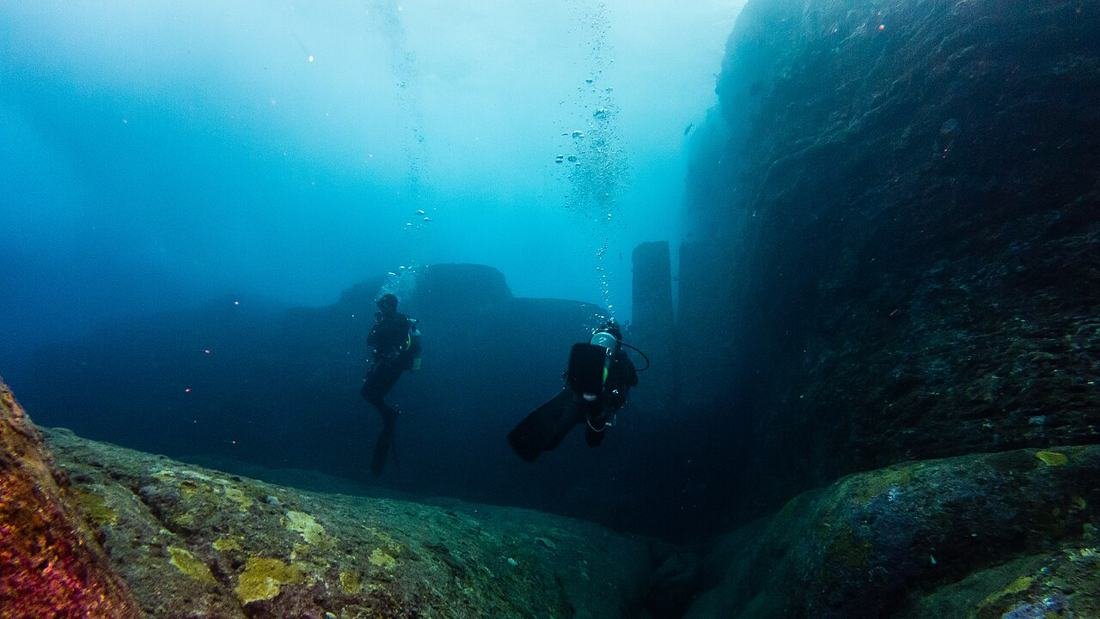
The Yonaguni Monument is a large underwater rock formation off the southern coast of Yonaguni, the westernmost inhabited island of Japan. It lies below the Arakawa-bana headland, in clear warm water on the edge of the Ryukyu chain, roughly 100 kilometers east of Taiwan. Its top comes within about 5 meters of the surface, and its base sits about 25 meters down.
What makes it famous is its shape. The rock breaks into broad flat platforms and tall steps with sharp edges and near right angles. From some angles it looks like a stepped building or a giant stairway. Divers have given names to its parts: a triangle pool, a so-called turtle, a stone that looks like a face, and a narrow passage between two tall slabs.
The formation was noticed in 1986 by Kihachiro Aratake, a local dive guide who was looking for hammerhead sharks. Marine geologist Masaaki Kimura of the University of the Ryukyus began studying it in the early 1990s. He came to believe it was a human-made complex, and he has spent decades arguing that case. Most geologists disagree. The debate has run for more than three decades without a clear resolution.
The rock itself is sandstone and mudstone laid down roughly 20 million years ago. Neither Japan's Agency for Cultural Affairs nor Okinawa Prefecture treats the site as a cultural property, and no official archaeological protection or excavation has taken place. Even so, it has become one of the most-discussed places in alternative history and a popular dive for visitors to the island.
The ancient-alien case
Ancient-astronaut theorists see Yonaguni as proof that a civilization flourished during the last Ice Age, when sea levels were far lower and this spot would have been dry land. Its broad terraces, straight edges and steps look to them like the terraced pyramids and platforms found around the world. If it was built before the seas rose, they say, it could be older than the pyramids of Egypt by thousands of years.
Their star witness is Masaaki Kimura, a professional marine geologist. Kimura has described roads, drainage channels, stairways, a carved face and a turtle-shaped platform, and he has linked the site to a lost Pacific culture. Some supporters tie it to the legend of Mu, a sunken continent popular in early twentieth-century fringe writing. Graham Hancock dove with Kimura and treated the site as possible evidence of a lost civilization in his book Underworld.
On Ancient Aliens, Giorgio Tsoukalos and others have presented Yonaguni as a pyramid drowned at the end of the Ice Age. In Secrets of Japan, Tsoukalos, William Henry and David Childress connected it to the so-called Dragon's Triangle, a stretch of ocean south of Japan where, they said, ships go missing. They floated the idea that the losses might be linked to a sunken base.
Theorists also point to the way the blocks appear to have been removed from some areas and not others. In their view, natural erosion should not leave clean, level floors next to vertical walls. They argue that the same flat-and-stepped pattern at so many ancient sites suggests a shared design, and possibly a shared teacher.
What archaeologists say
Most geologists say the monument is natural. The sandstone at Yonaguni is thinly layered and crossed by two sets of cracks, or joints, that meet at close to right angles. When waves and currents work on rock like this, whole blocks break away along the layers and the cracks, leaving flat floors and square steps behind. Similar stepped shapes can be seen on dry land along Yonaguni's coast, at a spot called Sanninudai.
Robert Schoch, a Boston University geologist who is open to many unconventional ideas, dove the site in 1997 and 1998 and judged it primarily natural. He has allowed that people might have used or reshaped parts of it, a kind of terraforming, but he found no clear sign of building. No tools, inscriptions, pottery or fitted masonry have been recovered from the formation itself. Critics also note that the steps are far too tall to climb.
The Dragon's Triangle has its own paper trail. Writer Charles Berlitz popularized it in the 1970s. Researcher Larry Kusche found in 1975 that people in Japan did not know of any such danger zone, and that the stories of lost ships were exaggerated or misreported.
Timeline
- about 20 million years agoThe sandstone and mudstone layers of the Yaeyama Group are laid down.
- c. 18,000-8,000 BCESea levels rise after the last Ice Age; much of the area around the islands is drowned (general sea-level history).
- 1986Dive guide Kihachiro Aratake spots the stepped formation while looking for hammerhead sharks.
- 1992 onwardMasaaki Kimura begins dives and surveys and argues the formation is man-made.
- 1997-1998Geologist Robert Schoch dives the site several times and concludes it is mostly natural.
- 2002Graham Hancock features Yonaguni in his book Underworld and its companion TV series.
- 2007Kimura tells the Pacific Science Congress he now dates the structures to 2,000-3,000 years ago.
- 2015Ancient Aliens presents Yonaguni in Hidden Pyramids as an Ice Age pyramid.
- 2025The Ancient Aliens episode Secrets of Japan returns to Yonaguni and the Dragon's Triangle.
Still unanswered
- Did people living on Yonaguni when sea levels were lower use, quarry or shape any part of the rock?
- Why has no full, peer-reviewed geological and archaeological survey of the whole formation been published?
- Are the so-called carvings, like the face and turtle, human work or tricks of the eye on eroded stone?
- What does the seabed around the island hide from the time when the coastline lay farther out?
Did you know?
- The monument was found by accident by a man hunting for sharks, not by anyone searching for ruins.
- Masaaki Kimura shortened his own age estimate for the site from more than 10,000 years to just 2,000 to 3,000 years.
- Robert Schoch, the geologist famous for arguing that Egypt's Sphinx is far older than Egyptologists say, still concluded that Yonaguni is mostly natural.
On Ancient Aliens
- S02E03 Underwater Worlds The episode's official synopsis asks whether a stepped stone structure off Japan predates the Egyptian pyramids.
- S09E10 Hidden Pyramids Presents Yonaguni as an artificial Ice Age pyramid, using edited comments from Robert Schoch.
- S19E19 The Top Ten Mysteries of the Deep Includes Yonaguni in its countdown of underwater mysteries.
- S21E17 Secrets of Japan Ties Yonaguni to a lost civilization and to ship losses in the Dragon's Triangle.
Episode numbers follow Wikipedia's episode list; History and some reviewers number a few seasons differently.
Visiting
Getting there. Yonaguni Island, Okinawa Prefecture, Japan. Visitors fly in from Naha or Ishigaki, or take the ferry from Ishigaki. The site is off Arakawa-bana at the island's southern tip.
What you can see. The monument can only be seen by boat. Certified divers join local dive shops, and glass-bottom and semi-submersible boat tours run in calmer seas. There is no fence or official site management. Currents can be strong, so it is usually recommended for experienced divers.
Tip. Winter is hammerhead season around Yonaguni, but seas can be rough; plan spare days in case boats cannot go out.
Sources
- Wikipedia: Yonaguni Monument en.wikipedia.org
- Wikipedia: Masaaki Kimura en.wikipedia.org
- Robert M. Schoch: Enigmatic Yonaguni underwater monuments robertschoch.net
- Explorersweb: Exploration Mysteries, Yonaguni Monument explorersweb.com
- TVmaze: Ancient Aliens 2x03 Underwater Worlds tvmaze.com
- Jason Colavito: Review of Ancient Aliens Hidden Pyramids jasoncolavito.com
- Jason Colavito: Review of Ancient Aliens S21E17 Secrets of Japan jasoncolavito.com
- Jason Colavito: Review of Ancient Aliens S19E19 The Top Ten Mysteries of the Deep jasoncolavito.com
- Wikipedia: List of Ancient Aliens episodes en.wikipedia.org
Research notes: what we could not confirm
- Episode numbering differs between sources: Wikipedia lists Hidden Pyramids as S09E11 (aired April 17, 2015), while Jason Colavito's review calls it S07E15, and the old entry called it S9E10.
- The Underwater Worlds synopsis refers to a 600-foot stepped structure off Japan without naming Yonaguni; the link is inferred.
- Published dimensions of the formation vary widely between sources.
- Kimura was listed as living in 2026 on Wikipedia; this was not otherwise confirmed.