What it is
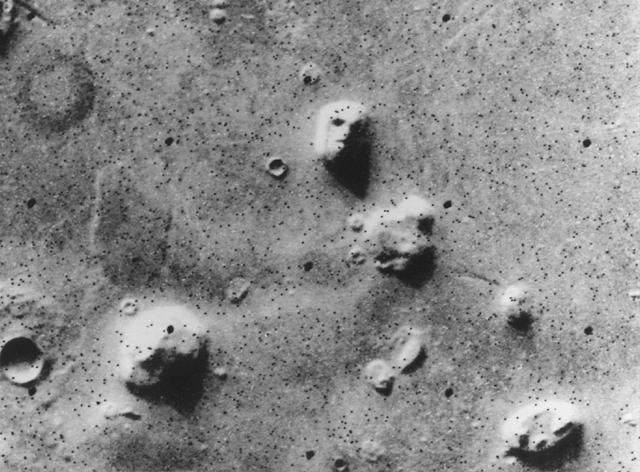
On July 25, 1976, NASA's Viking 1 Orbiter was scouting northern Mars for a safe place to set down the Viking 2 lander. One of its pictures, frame 35A72, showed a flat-topped hill in a region called Cydonia. Low afternoon light threw shadows across it. The result looked startlingly like a human face: two eyes, a nose and a mouth, staring straight up.
NASA showed the picture at a press briefing and called it a rock formation that happened to resemble a head. Viking chief scientist Gerald Soffen dismissed it as a "trick of light and shadow." For a few years, that was the end of it.
It did not stay that way. The Face on Mars became one of the most famous images ever taken of another planet. It spawned books, TV specials, a cover-up theory and a whole "city" of supposed ruins around it. It also became a textbook lesson in how our brains see faces where none exist.
The ancient-alien case
The modern story starts with two computer engineers at NASA's Goddard Space Flight Center, Vincent DiPietro and Gregory Molenaar. In the late 1970s they dug through the Viking archives and found the Face had been photographed twice. The second shot, frame 70A13, was taken about five weeks later with the sun higher in the sky. To them, the face still looked like a face.
They enhanced both images by computer and argued the features were too regular to be chance. They reported their work in a 1982 book, Unusual Martian Surface Features. They also flagged a nearby five-sided mountain that later came to bear their initials.
Writer Richard C. Hoagland took the idea much further. In his 1987 book The Monuments of Mars: A City on the Edge of Forever, he claimed the Face was part of a planned complex. He pointed to a cluster of pyramid-shaped hills he called "the City." He promoted the big five-sided peak, called the "D&M Pyramid" after DiPietro and Molenaar. His colleague Erol Torun measured its angles and argued they held hidden mathematical messages.
Hoagland also argued that NASA knew the truth and was hiding it. That claim has stayed at the heart of the theory ever since.
The idea even drew in a trained astronomer. Tom Van Flandern had worked at the U.S. Naval Observatory, where he ran the celestial mechanics branch of the Nautical Almanac Office. He came to believe the Cydonia features were built by intelligent beings. He tied them to his own theory that a large planet once existed where the asteroid belt is now, and exploded. He argued the case in his 1993 book Dark Matter, Missing Planets, New Comets.
Ancient-astronaut theorists fold all of this into a bigger story. In their view, Mars was once a living world with water and air. A civilization rose there, then fled or died as the planet dried out. Some suggest the survivors came to Earth, which might explain why Martian "pyramids" and Egyptian ones seem to echo each other.
Mars's small moon Phobos gets pulled in too. Around 1958 Soviet astrophysicist Iosif Shklovsky suggested Phobos might be hollow, based on odd readings of its orbit. That sparked talk of an artificial moon. In 1989 the Soviet probe Phobos 2 went silent just before it began a close study of the moon, which theorists see as suspicious. And a tall, lone boulder on Phobos, spotted in 1998 Mars Global Surveyor images and nicknamed the "Phobos monolith," got wide attention after astronaut Buzz Aldrin mentioned it in a 2009 interview.
What scientists say
Scientists say the Face is a natural mesa, and that every sharper photo has made that clearer. Viking's camera saw the region at about 50 meters per pixel. A whole "eye" was only a handful of dots. Sharper cameras would settle it, and they did.
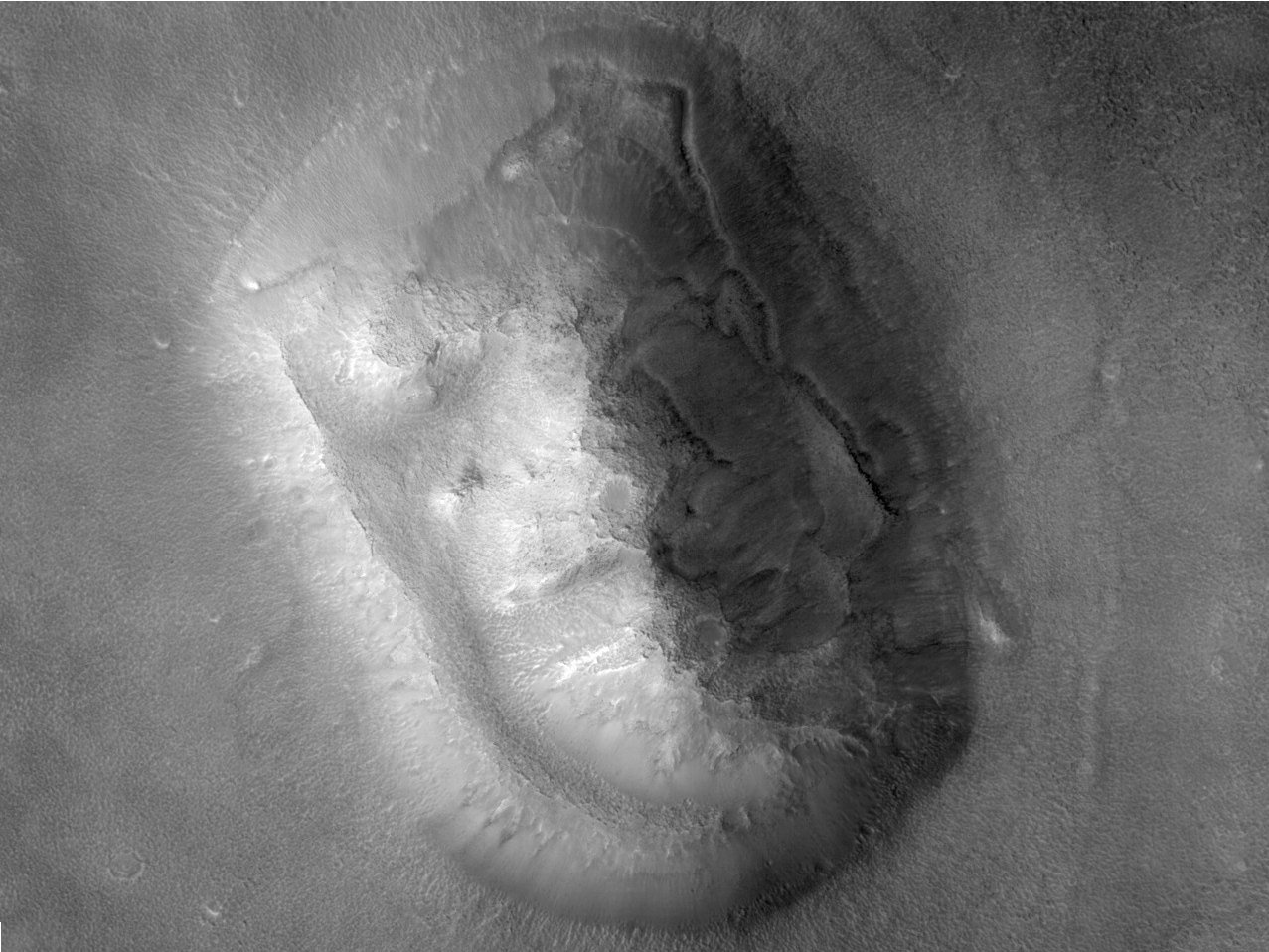
On April 5, 1998, NASA's Mars Global Surveyor photographed the Face at 4.3 meters per pixel, roughly ten times sharper than Viking. On April 8, 2001, it did better, about 2 meters per pixel, with the spacecraft rolled to the side for the shot. NASA's verdict: a natural-looking hill whose face-like look depends on the viewing angle and the lighting.
Europe's Mars Express added a 3D look in 2006. Its stereo camera showed a worn, slumping mesa with landslides and debris aprons at its base. In 2007, the HiRISE camera on NASA's Mars Reconnaissance Orbiter shot it at about 30 centimeters per pixel. It showed eroded slopes and boulders, with no walls, doorways or carved features.
The reason so many saw a face is called pareidolia: the brain's habit of finding faces and familiar shapes in random patterns. It is the same reason we see a man in the Moon or faces in clouds and electrical outlets. Carl Sagan made the Face a chapter of his 1995 book The Demon-Haunted World for exactly that reason.
The Cydonia area sits on the line between Mars's cratered southern highlands and its smooth northern plains. That border is full of buttes, mesas and knobs carved by erosion. NASA notes the Face is one of thousands. Earth has similar mesas too.
The Phobos claims have answers too. Better orbit measurements available by 1969 showed the odd behavior Shklovsky relied on did not exist. Phobos 2 failed from a computer or radio fault while already running on backup power. The "monolith" is a large boulder, likely thrown out by an impact.
Why the lighting mattered
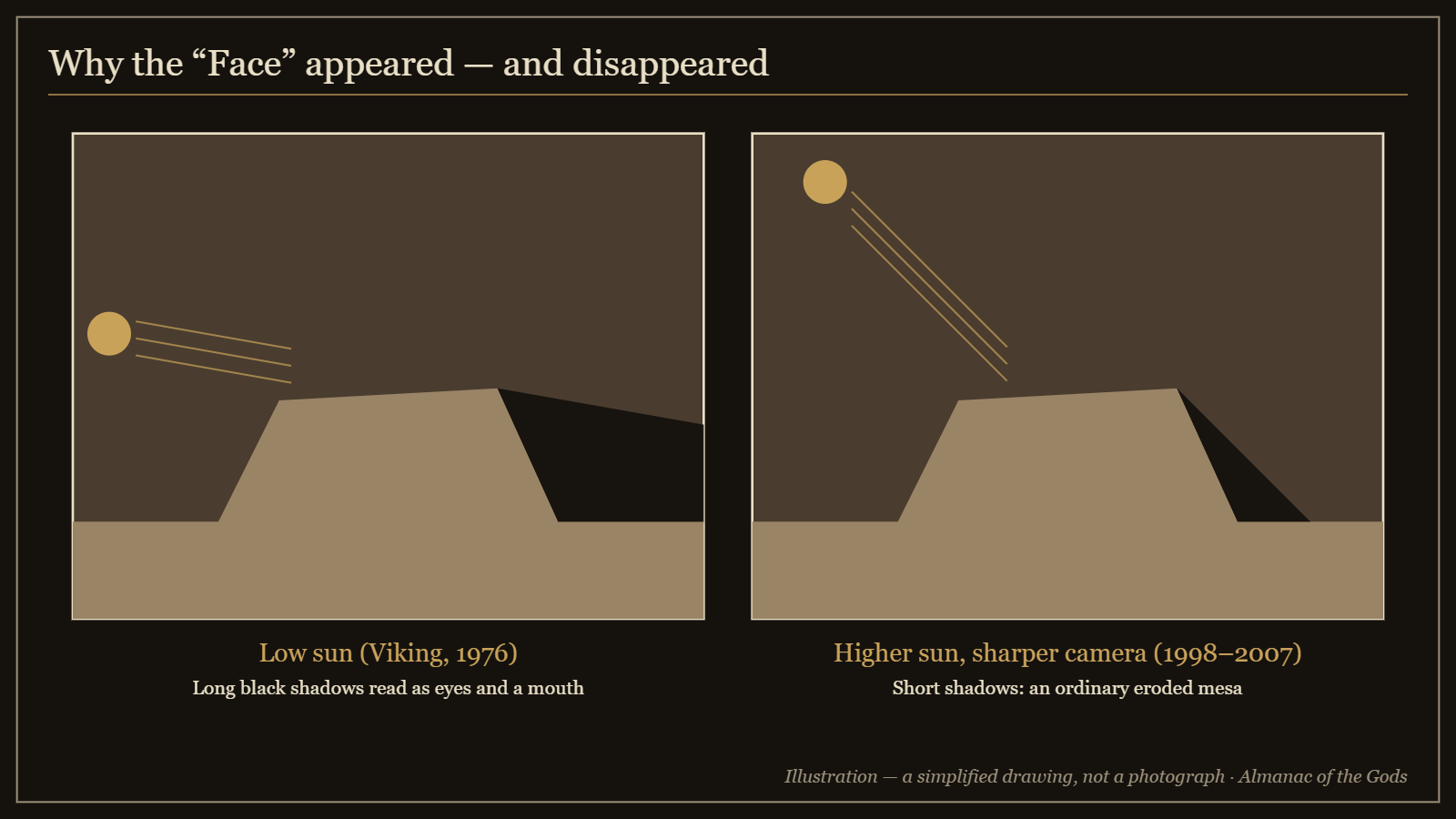
In frame 35A72 the sun was very low, about 10 degrees above the horizon. Low sun makes long shadows, and long shadows hide detail while exaggerating any dip or ridge. A notch became a mouth. Two hollows became eyes. When the 2001 Global Surveyor shot caught the hill in different light at 25 times Viking's sharpness, the "face" broke apart into ordinary ridges and slopes.
Supporters reply that a true face should look like a face from more than one angle, and that the Viking pair did. Critics answer that both Viking frames were blurry, and that once you know a face is "there," your brain keeps finding it.
Timeline
- c. 1958Iosif Shklovsky suggests Phobos may be hollow, fueling "artificial moon" talk.
- 1969Better orbit data show the odd Phobos motion was not real.
- Jul 25, 1976Viking 1 Orbiter takes frame 35A72 of Cydonia.
- Aug 30, 1976Viking 1 takes frame 70A13 of the same mesa under higher sun.
- 1982DiPietro and Molenaar publish Unusual Martian Surface Features.
- 1987Hoagland publishes The Monuments of Mars, describing the "City" and the D&M Pyramid.
- 1989Soviet probe Phobos 2 falls silent near Phobos.
- 1993Van Flandern's book argues the Face is artificial.
- 1995Carl Sagan covers the Face in The Demon-Haunted World.
- Apr 5, 1998Mars Global Surveyor images the Face at 4.3 m per pixel.
- Apr 8, 2001Mars Global Surveyor's sharpest view, about 2 m per pixel.
- Jul 22, 2006Mars Express captures Cydonia in 3D; images released that September.
- Apr 5, 2007HiRISE photographs the mesa at about 30 cm per pixel.
Still unanswered
- Did Mars once have a long-lived northern ocean, and did its shoreline shape the Cydonia mesas? Scientists are still debating it.
- How fast did the Cydonia hills erode, and how old are they?
- Is Phobos a captured asteroid or debris from a giant impact on Mars? Its origin is still an open question.
- Why do some people keep seeing a face even in the sharpest images? That is a question for psychology as much as geology.
Did you know?
- Viking was looking for a landing site for Viking 2 when it took the famous shot.
- Hoagland won a 1997 Ig Nobel Prize for "identifying artificial features" on the Moon and Mars.
- Mars Express tried for over two years to photograph Cydonia before dust and orbit timing finally cooperated in 2006.
- Phobos is only about 26 by 23 by 18 km, smaller than many cities.
- The "Phobos monolith" is about 85 meters across and 90 meters tall.
On Ancient Aliens
- S07E05Aliens and the Red PlanetMars-themed episode, aired February 21, 2014.
- S11E02Destination MarsMars-themed episode, aired May 13, 2016.
- S13E15Return to MarsMars-themed episode, aired January 7, 2019.
Episode numbers follow Wikipedia's episode list.
See it yourself
You can compare every photo for free. NASA's Photojournal has the original Viking frame (PIA01141) and the 2001 Mars Global Surveyor view (PIA03225). The University of Arizona's HiRISE site has the full 2007 image (PSP_003234_2210) and lets you zoom in to boulders. ESA's website has the 2006 Mars Express 3D views of Cydonia.
Try this: open the 1976 Viking frame next to the 2007 HiRISE image. Then blur your eyes or shrink the HiRISE picture until it is as fuzzy as Viking's. Watch the face come back. Mars itself is easy to spot in the night sky as a bright orange-red point, though no backyard telescope can show Cydonia.
Sources
- Cydonia (Mars)en.wikipedia.org
- PIA01141: Geologic "Face on Mars" Formationscience.nasa.gov
- "Face on Mars" Viking Orbiter 1 image data (35A72, 70A13)cdaweb.gsfc.nasa.gov
- PIA01441: Mars Orbiter Camera image of the "Face on Mars" (1998)pds-rings.seti.org
- PIA03225: Highest-Resolution View of "Face on Mars"jpl.nasa.gov
- PSP_003234_2210: Popular Landform in Cydonia Regionuahirise.org
- APOD: 3D Face on Mars (April 21, 2007)science.nasa.gov
- Face on Mars in Cydonia region, perspectiveesa.int
- Mars Express Exposes the Face of Marsmarsdaily.com
- Richard C. Hoaglanden.wikipedia.org
- The D&M Pyramidsites.math.washington.edu
- Tom Van Flandernen.wikipedia.org
- Mars, Face onencyclopedia.com
- Phobos (moon)en.wikipedia.org
- Phobos monolithen.wikipedia.org
- List of Ancient Aliens episodesen.wikipedia.org
Research notes: what we checked
- Size of the Face varies by source: NASA's PIA01141 caption says about 1.5 km across; Wikipedia says a 2 km long mesa; NASA's APOD says about 2 km wide and about 240 m high. We used "about 2 km long, roughly 240 m high."
- The year DiPietro and Molenaar found frame 70A13 is given differently in different sources (1977 vs. 1979), so we said "late 1970s." Their 1982 book is confirmed.
- The sun elevation of about 10 degrees for frame 35A72 comes from the NASA/GSFC data sheet, which lists a solar zenith angle of 79.93 degrees.
- We could not find a primary NASA page for the often-repeated quote from MGS scientist Jim Garvin or the comparison to Idaho's Middle Butte, so both were left out.
- Van Flandern's Face claims about the 2001 images (eye, pupil, nostrils) could not be checked against a reliable source and were left out; only his 1993 book and general position are stated.
- Buzz Aldrin's 2009 remarks are summarized only as mentioning the Phobos monolith; we did not quote him because we did not verify the exact wording.
- Wikipedia's list gives titles and air dates but no plot summaries for these three, so the notes give air dates only. Other episodes may mention Mars in passing but are not listed because we could not verify that.