What it is
The "Spaceship Moon" idea says our Moon is not a natural object. In its strongest form, the Moon is a hollowed-out world steered into orbit by an unknown intelligence. In a softer form, it simply arrived late, after people were already here to see the sky without it.
The idea pulls together three threads. First, old Greek and Roman writers who called the Arcadians "people from before the Moon." Second, the seismic "ringing" recorded by Apollo instruments. Third, a list of numbers about the Moon that theorists say are too neat to be chance.
The ancient-alien case
A people older than the Moon. Greek writers called the Arcadians of the central Peloponnese proselenoi, "before-the-Moon people." The earliest known use is credited to Hippys of Rhegium in the 5th century BC, preserved only in a later quotation. Aristotle and the astronomer Eudoxus of Cnidus also used the term, again in fragments quoted by others.
The poets kept it alive. Apollonius of Rhodes, in Argonautica book 4, describes early Arcadians "who lived even before the moon" (Seaton translation, 1912). Ovid's Fasti calls the Arcadians a folk older than the Moon. Statius (Thebaid 4), Lucian (On Astrology 26) and Plutarch (Roman Questions 76) repeat the boast. Theorists ask: why would anyone invent a time with no Moon?
Other "before the Moon" stories. Immanuel Velikovsky pointed to the Muisca (Chibcha) of Colombia, using Alexander von Humboldt's 1810s retelling, in which the hero Bochica turns a troublesome woman into the Moon. Zulu healer Credo Mutwa, in interviews with David Icke in the late 1990s, said two brothers named Wowane and Mpanku brought the Moon to Earth. Earlier still, Hanns Hörbiger's "World Ice Theory" and his follower H.S. Bellamy claimed the Moon was captured, and Bellamy read a moonless calendar into the Gateway of the Sun at Tiwanaku.
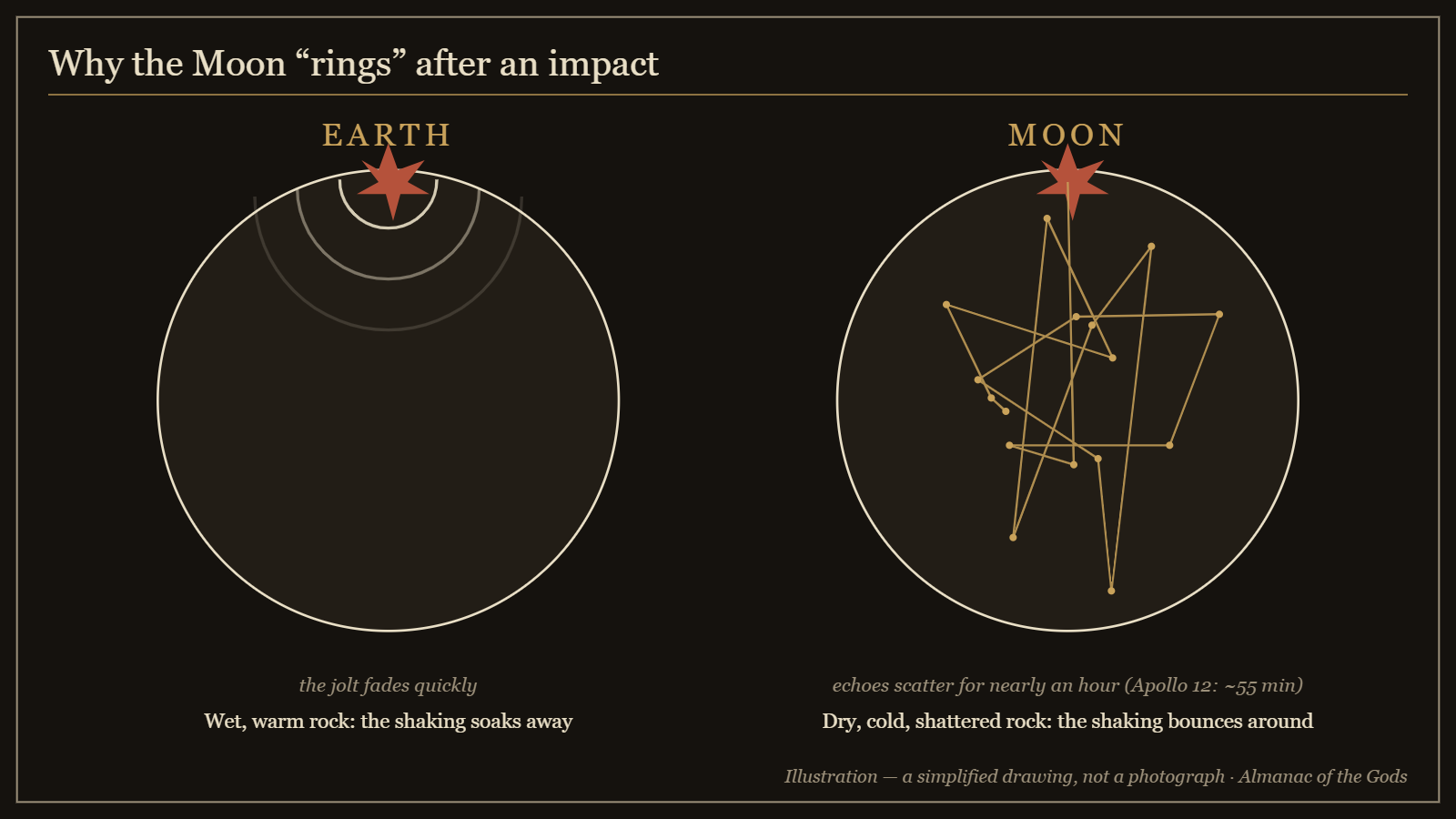
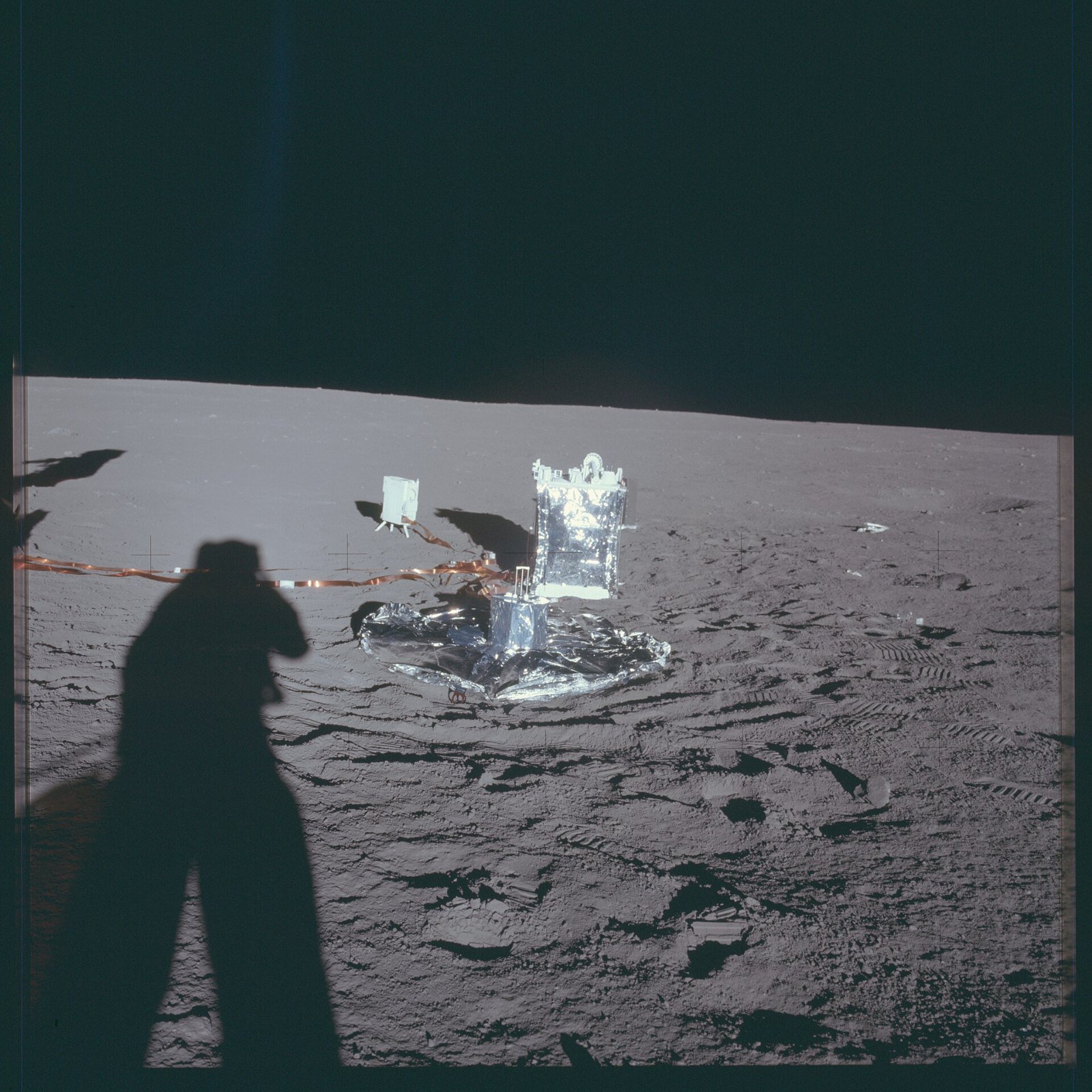
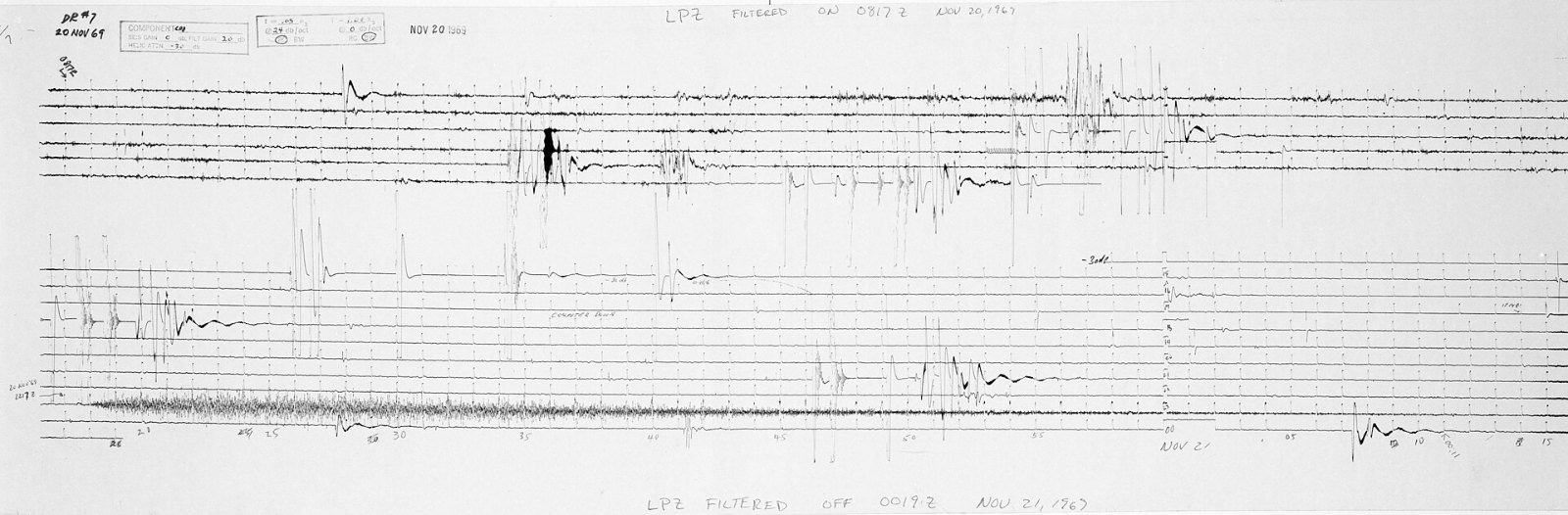
The bell. On November 20, 1969, Apollo 12 crews dropped their spent lunar module ascent stage onto the Moon. The seismometer they had set up the day before recorded a signal that built for about seven minutes and faded over roughly 55. A college paper carrying the news five days later said scientists reported the Moon "vibrated like a bell." Later, NASA aimed the spent Saturn S-IVB stages of Apollo 13 and later flights at the Moon, and those far bigger hits shook it for hours.
The Soviet article. In 1970, Michael Vasin and Alexander Shcherbakov published "Is the Moon the Creation of Alien Intelligence?" in the Soviet magazine Sputnik. They proposed the Moon was a hollow planetoid fitted out as a ship, with a tough armored shell. American writer Don Wilson ran with it in Our Mysterious Spaceship Moon (1975) and Secrets of Our Spaceship Moon (1979).
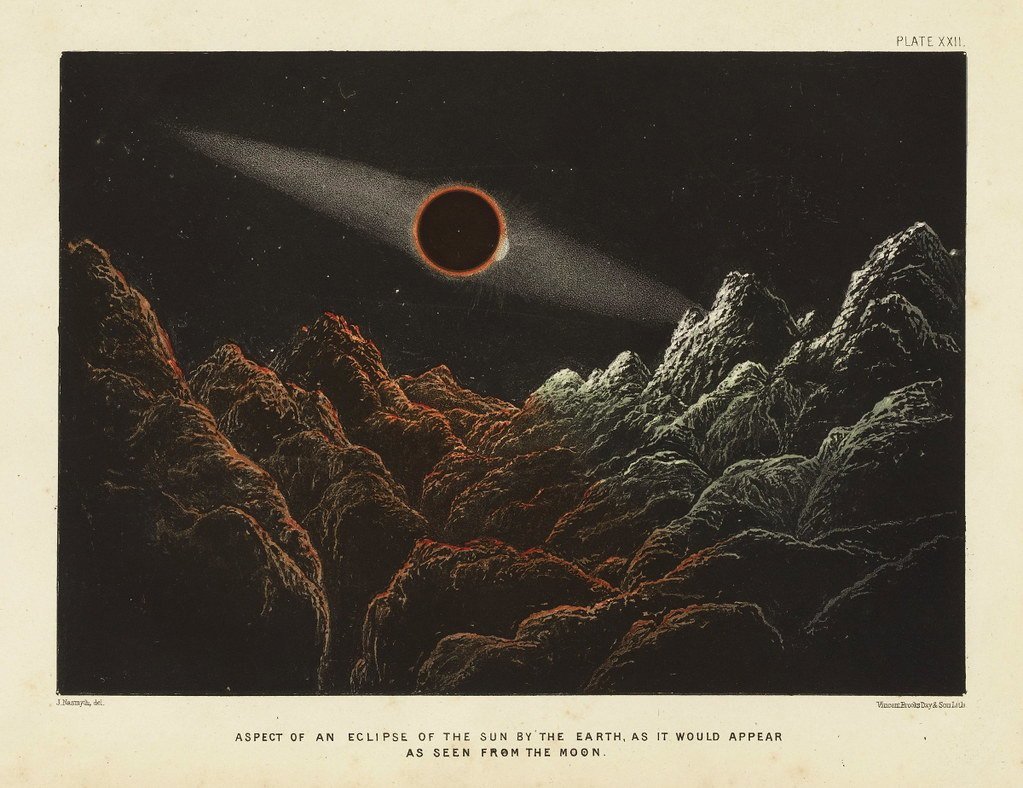
Too perfect? Theorists list the coincidences. The Moon looks almost exactly as wide as the Sun, which makes total eclipses possible. It always shows us the same face. It is lighter than Earth for its size. Its maria hide dense "mascons" that tug on spacecraft. Some Apollo basalts are rich in titanium, and some lunar rocks are older than any rock found on Earth's surface.
What scientists say
The ringing is real, and it is explained. The Apollo 12 science team (led by Gary Latham) said the long signal came from two things. Lunar rock is bone-dry and cold, so it barely soaks up vibration. And the top layers are shattered rubble, so waves bounce around for a long time instead of passing straight through. Their report called the mix "unlike anything observed within the Earth." Nothing in that report says hollow.
The Moon is not hollow. How mass is spread inside a body shows up in its moment of inertia. A perfectly even solid ball scores 0.4; a hollow shell scores about 0.67. The Moon scores about 0.393, close to an evenly packed solid with a small dense core. A 2011 NASA re-analysis of Apollo seismic data found a solid inner core, a fluid outer core and a partly melted layer above them.
Gravity maps agree. NASA's twin GRAIL probes (2011-2012) mapped lunar gravity in high detail. They found a crust about 34 to 43 km thick, low in density and deeply cracked by impacts. That fracturing is exactly what makes the Moon "ring." GRAIL also showed mascons are dense lava and uplifted mantle rock beneath giant impact basins.
Where it came from. The leading idea is the giant-impact hypothesis, first published in the mid-1970s by William Hartmann and Donald Davis, and by Alastair Cameron and William Ward. A Mars-sized body, often called Theia, struck the young Earth, and the Moon formed from the debris. That explains why the Moon is low in iron and low in density. Lunar rocks reach back about 4.4 to 4.5 billion years. Earth's are rarely as old only because plate tectonics and erosion keep recycling its surface.
The coincidences. The Sun is about 400 times wider than the Moon and about 400 times farther away, so they look the same size. But the Moon is slowly drifting away, so the match is temporary on geologic time. Tidal locking is normal: most big moons in the solar system keep one face to their planet. And the Greek "before the Moon" title is read by classicists as a brag of extreme age, much like saying "older than the hills."
How solid are the "before the Moon" sources?
Strong: The Greek and Latin uses of proselenoi are real. Apollonius, Ovid, Lucian, Statius and Plutarch survive in full texts you can read today. Hippys, Aristotle and Eudoxus survive only as fragments quoted by later writers, mainly the scholia on Apollonius and the lexicon of Stephanus of Byzantium.
Medium: The Muisca story is real, but it is a tale about how the Moon came to be. It is not a record that people saw a moonless sky. It reached us through Spanish chroniclers and Humboldt.
Weak: The Wowane and Mpanku story comes only from Credo Mutwa. Scholars such as David Chidester have questioned how much of Mutwa's published lore is traditional Zulu belief. Bellamy's Tiwanaku calendar was built to fit Hörbiger's ice theory, which astronomers dropped long ago.
Timeline
- 5th c. BCHippys of Rhegium calls the Arcadians "before-the-Moon" people, the earliest known use.
- 3rd c. BCApollonius of Rhodes puts pre-Moon Arcadians into the Argonautica.
- 1874James Nasmyth and James Carpenter publish The Moon, with photos of plaster lunar models.
- 1936H.S. Bellamy's Moons, Myths and Man argues the Moon was captured.
- 1968Paul Muller and William Sjogren report lunar mascons from Lunar Orbiter tracking.
- 1969Nov. 20: Apollo 12's ascent stage hits the Moon; the signal lasts about 55 minutes.
- 1970Apr. 14: Apollo 13's S-IVB stage hits the Moon. Vasin and Shcherbakov's Sputnik article appears.
- 1975Don Wilson publishes Our Mysterious Spaceship Moon. Hartmann and Davis publish the giant-impact idea.
- 1977Apollo seismometers are switched off on Sept. 30.
- 2011Re-analysis of Apollo seismic data reveals the Moon's layered core.
- 2012GRAIL gravity maps show a thin, heavily fractured crust.
- 2016Ancient Aliens airs "Space Station Moon."
Still unanswered
- Why are the Moon's oxygen and other isotopes so close to Earth's? Simple Theia models predict more difference, and scientists still debate the fix.
- Why did the Greeks attach "before the Moon" to the Arcadians in particular? Ancient commentators offered several guesses, and none settled it.
- Why is the Moon's far side crust thicker than the near side?
Did you know?
- Laser beams fired at mirrors left by Apollo 11, 14 and 15 are how we know the Moon drifts about 3.8 cm farther away each year.
- Because of that drift, total solar eclipses will eventually stop happening, many millions of years from now.
- Apollo seismometers recorded thousands of moonquakes between 1969 and 1977, including shallow quakes strong enough to rattle a house on Earth.
On Ancient Aliens
- S11E11Space Station MoonAired July 29, 2016. The one episode whose title names the Moon.
Episode numbers follow Wikipedia's episode list.
See it yourself
NASA's image library (images.nasa.gov) holds the Apollo 12 seismometer photos and the original impact readout; search "S69-59547." The raw Apollo seismic records are public through NASA's Planetary Data System, and the Washington University Lunar Orbital Data Explorer hosts the original Apollo 12 science report.
To see the eclipse coincidence, watch a total solar eclipse or simply compare the full Moon and the Sun (with eclipse glasses only) on the same day. Any small telescope will show the dark maria where the mascons hide. To read the ancient sources, Seaton's 1912 Argonautica is online free at Theoi.com.
Sources
- Latham et al., "Passive Seismic Experiment," Apollo 12 Preliminary Science Reportan.rsl.wustl.edu
- The Battalion, Nov. 25, 1969, p. 3newspaper.library.tamu.edu
- Apollo 12 Passive Seismic Experimenten.wikipedia.org
- Does the Moon Sound Like a Bell? (Amy Shira Teitel, 2016)popsci.com
- Moon Fact Sheetnssdc.gsfc.nasa.gov
- Hollow Moonen.wikipedia.org
- The Engineered Moon Conspiracy (Skeptoid #776)skeptoid.com
- GRAIL mission peers beneath the Moon's fractured surfacephysicsworld.com
- Proselenosen.wikipedia.org
- "A Lunar People: The Meaning of an Arcadian Epithet," Philologusdegruyterbrill.com
- Apollonius Rhodius, Argonautica Book 4 (Seaton translation)theoi.com
- Velikovsky, "The Earth Without the Moon"varchive.org
- Hans Schindler Bellamyen.wikipedia.org
- Credo Mutwaen.wikipedia.org
- List of Ancient Aliens episodesen.wikipedia.org
Research notes: what we checked
- A widely shared line saying the Moon rang like a bell for nearly an hour because of a strange underground structure is credited online to Wernher von Braun. We found no primary source for it and left it out. The earliest wording we confirmed is a Nov. 25, 1969 newspaper saying scientists reported the Moon "vibrated like a bell."
- Censorinus (De die natali 19) is often listed among "before the Moon" sources. Chapter 19 discusses the old Arcadian calendar; we could not confirm that it uses the pre-Moon phrase itself, so we did not cite him for it.
- Velikovsky says Democritus and Anaxagoras taught that Earth once had no Moon, citing Hippolytus. We could not confirm this in the text and left it out.
- The Wowane and Mpanku story traces only to Credo Mutwa's late-1990s interviews with David Icke; we found no independent Zulu ethnographic record of it.
- Some websites say Apollo-era moon soil was dated older than the solar system (figures like 5.3 billion years). We found no reliable support; accepted ages for lunar rocks top out around 4.4 to 4.5 billion years.
- Exact durations for the Apollo 13 and later S-IVB "ringing" vary by source (from about three to four hours), so we say "for hours."
- Wikipedia's episode list gives no summary for "Space Station Moon," and we found no other episode with "Moon" in its title, so only one episode is listed.