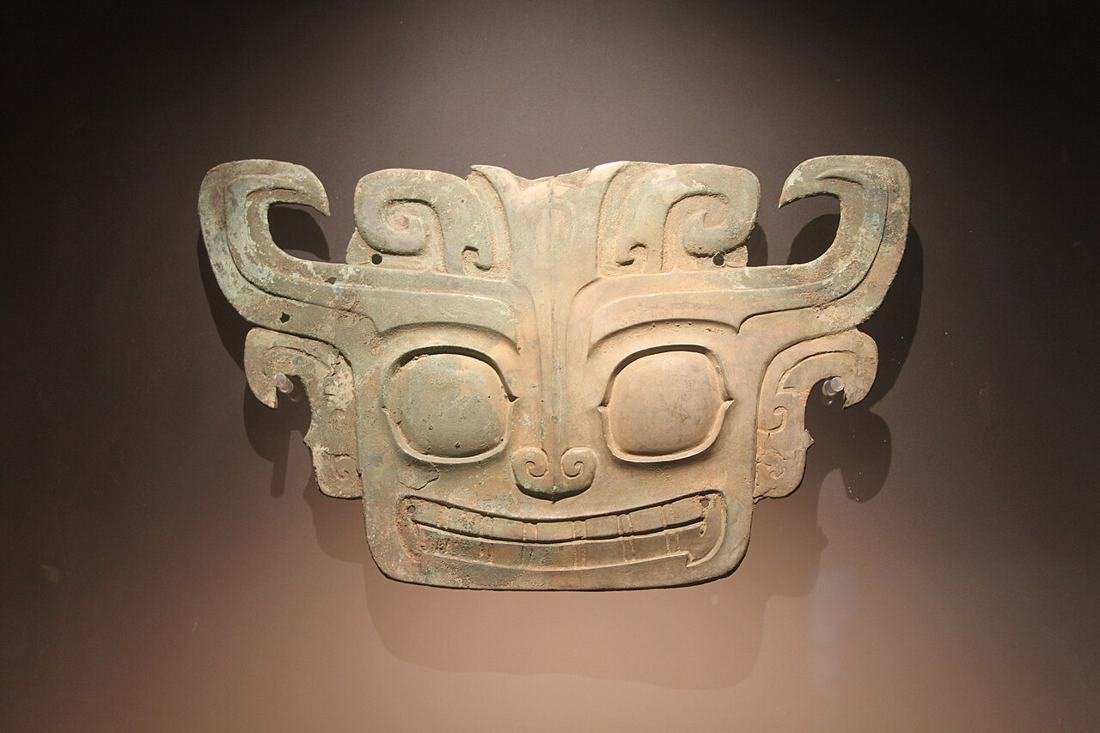
What it is
Sanxingdui is a Bronze Age site in Guanghan, Sichuan Province, about 38 km north of Chengdu. It was the center of a walled city on the Chengdu Plain, occupied for roughly 800 years, from about 1800 BCE to about 1000 BCE. Archaeologists link it to the early kingdom of Shu, a culture that lay far from the Yellow River heartland of the Shang dynasty and developed its own striking art.
Farmers turned up jade objects here in the late 1920s, but the site's fame dates from 1986. That year, workers digging for brick clay hit two pits packed with bronzes, gold, jade and elephant tusks. Many objects had been deliberately broken or burned before burial. Between 2020 and 2022, excavators opened six more pits under climate-controlled shelters, bringing the total to eight and adding thousands of new finds.
The objects look like nothing else from ancient China. There are bronze heads with angular faces, masks with huge ears and eyes that jut forward like tubes, a life-size standing man on a tall pedestal, and bronze trees with birds on their branches. Gold was beaten into masks and wrapped around bronze heads and a long staff. Many of these pieces now fill the Sanxingdui Museum, which opened a large new building in 2023.
Sanxingdui matters because it showed that Bronze Age China had more than one center. A powerful, rich society grew up on the Chengdu Plain alongside the Shang, trading with it but not copying it. Its bronze casters worked on a scale few others matched at the time. After Sanxingdui faded, the nearby Jinsha site in Chengdu carried on many of the same styles and symbols, which suggests the people moved rather than vanished.
The ancient-alien case
For ancient-astronaut writers, the faces are the heart of the matter. In 'The Vanishings' (2015), Giorgio Tsoukalos and David Childress argue that the bronze masks, with their slanted, bulging eyes and oversized ears, look like portraits of visitors who were not human. They ask why a people would make images so unlike themselves unless they were copying something they had seen.
The episode also leans on the idea of a culture that appears from nowhere and then disappears. The show describes a highly skilled civilization, unknown to written history, that ritually destroyed its own treasures and then left. Theorists read that as a sign of contact with, or departure to, somewhere beyond Earth.
The new finds of 2021 revived the debate far beyond the show. When the large gold mask was unveiled, social media users in China and abroad compared the faces to movie aliens and wondered aloud whether an outside civilization had been at work. Believers also point to the bronze trees topped with birds as images of travel between earth and sky.
What archaeologists say
Archaeologists say Sanxingdui was built by a local people, the ancestors of the Shu. The site has a long, layered history of houses, pottery and walls going back centuries before the pits. Radiocarbon dating published in 2022 and a 2025 study of matching fragments show the pits were filled in one event late in the Shang period, which fits a single large ritual rather than a sudden arrival or exit.
The masks follow a clear artistic style. Chinese legend says the first Shu king, Can Cong, had eyes that stuck out, and many scholars think the protruding-eyed masks honor him or other gods and ancestors. Jason Colavito notes that the slanted-eyed alien image only became common in the 1960s, and that the masks are stylized human faces. Wang Wei, then head of archaeology at the Chinese Academy of Social Sciences, called the alien idea unsupported by any evidence.
The 'vanishing' has an earthly answer too. The Jinsha site, found in 2001, shares Sanxingdui's gold work, symbols and lacquer technique, showing that the elite moved to a new center near today's Chengdu. Researchers have proposed an earthquake, a shift in river course, or a political or religious change as the trigger. The bronzes themselves were cast with advanced local methods that researchers have now worked out.
Timeline
- c. 1800 BCESanxingdui grows into an important settlement on the Chengdu Plain.
- c. 1600 BCEThe city's large earthen walls and moats take shape.
- c. 1201–1012 BCEPrecious objects are broken, burned and buried in a series of pits at the same time.
- c. 1000 BCEThe city is abandoned; the Jinsha site in today's Chengdu becomes the new center.
- Late 1920sA farmer digging an irrigation ditch finds a cache of jade objects.
- 1986Pits 1 and 2 are discovered, revealing the bronze heads, masks, trees and standing figure.
- 1997The Sanxingdui Museum opens at the site.
- 2001The Jinsha site is found in Chengdu, showing the culture carried on.
- 2020–2022Six new pits are dug under high-tech shelters, yielding a large gold mask and new bronze figures.
- 2023–2025A new museum building opens (2023); a September 2025 forum confirms all the pits were filled together in the late Shang period.
Still unanswered
- Why were so many precious objects broken, burned and buried in a single event?
- Who do the masks with protruding eyes represent: a founding king, gods, or ancestors?
- Did the Shu have writing? No clear inscriptions have been found at Sanxingdui.
- What made the city's leaders abandon it and move to Jinsha around 1000 BCE?
- Where did the metal for the bronzes come from, and how was the long-distance trade organized?
Did you know?
- The 2021 gold mask found in Pit 3 is the largest and heaviest gold mask known from the Shang and Zhou periods.
- Sanxingdui's bronzes include some of China's earliest lacquer-painted metalwork, a technique later seen at Jinsha.
- Ancient Aliens placed Sanxingdui in the Yellow River basin, but the site is on the Chengdu Plain in Sichuan, in the Yangtze River system.
On Ancient Aliens
- S09E11 The Vanishings Tsoukalos and Childress say the slanted-eyed bronze masks resemble aliens and cast Sanxingdui as a civilization that destroyed itself and vanished.
Episode numbers follow Wikipedia's episode list; History and some reviewers number a few seasons differently.
Visiting
Getting there. In Guanghan, Sichuan Province, about 38 km north of Chengdu. Most visitors make a day trip by road or train from Chengdu.
What you can see. The Sanxingdui Museum shows the main finds in its original halls and in the new building opened in 2023, including many objects from the 2020–2022 digs. Parts of the ancient city and the pit area are archaeological zones, and active excavation areas are not open to the public.
Tip. Pair the trip with the Jinsha Site Museum in Chengdu, where the story continues after Sanxingdui was abandoned.
Sources
- Sanxingdui (Wikipedia) en.wikipedia.org
- New discoveries at the Sanxingdui Bronze Age site in south-west China (Antiquity, Cambridge Core) cambridge.org
- New studies confirm Sanxingdui sacrificial pits date to late Shang Dynasty (Global Times, 2025) globaltimes.cn
- Why Was This Ancient Chinese City Abruptly Abandoned? (HISTORY) history.com
- Gazing at Sanxingdui: New Archaeological Discoveries in Sichuan (Hong Kong Palace Museum) hkpm.org.hk
- Sanxingdui Museum (Wikipedia) en.wikipedia.org
- Historical discovery revives wild theories of an alien civilisation in ancient China (South China Morning Post) scmp.com
- Review of Ancient Aliens 'The Vanishings' (Jason Colavito) jasoncolavito.com
- List of Ancient Aliens episodes (Wikipedia) en.wikipedia.org
Research notes: what we could not confirm
- Episode numbering differs by source: Wikipedia lists 'The Vanishings' as S9E12 (aired April 24, 2015); Colavito's review calls it S07E16; the old entry had S9E11, which Wikipedia gives as 'The Trans-Dimensionals.'
- The old entry's second episode, 'Hidden Pyramids' (S9E10), does not cover Sanxingdui and was dropped; 'The Hidden Empire' (S11E09) covers China but, per Colavito, not Sanxingdui. No second episode was confirmed.
- The claim that theorists read the bronze trees as images of ascent to the heavens was carried over from the old entry and not confirmed in an episode source.
- The date of the first jade find is given as 1927 by Wikipedia and 1929 by other popular sources; 'late 1920s' is used here.
- The claim that the Shu had no writing reflects the current record of no clear inscriptions; it was not confirmed from a page opened this session.
- A YouTube clip claiming Sanxingdui content from an early season could not be opened (the site refused the request).