What it is
Aramu Muru is a door-shaped carving cut into a wall of reddish sandstone in the Hayu Marka hills of southern Peru, near the town of Juli in the Puno Region, not far from the shore of Lake Titicaca. The site sits above 3,800 m on the high Altiplano, among weathered rock outcrops. Locals and tour operators call it the Puerta de Hayu Marka, or the Gate of the Gods.
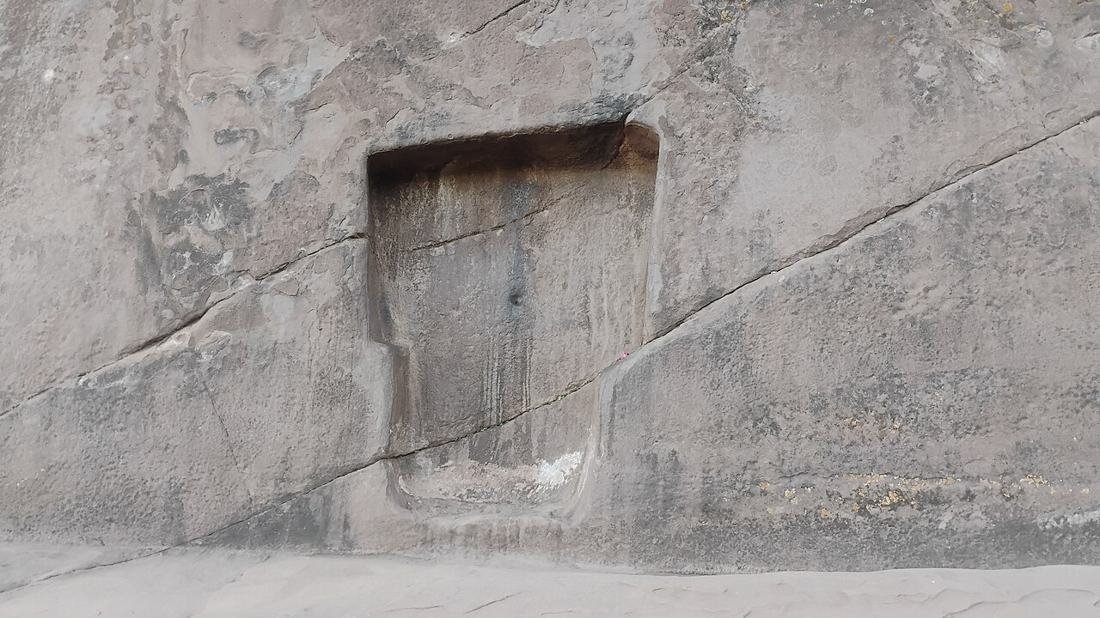
The main feature is a smooth, squared face about 7 m tall and 7 m wide. In its center is a smaller T-shaped recess, roughly 2 m high, about the size of a standing person. At the back of that recess is a small round hollow. The recess is a blind niche: it goes a short way into the rock and stops. Nothing lies behind it.
No formal excavation or detailed archaeological study of the site has been published. The Lake Titicaca basin has been home to farming and herding peoples for about 4,000 years, including the Tiwanaku, the Lupaqa and later the Inca. Specialists who comment on the site generally see it as a ceremonial niche or an unfinished Inca-era carving, similar in spirit to other shrines cut into living rock in the Andes.
Aramu Muru matters to this story less as an archaeological site than as a modern legend. It became widely known only in the 1990s, when a local guide promoted it and linked it to a tale of a priest escaping through a magical doorway. That tale, it turns out, traces to a 20th-century American UFO writer, which makes the site a case study in how new myths attach themselves to old stones.
The ancient-alien case
Ancient Aliens included the Puerta de Hayu Marka in its 2010 episode 'Mysterious Places' as one of the world's hot spots of strange activity. The show presented the doorway as a possible interdimensional portal and placed it alongside the Bermuda Triangle and Mexico's Zone of Silence as places where UFOs and odd phenomena seem to cluster.
The legend at the heart of the claim tells of Aramu Muru, a priest who fled the Spanish conquerors carrying a golden disc. When he reached the gate, he fitted the disc into the small round hollow, the doorway filled with blue light, and he passed through, never to return. Believers say the hollow is where the key once sat, and some visitors report visions, humming or a sense of energy when they touch it.
Guide José Luis Delgado Mamani, who brought the site to public attention in 1996, has said he dreamed of the doorway and of glowing passages before he found it. Local stories collected by tour guides describe tall figures with glowing lights stepping through the rock. Writers such as Jerry Willis have promoted it as a stargate.
For theorists, the gate fits a worldwide pattern of ancient portal legends, tied in the Andes to the belief that gods emerged from lakes, caves and mountains. They see the blind doorway as a symbol, or a working device, left by beings who could travel between worlds.
What archaeologists say
Historians say the portal legend is modern. The character of Aramu Muru first appears in George Hunt Williamson's book Secret of the Andes, published in the early 1960s under the pen name Brother Philip. Williamson was a figure in the 1950s UFO contactee movement, and his story drew on Theosophy and the lost continent of Lemuria, not on Aymara or Inca tradition. The link to this particular rock was made in the 1990s.
There is no published excavation of Aramu Muru, so its date and purpose remain uncertain. Archaeologists who have commented see it as a natural rock face that was smoothed and carved into a shrine niche, or as an unfinished project, most likely from the Inca era. Carved rock shrines, called huacas, are common across the Andes, where mountains and outcrops were treated as sacred.
The Spanish-era escape tale has no record in colonial sources. No golden disc has ever been documented, and the round hollow is small and shallow. The reported sensations are personal experiences with no measured physical cause.
Timeline
- Geological pastErosion shapes the red sandstone outcrops of the Hayu Marka hills near Lake Titicaca.
- c. 2000 BCE onwardFarming and herding peoples settle the Titicaca basin; later the Tiwanaku culture dominates the region (c. 500-1000 CE).
- 1400s-1500s CEThe Lupaqa kingdom around Juli is absorbed by the Inca Empire; many archaeologists place the carved niche in this Inca-era setting, though it has not been dated.
- Early 1960sAmerican UFO contactee George Hunt Williamson, writing as Brother Philip, publishes Secret of the Andes, which introduces a Lemurian master called Aramu Muru who guards a golden sun disc near Lake Titicaca.
- 1996Local guide José Luis Delgado Mamani publicizes the site and ties it to the Aramu Muru story and local legends of a doorway to the gods.
- 2010Ancient Aliens features the Puerta de Hayu Marka as an interdimensional doorway in 'Mysterious Places' (S02E01).
- 2020sThe site becomes a regular stop for spiritual tourism from Puno, with visitors pressing their foreheads to the central hollow.
- Sept 2026Chilean outlet Meganoticias publishes a report tracing the portal legend to Williamson's book rather than to ancient Aymara tradition.
Still unanswered
- When the niche was carved and by whom, since it has never been scientifically dated.
- Whether it was a finished shrine or an abandoned project.
- How much genuine local folklore about the rock existed before the 1990s, and how much was blended in from Williamson's book.
- Whether other worked stones or offerings lie buried at the foot of the wall.
Did you know?
- The central niche is a dead end: it goes only a short way into solid rock.
- The Aramu Muru legend comes from a book by an American UFO contactee, not from pre-Hispanic records.
- The same stretch of Lake Titicaca shore is near Juli, a town known for its colonial-era stone churches.
On Ancient Aliens
- S02E01 Mysterious Places Presents Peru's Puerta de Hayu Marka as a doorway believed to be interdimensional, among other UFO hot spots.
Episode numbers follow Wikipedia's episode list; History and some reviewers number a few seasons differently.
Visiting
Getting there. In the Hayu Marka hills near Juli, Puno Region, Peru, about 35 km from Puno; visitors go by taxi, tour or local bus toward Juli, then walk a short way to the rock.
What you can see. The rock is in open countryside and can be visited on foot; local tours from Puno often combine it with a stop in Juli. There are few facilities. Treat the carved face with care and avoid climbing on it.
Tip. Go with a local guide from Puno, dress for strong sun and cold wind at nearly 4,000 m, and acclimatize in Puno first.
Sources
- No One Knows What Peru's Mysterious Gate of the Gods Was For - IFLScience (2023) iflscience.com
- Aramu Muru - Atlas Obscura atlasobscura.com
- The Mysterious Stargate of Aramu Muru, Puno - InkaNatura inkanatura.com
- La verdad histórica sobre la leyenda del portal dimensional del Titicaca - Meganoticias (Sept 2026) meganoticias.cl
- Ancient Aliens S02E01 Mysterious Places - TVmaze api.tvmaze.com
- Ancient Aliens S07E01 Aliens and Stargates - TVmaze api.tvmaze.com
Research notes: what we could not confirm
- Wikipedia's Hayu Marka article could not be fetched, so the entry relies on news and travel sources; no peer-reviewed archaeology on the site was found.
- The old entry listed S07E01 'Aliens and Stargates'; its TVmaze synopsis mentions Inca beliefs about gods coming through mountain portals but does not name Hayu Marka, so it is left out.
- Which named theorists spoke about Hayu Marka in S02E01 could not be confirmed.
- The publication year of Secret of the Andes is given as 1960 by Meganoticias; other references give 1961.
- The guide's name varies in sources (José Luis Delgado Mamani; some call him Jorge Luis Delgado), and the discovery year is given as 1996 or the early 1990s.
- The claim that the niche is Inca-era is an opinion of commentators, not a dated finding; IFLScience says archaeologists think it predates the Inca.
- The 'huaca' interpretation is a general Andean parallel, not a published study of this rock.
- The 2020s spiritual-tourism entry is a general observation from travel sources and has no fixed date.
- Juli's colonial stone churches are a well-known local feature but were not checked in a source opened for this entry.