What it is
Lalibela is a small town at about 2,500 meters in the mountains of Ethiopia's Amhara Region. It was once called Roha and later took the name of King Gebre Meskel Lalibela of the Zagwe dynasty, who ruled around 1181 to 1221. The town holds eleven medieval churches cut directly from the living volcanic rock, and it remains one of the holiest places in Ethiopian Orthodox Christianity.
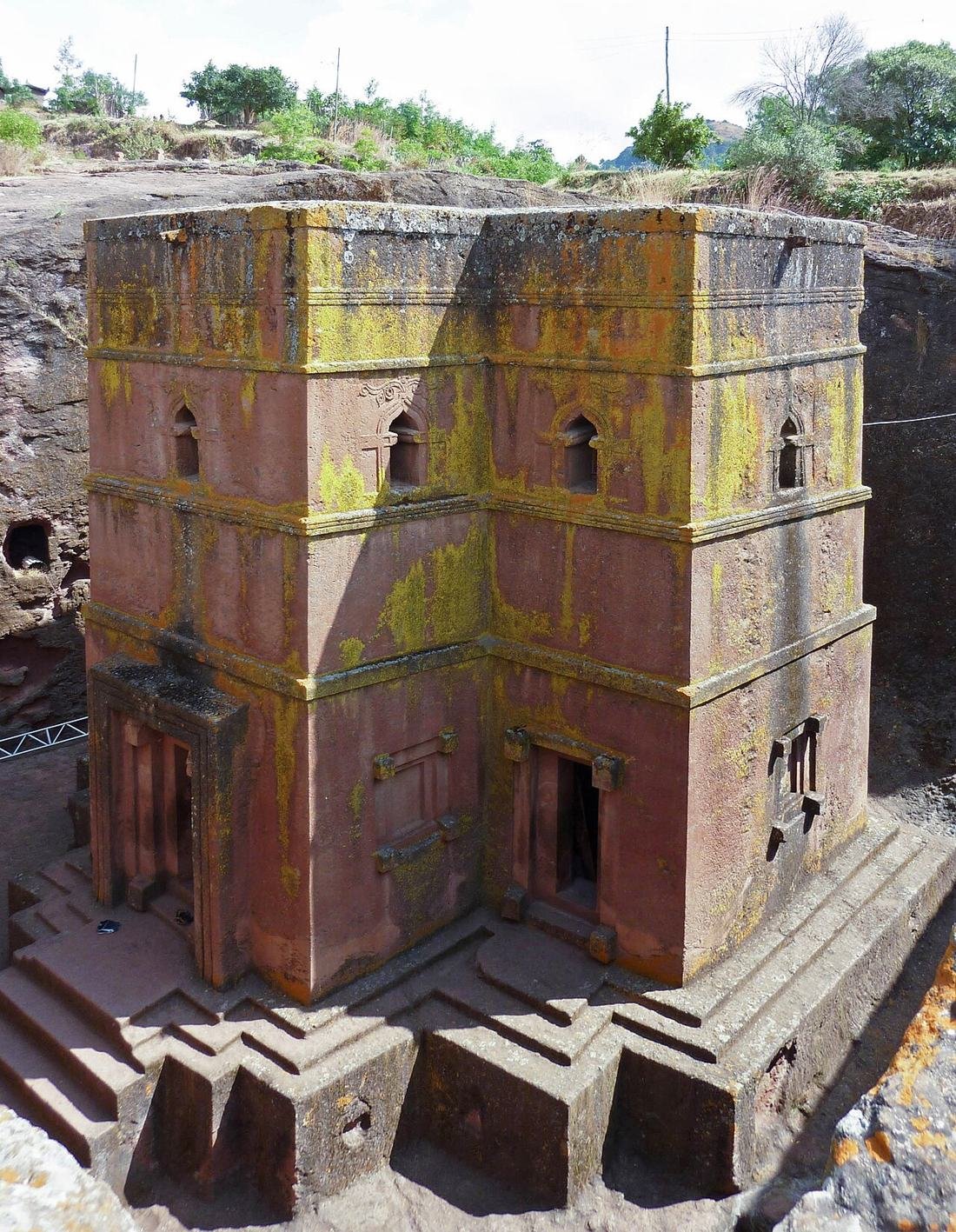
Instead of stacking stones, the builders dug deep trenches around huge blocks of rock and then hollowed the blocks out, leaving doors, windows, columns, arches and roofs all of one piece. Some churches stand fully free inside their pits, while others are still attached to the cliff on one side. Tunnels, trenches and stairways link them, and a channel called the Jordan divides the site into groups.
The churches fall into a northern group of five, including Bete Medhane Alem, often called the largest monolithic church in the world; an eastern group of five, including Bete Amanuel and Bete Abba Libanos; and the lone Bete Giyorgis, the Church of Saint George. Bete Giyorgis is shaped like a cross when seen from above and sits in its own deep pit, and it is the image most people know.
Tradition holds that Lalibela wanted a 'New Jerusalem' at a time when Muslim conquests made pilgrimage to the Holy Land hard. Many place names echo Jerusalem, and thousands of pilgrims still gather for Christmas (Genna) and Epiphany (Timkat). The churches are active places of worship, not museums. Ancient Aliens features them for the speed and precision of the carving and for the legend of angelic help.
The ancient-alien case
Theorists start with the method. Carving a whole church downward from a single block leaves no room for error: cut too deep and the mistake is permanent. In Aliens and Sacred Places, David Childress argues that the smooth walls and sharp edges look like the work of power tools, such as saws and grinding wheels, rather than hand chisels.
The speed of the work is the second point. Tradition says the eleven churches were finished within the reign of one king, some within a couple of decades. Theorists ask how a medieval workforce could remove so much rock so quickly and with such precision, and suggest the builders had help.
That help, theorists say, is written into the legend. Ethiopian tradition holds that angels carved by night what human workers carved by day, and that Lalibela was carried to heaven, where he was shown what to build. Giorgio Tsoukalos argues that angels in ancient accounts were really misunderstood flesh-and-blood visitors from elsewhere. Bill Birnes retells the story of Lalibela's heavenly journey and nighttime helpers as a possible memory of such contact.
Some ancient-astronaut writers group Lalibela with other great rock-cut sites, such as the Kailasa temple at Ellora in India, as examples of 'subtractive' building that they see as beyond ordinary tools of the time.
What archaeologists say
Archaeologists and historians say the churches were carved by skilled Ethiopian masons using iron picks, chisels and hammers. The volcanic tuff is fairly soft when freshly cut and hardens with exposure, which makes deep carving practical. Tool marks can still be seen on many surfaces, and carving from a single block has a long tradition in the region, going back to the rock churches of Tigray and Aksumite stonework.
Scholars also question the idea that everything was done at once. David Phillipson's studies suggest the site grew in phases, with some spaces first cut centuries earlier and later converted into churches, which spreads the labor across a much longer period. The design and naming fit a clear religious plan to recreate Jerusalem in Ethiopia.
The angel legend is a well-known feature of Ethiopian Orthodox tradition, part of the saintly life story written about King Lalibela, and historians read it as a sign of how holy the site was to the faithful, not as an engineering record. Today the main concerns are practical: UNESCO reports cite water damage, cracking, fading wall paintings, and the effects of conflict and unplanned building nearby.
Timeline
- c. 600–800 CESome archaeologists, notably David Phillipson, argue that a few of the carved spaces began as secular or defensive structures in the late Aksumite period.
- c. 1181–1221 CEKing Gebre Meskel Lalibela of the Zagwe dynasty reigns; tradition credits him with the churches as a New Jerusalem.
- Late 12th–early 13th centuryMost of the eleven churches, including Bete Giyorgis, are carved in their present form.
- 1520sPortuguese priest Francisco Álvares visits and writes one of the first European descriptions of the churches.
- 1978UNESCO inscribes the Rock-Hewn Churches, Lalibela, on the first World Heritage List.
- 2008Large protective roofs are placed over several churches to shield them from rain, a step later debated by conservators.
- Aug–Dec 2021Tigrayan forces occupy the town during Ethiopia's civil war; government forces retake it in December.
- 2023–2026Fighting between the Ethiopian army and Fano militias affects Amhara; the US advises against all travel to the region as of August 2026, and UNESCO continues to track conservation problems.
Still unanswered
- How many of the churches began as older, non-religious structures before Lalibela's reign?
- How large was the workforce, and how many years did the full complex really take?
- Are the 2008 protective shelters helping or harming the churches, and what should replace them?
- How much damage has the conflict in Amhara since 2021 done to the site and its community?
Did you know?
- Bete Giyorgis, the Church of Saint George, forms a perfect cross when seen from above.
- A stream channel at the site is named the Jordan, part of the plan to echo the Holy Land.
- Lalibela was on the very first World Heritage List in 1978.
On Ancient Aliens
- S03E03 Aliens and Sacred Places David Childress argues the churches needed power tools, and Tsoukalos and Birnes recast the angel-builders legend as extraterrestrial help.
Episode numbers follow Wikipedia's episode list; History and some reviewers number a few seasons differently.
Visiting
Getting there. Lalibela town in Ethiopia's Amhara Region, far north of Addis Ababa; most visitors arrive by domestic flight to Lalibela Airport.
What you can see. Visitors normally walk between the churches through trenches and tunnels, usually with a local guide, and remove shoes inside. The churches are active places of worship. As of August 2026 the US government advises against all travel to the Amhara Region because of armed conflict, and access can change quickly.
Tip. Check current security advice before planning any trip, and if you do go, expect the biggest crowds and most moving ceremonies at Genna and Timkat.
Sources
- Rock-Hewn Churches, Lalibela (UNESCO World Heritage Centre) whc.unesco.org
- Lalibela (Wikipedia) en.wikipedia.org
- Church of Saint George, Lalibela (Wikipedia) en.wikipedia.org
- Ethiopia Travel Advisory (US State Department) travel.state.gov
- Digging Up Ancient Aliens, episode 25: Sacred Places diggingupancientaliens.com
- List of Ancient Aliens episodes (Wikipedia) en.wikipedia.org
Research notes: what we could not confirm
- Correction: the old entry credited the power-tools claim to Tsoukalos and Birnes; the podcast breakdown of S03E03 attributes it to David Childress, with Tsoukalos and Birnes handling the angels legend.
- Only S03E03 could be confirmed; the old entry's S09E01 'Forbidden Caves' was not verified and was dropped.
- The claim that Lalibela is grouped with Ellora and Ajanta on the show was not confirmed in an episode source; it is presented only as a general theorist argument.
- The 1520s Álvares visit, the 2008 shelters, and the hardening of tuff after cutting are from general knowledge and were not checked in a source opened for this entry.
- Exact dimensions of Bete Medhane Alem and Bete Giyorgis could not be confirmed; the 25 m figure is for the pit around Bete Giyorgis, per Wikipedia.