What it is
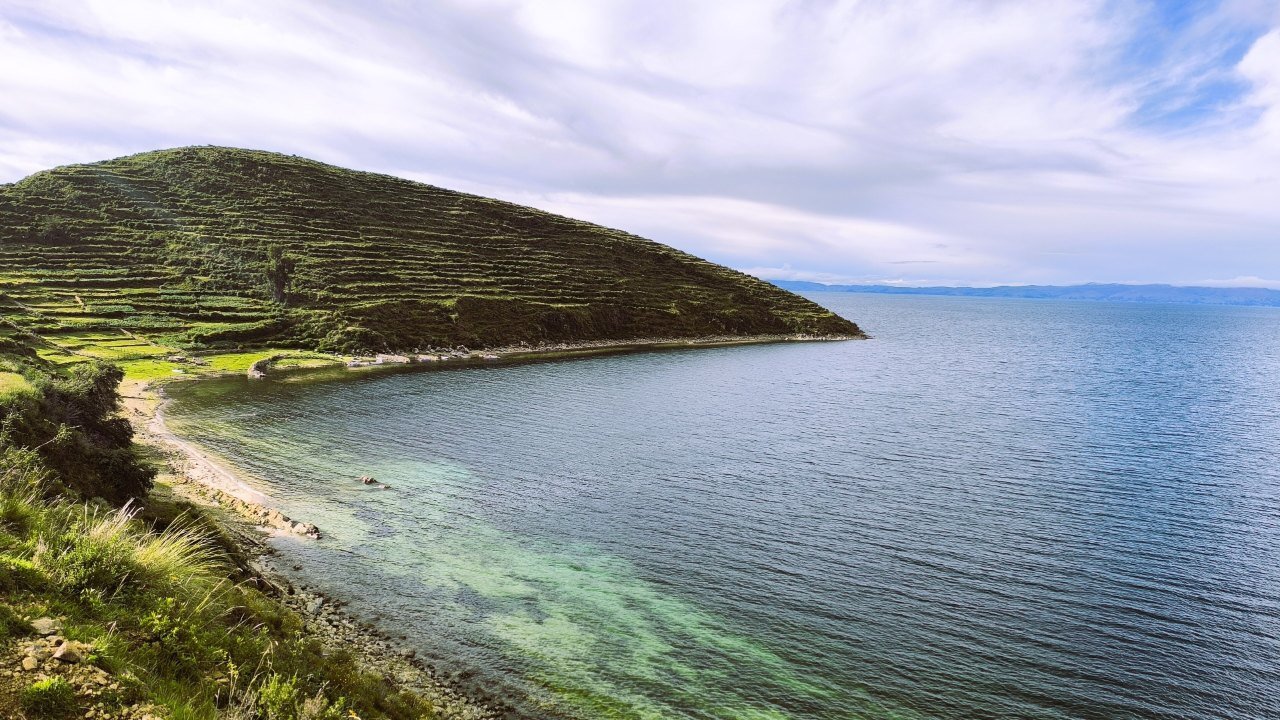
Lake Titicaca straddles the border between Peru and Bolivia on the Altiplano, the high Andean plateau. Its surface sits about 3,812 meters above sea level, and it covers roughly 8,370 square kilometers. It is often billed as the highest navigable lake in the world, although some smaller lakes lie higher. The main towns on its shores are Puno in Peru and Copacabana in Bolivia.
The lake holds more than 40 islands. The Uros people live on dozens of floating islands built from totora reeds near Puno. On the Bolivian side, the Island of the Sun was one of the holiest places in the Inca world, a pilgrimage center tied to the Inca story of their own origins. About 16 kilometers south of the lake stand the ruins of Tiwanaku, capital of a powerful state that dominated the southern Andes between about 500 and 900 CE.
In Andean myth the lake is a place of origins. Spanish chroniclers recorded that the creator god Viracocha rose from its waters to make the sun, moon and stars and to shape the first people. In an Inca founding story, Manco Cápac and Mama Ocllo emerged from the lake before setting out to found Cusco. These stories made the lake a sacred center of the Andean world, and they remain central to how the lake is seen today.
Underwater archaeology has confirmed that the lake was sacred long before the Inca. Divers working around the Island of the Sun have recovered offerings that Tiwanaku priests dropped from boats, as well as later Inca stone boxes. Today the lake also faces a modern threat: falling water levels driven by drought, heat and water extraction. Scientists warn that the lake could keep shrinking in coming years.
The ancient-alien case
Ancient Aliens points to what lies beneath the surface. In 'Underwater Worlds', the show links the ruins of recently found temples under Lake Titicaca to a wider pattern of sunken sites around the globe, and asks whether stories of lost underwater cities such as Atlantis preserve memories of an advanced, perhaps alien-guided civilization.
Theorists read the Viracocha myth as a contact story. A powerful being who rises from the water, lights up the sky with the sun, moon and stars and shapes the first people looks to them like an account of a visitor arriving by some kind of craft. At Tiwanaku, Giorgio Tsoukalos has argued that the carved figure on the Gateway of the Sun, often identified with Viracocha, shows beings coming down from the sky. Local guide Jorge Delgado told the show that the Inca gods were space visitors he calls the Space Brothers.
The region's age is a third strand. Early 20th-century engineer Arthur Posnansky used star alignments to argue that Tiwanaku was built many thousands of years ago, when, he believed, the lake stood higher and reached the city. Graham Hancock revived that idea in Fingerprints of the Gods, and Ancient Aliens has repeated a very early date for the ruins. David Childress has promoted the Fuente Magna, a stone bowl said to be found near the lake and to carry writing like Sumerian cuneiform, as proof of contact with the Old World.
Modern sightings round out the case. Alternative websites report locals seeing lights rise from or plunge into the lake, and some writers suggest an underwater base. These stories circulate widely online, though they are anecdotal.
What archaeologists say
Archaeologists say the underwater finds are real but human. The 2019 excavation at Khoa reef used sonar mapping and photogrammetry and found Tiwanaku-era puma-shaped incense burners, sacrificed juvenile llamas and fine ornaments, along with stone anchors that show they were dropped from boats. These were offerings placed on a sacred reef, not the remains of a drowned city. Earlier dives by Johan Reinhard found similar Inca and Tiwanaku objects.
Tiwanaku itself belongs to the first millennium CE, with its peak between about 500 and 900 CE. Jason Colavito and others note that Posnansky's star-based dating assumed alignments he never proved, and that the show misstates even his figure. The Fuente Magna bowl has a murky history of ownership and no secure find context, so scholars do not accept it as evidence of Sumerian writing in the Andes.
Viracocha stories were written down by Spanish chroniclers after the conquest, and they fit a wider Andean pattern in which lakes, springs and caves are places where people and gods emerge. Historians read them as religious traditions, not eyewitness reports of spacecraft.
Timeline
- c. 500–1100 CETiwanaku religious specialists sink offerings of puma-shaped incense burners, young llamas, gold and shell ornaments at Khoa reef near the Island of the Sun.
- c. 500–900 CETiwanaku, just south of the lake, reaches its peak as capital of a southern Andean state.
- 15th–16th centuryThe Inca turn the Island of the Sun into a major pilgrimage center and leave stone offering boxes in the lake.
- 1989–1992Johan Reinhard leads an underwater research project that recovers Inca and Tiwanaku artifacts.
- 2000The Atahuallpa 2000 expedition announces a submerged structure it calls a pre-Inca temple, about 1,000 years old, after more than 200 dives.
- 2000UNESCO lists Tiwanaku as a World Heritage Site.
- 2019Christophe Delaere, José Capriles and colleagues publish the Khoa reef excavation in PNAS, showing organized Tiwanaku ritual centuries before the Inca.
- 2020The same researchers describe an intact Inca stone offering box with gold, silver and shell figurines from Khoa reef.
- 2023After a record winter heat wave and weak rains, the lake heads toward its lowest level since 1996.
- 2026Water levels fall again as drought and a developing El Niño threaten the lake that 1.3 million people in Puno rely on.
Still unanswered
- What exactly the Atahuallpa 2000 expedition found, and whether its 'temple' is a built structure, has never been fully published.
- How lake levels rose and fell over the last few thousand years, and which shoreline sites they drowned, is still being reconstructed.
- How closely Tiwanaku's lake rituals shaped the later Inca cult on the Island of the Sun remains a research question.
- Whether Lake Titicaca can hold its level as the climate warms is an urgent open question for the people who depend on it.
Did you know?
- Lake Titicaca is often called a freshwater lake, but its water is slightly brackish.
- The lake is home to the giant Titicaca water frog and a flightless grebe found nowhere else.
- Stone anchors found next to the Tiwanaku offerings show the objects were lowered from boats in ceremonies.
On Ancient Aliens
- S02E03 Underwater Worlds Cites ruins of recently found temples beneath Lake Titicaca as part of a worldwide pattern of sunken sites.
- S04E06 The Mystery of Puma Punku Covers the Tiwanaku ruins near the lake, Posnansky's ancient dating and the Fuente Magna bowl.
- S20E20 Resurrecting Puma Punku Tsoukalos reads the Viracocha figure on Tiwanaku's Gateway of the Sun as aliens coming down from the sky.
Episode numbers follow Wikipedia's episode list; History and some reviewers number a few seasons differently.
Visiting
Getting there. Puno on the Peruvian shore, reached by road or by flying to nearby Juliaca, or Copacabana on the Bolivian side, a few hours by road from La Paz.
What you can see. Boats from Puno visit the Uros floating islands and Taquile Island. From Copacabana, boats run to the Island of the Sun and Island of the Moon, with Inca ruins and walking trails. The underwater sites are not open to visitors. Tiwanaku, south of the lake near the Bolivian shore, is an easy day trip from La Paz. Low water in dry years can change boat routes.
Tip. At 3,800 meters altitude sickness is common, so spend a day or two acclimatizing before hiking the islands.
Sources
- Wikipedia: Lake Titicaca en.wikipedia.org
- Delaere et al. 2019, Underwater ritual offerings in the Island of the Sun and the formation of the Tiwanaku state (PNAS) pnas.org
- Phys.org: Rise of religion pre-dates Incas at Lake Titicaca phys.org
- Delaere and Capriles 2020, The context and meaning of an intact Inca underwater offering from Lake Titicaca (Antiquity) cambridge.org
- UNESCO World Heritage Centre: Tiwanaku whc.unesco.org
- ABC News: Temple found under Lake Titicaca (2000) abcnews.com
- Wikipedia: Inca mythology en.wikipedia.org
- Peru Support Group: Lake Titicaca is shrinking, and will shrink more as El Niño hits (August 2026) perusupportgroup.org.uk
- Jason Colavito: Review of Ancient Aliens S04E06 'The Mysteries of Puma Punku' jasoncolavito.com
- Jason Colavito: Review of Ancient Aliens S20E20 'Resurrecting Puma Punku' jasoncolavito.com
Research notes: what we could not confirm
- Correction to the old entry: 'Aliens and Temples of Gold' (S03E04) concerns Lake Puray near Cusco, not Lake Titicaca, so it has been dropped.
- The 'Underwater Worlds' claim about temples under the lake is confirmed from the episode synopsis (Rotten Tomatoes, podcast summaries); I could not confirm the old entry's line about local legends of an underwater UFO base being said in that episode.
- The S04E06 and S20E20 episodes focus on Puma Punku and Tiwanaku near the lake rather than the lake itself. Episode numbers follow Jason Colavito's reviews; Wikipedia's numbering for S20E20 was not checked.
- Graham Hancock's discussion of Posnansky and Tiwanaku in Fingerprints of the Gods is well known, but I did not open a source confirming his exact position for this dossier.
- UFO sighting reports over the lake come from alternative websites and are anecdotal.
- The 2000 Atahuallpa 2000 announcement (temple about 200 by 50 meters, wall about 800 meters) was reported in the press but I found no peer-reviewed publication of it.
- Travel details such as the Juliaca airport and road times from La Paz are general knowledge and were not checked against a current source.